What you'll learn
In 25 minutes you will make reliably light, lemon-scented ricotta pancakes and learn 2026 best practices: precise cooking temperatures for modern griddles, improved plant-based and gluten-free swaps, aquafaba ratios for vegan lift, and updated storage/reheat methods (air-fryer and oven) so your batch tastes as fresh as when you make it.
What you'll need
- Ingredients (see full list below)
- Tools: kitchen scale (recommended), nonstick skillet or electric/griddle with temperature control, silicone spatula, mixing bowls, whisk, handheld mixer or stand mixer
- Time: 25 minutes total (10 min prep, 15 min cook)
- Skill level: beginner-friendly; attention to folding technique and heat control required
Why this method still works — and what's new in 2026
The original ricotta-plus-whipped-white method traps air without overdeveloping gluten, producing a tender interior and crisp edge. Since 2024–2026, two practical changes make the result more consistent in home kitchens: 1) calibrated temperature guidance for induction and electric griddles (aiming for a 325–350°F / 160–175°C surface) that prevents overbrowning while allowing the center to set, and 2) better plant-based ricotta and aquafaba techniques that close the gap between dairy and vegan textures. These updates reflect product improvements and more precise home equipment common in 2026.
At-a-glance
- Prep time: 10 minutes
- Cook time: 15 minutes
- Total time: 25 minutes
- Makes: about 10–12 pancakes (4-inch) — serves 3–4
- Cooking method: stovetop skillet or electric griddle (induction-friendly)
Ingredients
Standard version:
- 1 cup (250 g) whole-milk ricotta (or high‑quality plant ricotta for dairy-free)
- 1 cup (125 g) all-purpose flour (or 1:1 gluten-free blend — see notes)
- 2 tbsp granulated sugar (adjust to taste)
- 1 tsp baking powder
- 1/4 tsp baking soda
- 1/4 tsp fine sea salt
- 2 large eggs, separated (or vegan swaps below)
- 3/4 cup (180 ml) milk (dairy or unsweetened plant milk — soy/oat recommended)
- 2 tbsp unsalted butter, melted (plus more for pan) — or neutral oil
- Zest of 1 lemon (≈1 tbsp) and 2 tbsp fresh lemon juice
- 1 tsp vanilla extract (optional)
Equipment
- Mixing bowls (large + small)
- Whisk, rubber/silicone spatula
- Hand mixer or stand mixer (for egg whites or aquafaba)
- Nonstick skillet, cast‑iron pan, or electric griddle with temperature control
- Kitchen scale (recommended for consistency)
Step-by-step tutorial
-
1. Measure and prep (2 minutes)
Gather ingredients and preheat the griddle to medium. If you have a temperature-controlled griddle, set it to 325–350°F (160–175°C). Separate eggs: yolks to the large bowl, whites to a clean small bowl. Zest lemon before juicing it.
Expected result: Ingredients ready and griddle approaching cooking temp by the time batter is folded.
-
2. Combine dry ingredients (1 minute)
Whisk flour, sugar, baking powder, baking soda and salt in the large bowl to evenly distribute leaveners.
Expected result: Homogeneous dry mix with no clumps of baking powder.
-
3. Make the batter base (3 minutes)
Add ricotta to the dry mix and stir briefly to coat curds. Add yolks, milk, melted butter, lemon zest, lemon juice and vanilla. Stir gently until just combined — small lumps are fine. Overmixing tightens the crumb.
Expected result: A slightly thick, lumpy batter that will relax once aerated.
-
4. Whip the egg whites (or aquafaba) (3 minutes)
For dairy version: beat egg whites to soft peaks using a hand mixer — soft peaks give volume without stiffness. For vegan version: use aquafaba (chickpea brine) — measure about 3 tbsp (45 ml) aquafaba per egg white replaced; for two whites, whip ~6 tbsp (90 ml). Add a pinch (≈1/8 tsp) cream of tartar to stabilize. Whip to soft peaks.
Expected result: Glossy soft peaks that hold some structure but still fold easily.
-
5. Fold whites into batter (1 minute)
Fold one-third of the whipped whites into the batter to lighten it, then fold in the remainder gently with wide strokes. Turn the bowl rather than overmixing; batter should be airy and slightly billowy.
Expected result: A light, airy batter with visible streaks of aeration.
-
6. Heat the pan and cook (10–12 minutes)
Lightly butter the surface. Spoon ~1/4 cup batter per pancake onto the griddle. Cook until bubbles form and edges set, 2–3 minutes; flip and cook 1–2 minutes more until golden and set. If using an induction skillet without surface temp readout, medium-low to medium typically corresponds to the recommended range; reduce heat if browning too fast.
Tip (2026): Modern electric griddles often maintain surface temps — 325°F produces even browning and thorough cooking for ricotta pancakes.
Expected result: Pancakes with golden edges, tender center and a hint of lemon aroma.
-
7. Serve immediately
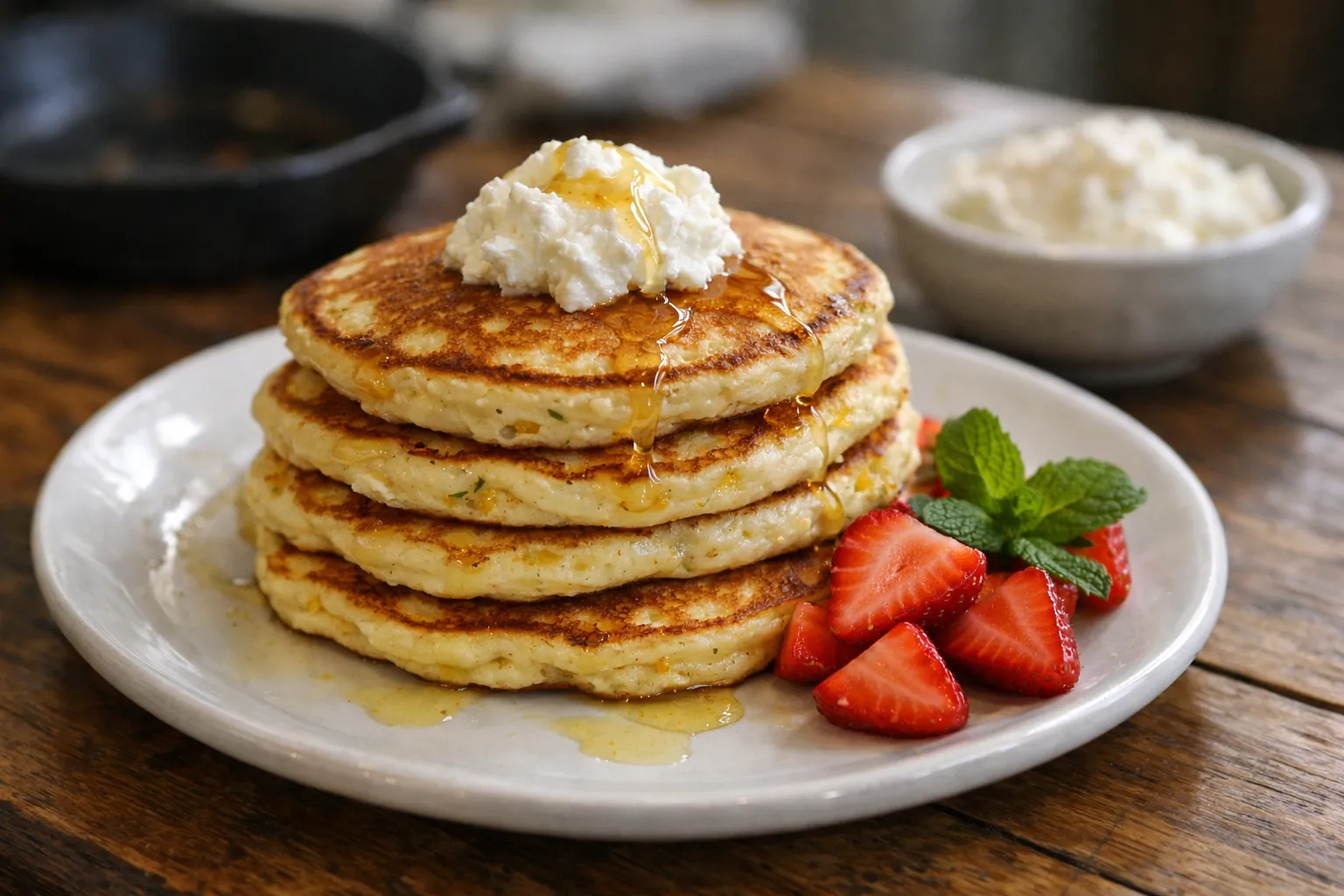
Stack on a warmed plate and serve with berries, a lemon‑honey drizzle or ricotta sweetened with a touch of honey and lemon zest. For savory, warm extra ricotta with lemon zest and black pepper to serve alongside smoked salmon.
Timing and modern equipment tips
- Start heating the pan while you whip the whites so the griddle is ready when the batter is folded.
- If keeping pancakes warm, use a 200°F (95°C) oven for up to 15 minutes; for crisp edges without drying, place on a wire rack over a baking sheet.
- Reheating (2026): from refrigerated, reheat in a 350°F (175°C) air fryer for 2–3 minutes or in a 350°F oven for 5–7 minutes. Air fryer gives edge crispness similar to fresh.
Dietary modifications — updated for 2026
- Gluten-free: Use a modern 1:1 gluten-free blend that contains xanthan gum. Many blends in 2026 include legume flours; if batter feels loose, add 1 tbsp tapioca starch for better lift and chew.
- Dairy-free: High‑quality plant ricotta (cashew or oat-based) is widely available and performs similarly to dairy ricotta. If using a thinner alternative, add 1 tbsp neutral oil to the batter.
- Vegan: Blend silken tofu with lemon juice and 1–2 tbsp oil for the ricotta substitute, or use commercial plant ricotta. Replace egg whites with whipped aquafaba (≈3 tbsp aquafaba per egg white); add 1/8 tsp cream of tartar per 3 tbsp aquafaba for stability and whip to soft peaks. Add 1 tsp extra baking powder if you want more lift.
- Lower sugar: Reduce sugar to 1 tbsp and rely on fruit or a light syrup; ricotta and lemon give natural sweetness perception so you can lower sugar without losing flavor.
Make-ahead and storage
Fridge: 2–3 days in an airtight container. Freeze: layer pancakes between parchment and seal in a freezer bag for up to 1 month. Reheat from frozen in a 350°F air fryer for 3–4 minutes or in a toaster oven. Avoid microwaving for best texture; if used, microwave briefly then finish in a hot skillet for a crisp edge.
Troubleshooting
- Batter too thick? Add 1–2 tbsp milk; ricotta moisture varies by brand.
- Pancakes dense or flat? Make sure whites (or aquafaba) reached soft peaks and were folded gently. Check baking powder freshness — replace every 6–12 months.
- Browning too fast? Lower heat to the 325–350°F range; ricotta pancakes need a gentle cook to set through.
- Vegan aquafaba won’t whip? Use cold aquafaba, a clean bowl, and add a pinch of cream of tartar; some canned chickpea liquids whip better than others — try draining and refrigerating for a few hours first.
Presentation ideas
For brunch in 2026: stack 3 pancakes, top with macerated berries (1 tbsp sugar + 1 tbsp lemon juice, 10–15 minutes), a spoonful of whipped ricotta or plant ricotta, and a scattering of microgreens for a savory twist. Serve with high-quality maple syrup or a lavender-honey drizzle for a contemporary finish.
FAQ
Can I use store-bought cottage cheese instead of ricotta?
Yes. Drain and pulse cottage cheese in a blender to a smoother texture before measuring 1 cup; cottage cheese has larger curds and more moisture, so you may need a tablespoon less milk.
Are these safe to serve to kids or pregnant guests when using raw egg whites?
Pancakes are cooked through, which reduces Salmonella risk. If you or guests are concerned, use pasteurized eggs or pasteurized aquafaba/egg white products. Always follow current local food-safety guidance for vulnerable diners.
How do I adapt the recipe for high-altitude baking?
At elevations above 3,000 ft, reduce baking powder by about 1/8–1/4 tsp and increase liquid by 1–2 tbsp to prevent over-expansion and collapsing. Watch cooking time — you may need slightly lower heat and a touch longer to set the centers.
What modern tools actually improve consistency?
A kitchen scale for flour, a temperature-controlled griddle (induction or electric) to maintain 325–350°F, and a handheld mixer for reliably whipped whites/aquafaba will give the most repeatable results.
These updated tips reflect small changes in ingredients and equipment availability through 2026 that make the classic lemon ricotta pancake even more dependable. Follow the folding technique, respect temperature, and use the modern swaps above to fit your diet — and enjoy consistently light, lemony pancakes every time.