
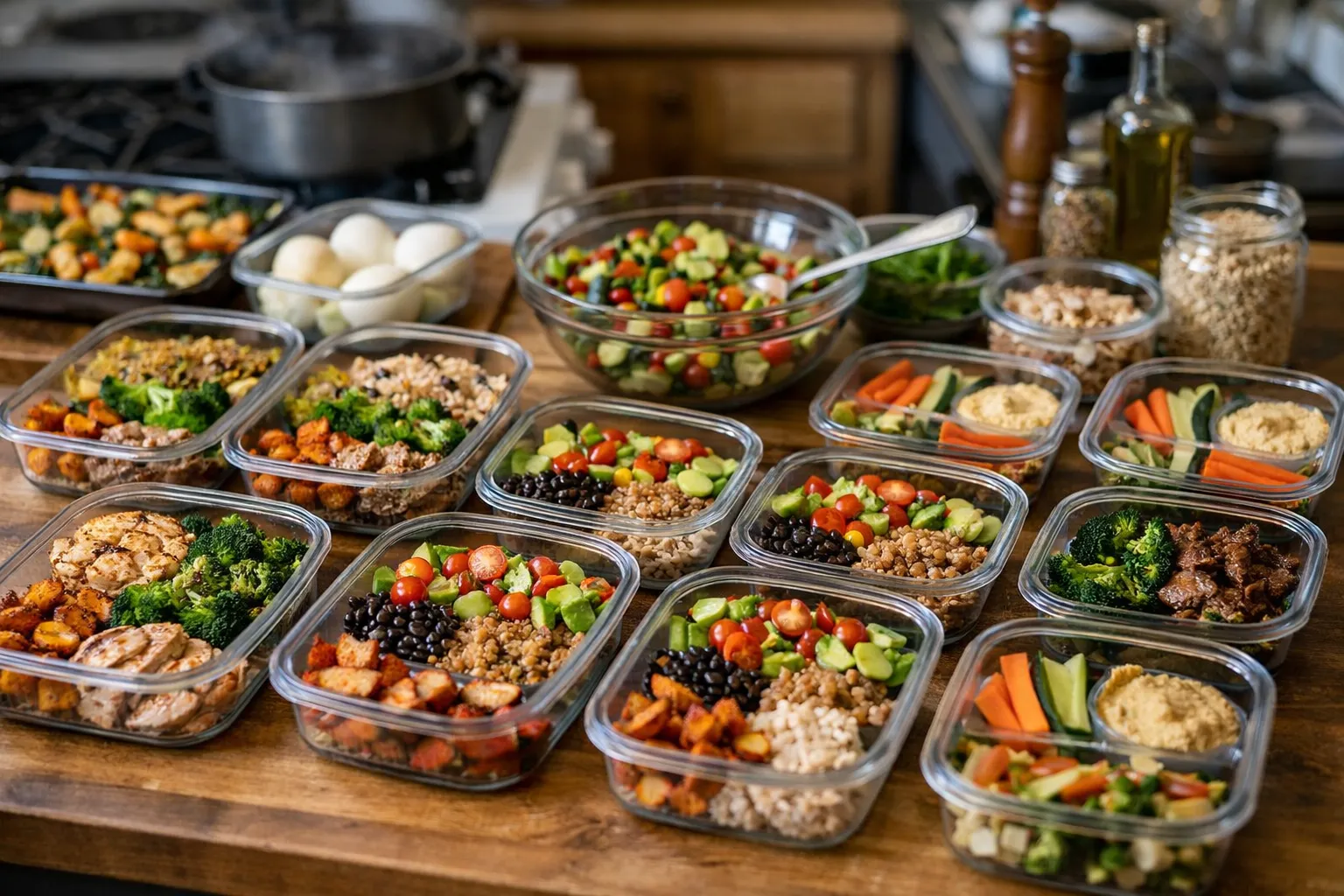
We love a good game plan. If you're juggling work, family and trying to eat well, Sunday meal prep should be your playbook — not a half-hearted benchwarmer strategy. This guide walks you through a reproducible 4-hour Sunday session that produces five flexible lunches built from two proteins (roasted chicken + baked tofu), three grain bases, and a set of roasted vegetables and sauces. You'll get concrete shopping lists, oven and stovetop timing to run everything efficiently, storage and safety rules, and assembly templates so lunches stay interesting all week.
Who this is for and why it matters
This guide is for home cooks and meal planners who want a reliable weekly system: office workers, parents, and anyone who needs ready-to-go lunches that aren't boring. The payoff is clear — fewer takeout meals, predictable nutrition, less daily decision fatigue, and better control of portions and cost. Think of this like a five-game series we prep and win on Sunday.
Prerequisites / Context
- Equipment: one full-size oven, one large sheet pan (or two), one skillet (10–12 inch), medium pot (2–3 qt) for grains, measuring cups, instant-read thermometer.
- Food-safety basics: reheat foods to 165°F (74°C) before eating; refrigerated cooked poultry and cooked grains are safe 3–4 days (FoodSafety.gov, research_studies); freeze leftovers you won't eat within 4 days.
- Timing assumption: you have roughly 4 continuous hours on Sunday and a standard home kitchen layout.
High-level plan (the 4-hour timeline)
- 0:00–0:15 — Finalize menu, preheat oven, start marinade for chicken and tofu, rinse grains.
- 0:15–0:40 — Roast chicken and start vegetables; bring water for quinoa/rice.
- 0:40–1:10 — Bake tofu, finish roasting vegetables, cook quinoa.
- 1:10–2:00 — Sauté a quick grain (e.g., farro) or warm rice; cool cooked foods slightly.
- 2:00–3:00 — Portion into containers, add sauces, let cool to fridge-safe temps.
- 3:00–4:00 — Clean up, label containers with dates, move 1–2 meals to freezer if needed.
Step 1 — The menu and shopping list
Playbook: Two proteins, three bases, roasted veg + two sauces. That gives mix-and-match flexibility so we don’t eat the same bowl five days straight.
Menu (5 lunches)
- Protein A — Roasted lemon-herb chicken breast (2–3 breasts)
- Protein B — Baked sesame-maple tofu (1 block extra-firm)
- Grain/Base 1 — Quinoa (1.5 cups dry)
- Grain/Base 2 — Brown rice (1.5 cups dry)
- Grain/Base 3 — Farro or bulgur (1 cup dry)
- Veg — Sheet-pan roasted broccoli, bell peppers, red onion, and carrots
- Sauces — Quick lemon-tahini and soy-ginger vinaigrette
- Extras — Fresh greens (spinach or arugula), roasted chickpeas (optional), sliced lemon, herbs
Shopping list (approx. quantities for 5 lunches)
- Chicken breasts: 1.5–2 lb (700–900 g)
- Extra-firm tofu: 1 block (14–16 oz)
- Quinoa: 1.5 cups dry
- Brown rice: 1.5 cups dry
- Farro or bulgur: 1 cup dry
- Mixed vegetables: 2–3 heads broccoli or 3 cups florets, 2 bell peppers, 1 large red onion, 3 carrots
- Tahini, lemon, soy sauce, sesame oil, maple syrup, olive oil, garlic, ginger, salt, pepper
- Container set: five 24–28 oz meal prep containers with lids
Step 2 — Prep and mise en place (0:00–0:15)
- Preheat oven to 425°F (220°C). Line two sheet pans with foil or parchment for easy cleanup.
- Marinade for chicken: whisk 2 tbsp olive oil, zest + juice of 1 lemon, 2 minced garlic cloves, 1 tsp dried oregano, salt and pepper. Pat chicken dry, coat, and let rest.
- Tofu: press for 10–15 minutes (wrap in towels and weigh with a plate). Toss with 1 tbsp soy sauce, 1 tsp sesame oil, 1 tbsp maple syrup, and 1 tsp cornstarch for crispness.
- Vegetables: cut broccoli into florets, peppers into strips, red onion into wedges, carrots into coins. Toss in 1–2 tbsp olive oil, salt, pepper, and a pinch of chili flakes.
- Rinse grains: 1.5 cups quinoa, 1.5 cups brown rice, 1 cup farro. Put measured water on to boil as needed.
Why this setup? Staging everything first reduces dead time. We’re optimizing oven load and stovetop use to keep total time near four hours.
Step 3 — The oven play: chicken, tofu, and vegetables (0:15–1:10)
- Place chicken on one sheet pan. Roast at 425°F for 18–22 minutes (depending on thickness) until internal temp is 165°F (74°C). Use instant-read thermometer. Let rest 5–10 minutes; slice.
- At the same time, put the tofu cubes on the second sheet pan and roast 25–30 minutes, flipping halfway, until edges are browned and slightly crisp.
- Vegetables: arrange in a single layer on a tray. Roast 20–25 minutes at 425°F, stirring once at the halfway mark. Broccoli may char slightly—that’s flavor.
Why two proteins? Two proteins broaden meal variety without doubling work. Chicken is fast, reliable protein; tofu gives a plant-forward option and holds up well to reheating.
Step 4 — Grains and quick stovetop work (0:40–2:00)
- Quinoa: 1 part quinoa to 2 parts water. Bring to boil, simmer 15 minutes, remove from heat and let sit 5 minutes. Fluff with fork.
- Brown rice: follow package instructions—typically 1:2 ratio; simmer 35–40 minutes. Start rice early so it finishes while other items bake.
- Farro: quick-cook farro takes 20–25 minutes; if using pearled farro, 15–20 minutes. Drain and toss with 1 tbsp olive oil and lemon zest.
Timing tip: stagger starts—begin rice first, quinoa later. While grains cook, finish sauces, toast seeds (optional), and crisp any roasted chickpeas in the oven if using.
Step 5 — Portioning and cooling (2:00–3:00)
- Portion bases: divide grains into five containers. Example: 3/4 cup cooked grain per container for standard lunches.
- Add proteins: 4–6 oz sliced chicken or 1/2 cup tofu per container. Mix and match proteins across containers so not every box is the same.
- Vegetables: add 1–1.5 cups roasted veg per container.
- Sauces: place 2–3 tbsp sauce in small separate compartments or small jars to keep bowls from sogging. Or drizzle one container upfront if you plan to eat it same day.
- Cool: let containers sit uncovered on a rack until steam subsides (about 20–30 minutes), then cover and refrigerate. Don't stack hot containers tightly — that traps heat and raises fridge temps.
Why this approach? Cooling safely prevents temperature danger zones and preserves texture. Sauces kept separate prevent limp vegetables and soggy grains.
Step 6 — Storage, labeling and reheating
- Refrigeration: store meal containers in fridge at 40°F (4°C) or below. Eat within 3–4 days (FoodSafety.gov, research_studies).
- Freezing: freeze up to 2–3 months for best quality (proteins and grains freeze well; sauces with dairy or emulsions may separate). Thaw in fridge overnight before reheating.
- Reheating: reheat covered in microwave or skillet; bring internal temp to 165°F (74°C) before eating (USDA guidance).
Common mistakes and how to avoid them
- Overloading the oven: crowding sheet pans causes steaming, not roasting. Keep single layer or use a second round in the schedule.
- Not using an instant-read thermometer: guessing chicken doneness wastes safety and quality. Measure 165°F in the thickest part.
- Putting hot food straight into fridge: hot containers raise fridge temp and extend microbial risk. Cool on a rack first.
- One-protein monotony: prepping only one protein means the week gets boring. Two proteins create variety with minimal extra work.
- Too much sauce upfront: pre-dressing bowls makes them soggy by day three. Pack sauces separately.
Pro tips (advanced plays)
- Swap proteins midweek: freeze two meals and rotate a fresh-cooked item Wednesday night to keep variety and texture high.
- Invest in glass meal containers with tight lids and compartments — they stack better and don’t retain odors like plastic.
- Use marinades that double as dressings. A lemon-garlic shake for chicken can be thinned with water and used as a bowl dressing.
- Roast a forgiving veg like sweet potato or cauliflower for sturdier texture if you expect reheating more than twice.
- Batch-cook beans or lentils the same afternoon for a protein-rich topper that stretches meals and adds fiber.
Examples: Two sample lunch configurations
- Lunch A — Mediterranean Bowl: Farro base, sliced lemon-herb chicken, roasted peppers & red onion, a spoon of hummus or lemon-tahini, chopped parsley.
- Lunch B — Asian-Inspired Grain Bowl: Brown rice, sesame-maple tofu, roasted broccoli, edamame (frozen and thawed), soy-ginger vinaigrette, toasted sesame seeds.
Mixing and matching like this keeps the week interesting and ensures you don’t get stuck eating the same flavor profile every day.
Why this method beats ordering daily
Meal prep reduces decision fatigue, improves nutrition consistency, and typically saves money. It also gives you control over portion sizes and ingredients — especially important if you’re watching sodium, sugar, or calories. We’re playing the long game: a disciplined Sunday session prevents weekday chaos.
FAQ
How long will these meals keep in the fridge?
Cooked poultry, grains and roasted vegetables are safe for 3–4 days refrigerated (FoodSafety.gov, research_studies). If you won’t eat them within 4 days, freeze some portions.
Can I swap proteins — e.g., use salmon or tempeh?
Yes. Adapt oven times: salmon fillets typically roast at 400–425°F for 10–15 minutes. Tempeh can be marinated and baked 20–25 minutes. Always use an instant-read thermometer for animal proteins.
How do I prevent soggy vegetables?
Roast at high heat (425°F) to get color and limit moisture. Cool on a rack before sealing containers. Keep dressings separate until just before eating.
Is it safe to reheat food more than once?
Reheat only the portion you’ll eat. Repeated cooling and reheating increases microbial risk. If you need multiple meals reheated, thaw from the freezer fresh or reheat once from refrigerated state.
How can I scale this plan for two people?
Double the ingredients and use larger containers. Stagger portions so not all meals are identical — e.g., 6 chicken lunches, 4 tofu lunches — to maintain variety and reduce waste.
Final words — commit to the Sunday ritual
We don’t mince words: if you’re serious about eating well during the week, carve out the four hours. It’s the equivalent of a full-season commitment rolled into one afternoon. The results are practical — five ready lunches, less stress, more money saved — and when you open that fridge Monday morning, you’ll feel like you’ve already won the first quarter of the week.
Want a downloadable shopping list and timed checklist to print and use each Sunday? Here’s your playbook — take it to the kitchen and run it like a coach. We’ll be here for the postgame analysis.