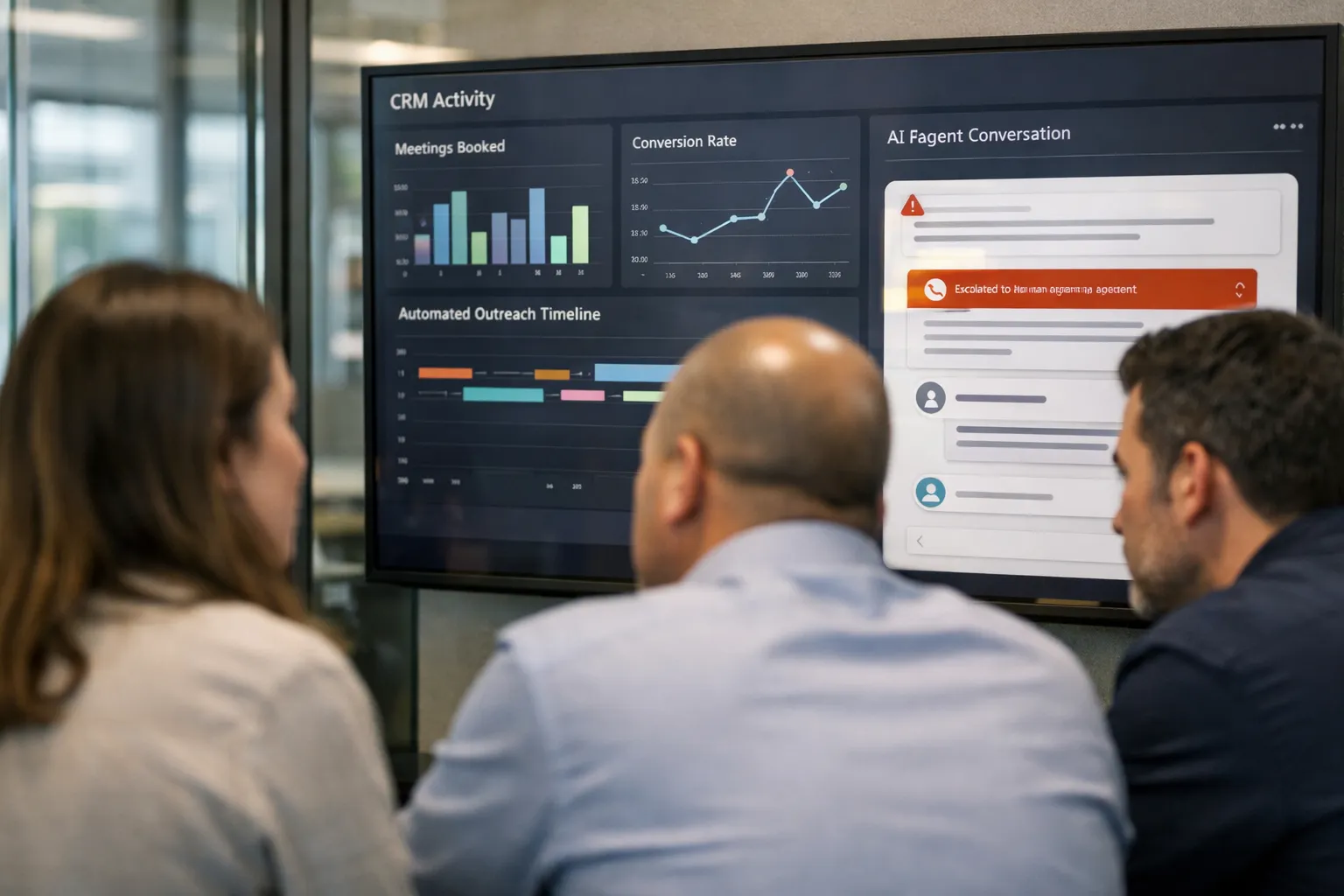
Overview: As of July 2026, AI sales agents are a standard part of B2B go-to-market toolkits. This update evaluates the trade-offs between fully autonomous agents and human-in-the-loop (HITL) systems, adds 2026 developments (vendor consolidation, private-model deployments, and rising regulatory scrutiny), and provides an actionable ROI-focused playbook for GTM leaders deciding where and how to automate outreach and qualification.
Background — what changed since mid‑2024
Two technical and two market forces accelerated adoption between 2024 and mid‑2026. On the technical side, model robustness and agent orchestration matured: prompt orchestration frameworks, retrieval-augmented generation (RAG) with enterprise knowledge bases, and stronger guardrail toolkits reduced hallucination rates for domain queries. On the market side, persistent cost pressure and tighter sales hiring budgets pushed revenue teams to seek higher pipeline productivity without proportional headcount growth. Finally, vendors quickly split into two camps—platforms pushing safe, high-volume autonomous playbooks, and specialist HITL providers emphasizing auditability and human oversight.
Data and evidence — what GTM teams are actually measuring (2026)
Teams evaluating AI sales agents now track three measurement classes: unit economics, conversion quality, and compliance exposure. Common, repeatable metrics in 2026 include:
- Cost per qualified meeting (CPQM): all-in unit cost including model API or on-prem compute, delivery and integration costs, plus human oversight labor.
- Qualified meeting conversion and downstream ARR: SQL-to-opportunity conversion and deal win rate for meetings that originated from automated outreach.
- Escalation and latency: percentage of conversations flagged for human review and average human response SLA (hours).
- Auditability metrics: immutable interaction logs, provenance for claims (which knowledge source replied), and percentage of replies requiring legal review.
Benchmarks published in public case studies and vendor disclosures in 2025–26 commonly report meeting-rate uplifts from automation in the mid‑teens to low‑double digits for SMB segments, and conversion improvements when HITL is applied to named accounts. Independent audits and red-team testing have become a standard pre-deployment step for regulated customers.
Recent vendor and market developments (mid‑2026)
- Private-model and hybrid hosting became mainstream. Many enterprises now require either private model hosting or on-prem inference for customer data; vendors offer model-agnostic connectors (OpenAI, Anthropic, Mistral, on-prem LLMs) and increasingly certify SOC 2 or ISO controls for model access.
- Domainized models and RAG reduced factual errors. Vendors layered RAG retrieval from CRM and contract repositories; this has reduced hallucination risk for product and pricing queries but requires careful knowledge-graph hygiene.
- Tiered automation is standard product strategy. Most sales-engagement platforms now expose a “tiered automation” workflow: autonomous sequences for low-touch leads, HITL drafting/approval for mid-value accounts, and direct human ownership for strategic deals.
- Regulatory pressure and buyer expectations rose. Procurement and legal teams increasingly demand provenance, audit trails and consumer consent records for outreach—forcing many companies to limit autonomous replies in regulated verticals.
Autonomous agents: updated upside and shortcomings
Autonomous agents in 2026 are more capable, especially when paired with enterprise RAG and strict templates. Their advantages remain scale, speed and consistent execution. Practical benefits include:
- 24/7 prospecting that dramatically reduces average reply latency and re-engages cold leads at scale.
- Predictable A/B testing at higher volumes, enabling rapid iteration on subject lines, sequencing cadence and CTAs.
- Lower incremental direct people costs when targeting large low-touch segments.
Limitations are still material:
- Qualification depth: the best autonomous flows still struggle with complex qualification that requires synthesis across prior conversations, nuanced pricing negotiation or legal nuance.
- Compliance and brand risk: unsupervised agents increase the chance of off‑brand tone or inaccurate contractual claims unless templates and provenance are enforced.
- Hidden operational costs: maintaining retrieval pipelines, prompt-playbooks, monitoring dashboards and red-team testing can erode headline cost savings.
Human-in-loop: why it remains the pragmatic choice for many deals
HITL approaches combine automation for drafting and routine state changes with human judgment for approval and escalation. In 2026, HITL variants include:
- Draft-and-approve: AI writes the outbound or reply; a human editor approves or refines before send—common for named accounts.
- Confidence-triggered escalation: replies under a confidence threshold (or that reference sensitive topics) route to an SLA-bound human reviewer.
- Parallel routing: automation handles SMB segments while humans own enterprise workflows; a single lead can move between modes as opportunity value changes.
HITL typically yields higher downstream revenue per meeting for mid- and enterprise segments because human sellers preserve nuance and relationship context. The trade-off is reduced headcount cost savings and potential bottlenecks if escalation SLAs are misconfigured.
Comparative ROI framework (updated for 2026)
Model ROI across three buckets: unit economics, pipeline impact and risk exposure. Below are updated considerations and practical thresholds used by GTM teams in 2026.
Unit economics
- Include long-term operational costs: model price increases, vector DB storage and refresh, engineering to maintain RAG sources, and red-team/regression testing cadence (quarterly at scale).
- Target metric: true cost per qualified meeting over 12 months. Many teams set a threshold CPQM below 60–70% of a human SDR's all-in cost before expanding autonomous to new segments.
Pipeline impact
- Measure full-funnel conversion (outreach → meeting → SQL → opportunity → close). Autonomous agents often increase volume but may reduce SQL conversion if qualification rules are shallow.
- Use cohort analysis by account tier: compare autonomous, HITL and human-only cohorts on win rate and average contract value (ACV) over a 6–12 month window.
Risk exposure
- Regulated verticals (healthcare, finance, government) and enterprise procurement increasingly require auditable provenance. Where auditability is mandatory, HITL or on-prem models are commonly chosen.
- Factor reputational risk into long-term pipeline velocity: a single mis-sent claim or tone misalignment with a named account can cost multiple future opportunities.
When autonomous agents are the right bet (2026)
- High-volume, low-LTV segments (SMB onboarding, freemium-to-paid upgrades, churn prevention) where speed and coverage materially increase revenue.
- Organizations that have invested in knowledge hygiene and automated provenance (service catalogs, pricing FAQs) so agents can reply safely from trusted sources.
- When guardrails and monitoring can keep the human escalation rate low (aiming at under 10–15% of threads flagged).
When HITL is better (2026)
- Named‑account selling, technical pre-sales discussions, and industries with compliance or procurement sensitivities.
- When the ACV is high enough that marginal human time yields outsized revenue improvement.
- When legal or procurement teams require signed provenance for claims or pricing details.
Updated implementation checklist for leaders (practical steps)
Run pilots as controlled experiments. Use the checklist below to make decisions backed by data.
- Segment and parallel-cohort: divide leads by ARR, vertical and intent. Run autonomous, HITL and human-only cohorts in parallel for at least 90 days, and extend to 180 days for enterprise deals.
- Define primary and secondary KPIs: CPQM, SQL conversion, opportunity ARR, escalation rate, and audit-compliance pass rate.
- Guardrail bundle: approved-language repository, prohibited-claims list, and RAG source whitelists. Automate tests that run sample replies through legal and compliance checks (synthetic lead testing).
- Set escalation SLAs: human review SLA targets (commonly 1–4 hours during business periods), priority routing for named accounts, and rules to auto-lock accounts moving up in ACV.
- Telemetry and logging: immutable logs of prompts, responses, retrieval sources and human edits; retain logs for contract-appropriate retention periods to support audits or disputes.
- Red-team and regression cadence: quarterly adversarial tests on templates and prompts; monthly regression checks after model or knowledge-base updates.
- TCO planning: estimate costs for 24 months including model API inflation scenarios, vector DB growth, software licensing, and incremental human oversight hours.
Vendor selection and deployment model (what to require in 2026)
- Model-agnostic connectors: require vendors to support major providers (OpenAI, Anthropic, Mistral) and local/private deployments.
- Provenance and explainability: vendors should expose which document or CRM field justified a reply and provide confidence metrics for each assertion.
- CRM-native bi-directional sync: minimize state drift by choosing solutions with native Salesforce/HubSpot adapters or robust middleware connectors.
- Security and compliance certifications: SOC 2, ISO 27001, data residency guarantees and contractual SLAs for data deletion and model access.
Multiple perspectives
SaaS vendors: emphasize scaling and template libraries, pointing to volume gains and reduced latency. Sales leaders: often report faster top-of-funnel growth but insist on human overlays for enterprise. Legal/compliance teams: prioritize audit trails and provenance, often restricting autonomy in regulated verticals. Buyers: increasingly expect clear identification when they are interacting with an AI and demand easy ways to escalate to a human.
Implications for GTM teams
Decisions now require an integrated view of economics and risk. For most mid-sized and enterprise organizations in July 2026, the pragmatic path is staged: deploy autonomous agents where ACV and compliance risk are low, instrument aggressively, and route higher‑value interactions into HITL. Expect to maintain a blended workforce—fewer full-time SDRs handling routine volume and more senior reps managing complex conversations.
Outlook — what to watch through 2026–27
Expect continued specialization: major platform vendors will standardize safe autonomous playbooks for volume segments while HITL orchestration providers will double down on auditability and vertical compliance. Regulatory and procurement demands will push more enterprises toward private or on-prem model options; at the same time, improvements in RAG and domain models will progressively lower hallucination risk. The core pattern—tiered automation with clear audit trails—will persist as the industry norm.
Bottom line
There is no universal answer. Autonomous AI agents can materially lower cost per meeting for low-touch segments, but they carry quality, compliance and brand risks. HITL preserves nuance and reduces asymmetric legal exposure but limits scale. The right choice in July 2026 is evidence-driven: pilot both approaches, instrument full-funnel outcomes, enforce provenance and rollback controls, and expand automation only where conversion economics and compliance posture are aligned.
FAQ
When should we restrict autonomous replies entirely?
Restrict autonomous replies when the account tier or vertical requires signed provenance (e.g., healthcare, regulated finance, government) or when legal teams cannot accept any automated assertions about pricing or contractual terms. If procurement or compliance insist on auditability that your stack cannot provide, default to HITL or on-prem solutions until controls are in place.
What is an acceptable human escalation rate?
There is no universal rule, but many teams target an initial escalation rate of 10–20% for pilot cohorts to conserve human bandwidth while keeping risky threads under review. Aim to reduce that rate over time through better templates, RAG source curation and confidence-tuning while maintaining SLA for escalations.
How long should a pilot run before making a scaling decision?
At least 90 days for SMB and mid‑market use cases; 180 days or more for enterprise-focused pilots where sales cycles stretch and downstream ARR matters. Evaluate full-funnel impacts and cohort-based win rates rather than just meetings booked.
Which monitoring tools are essential?
Essential monitoring includes immutable interaction logs, provenance tracing showing which knowledge source justified each claim, confidence scoring, rate of legal/compliance hits, and human-edit audit trails. Red-team test results and regression test dashboards should also be part of regular reporting.
Can small companies safely use autonomous agents?
Yes—if they limit autonomous agents to low-risk segments, maintain strict canned responses for pricing or legal claims, and set a conservative escalation threshold. Small companies should prioritize vendor certifications, SOC 2 compliance, and template-level safeguards to reduce brand risk.