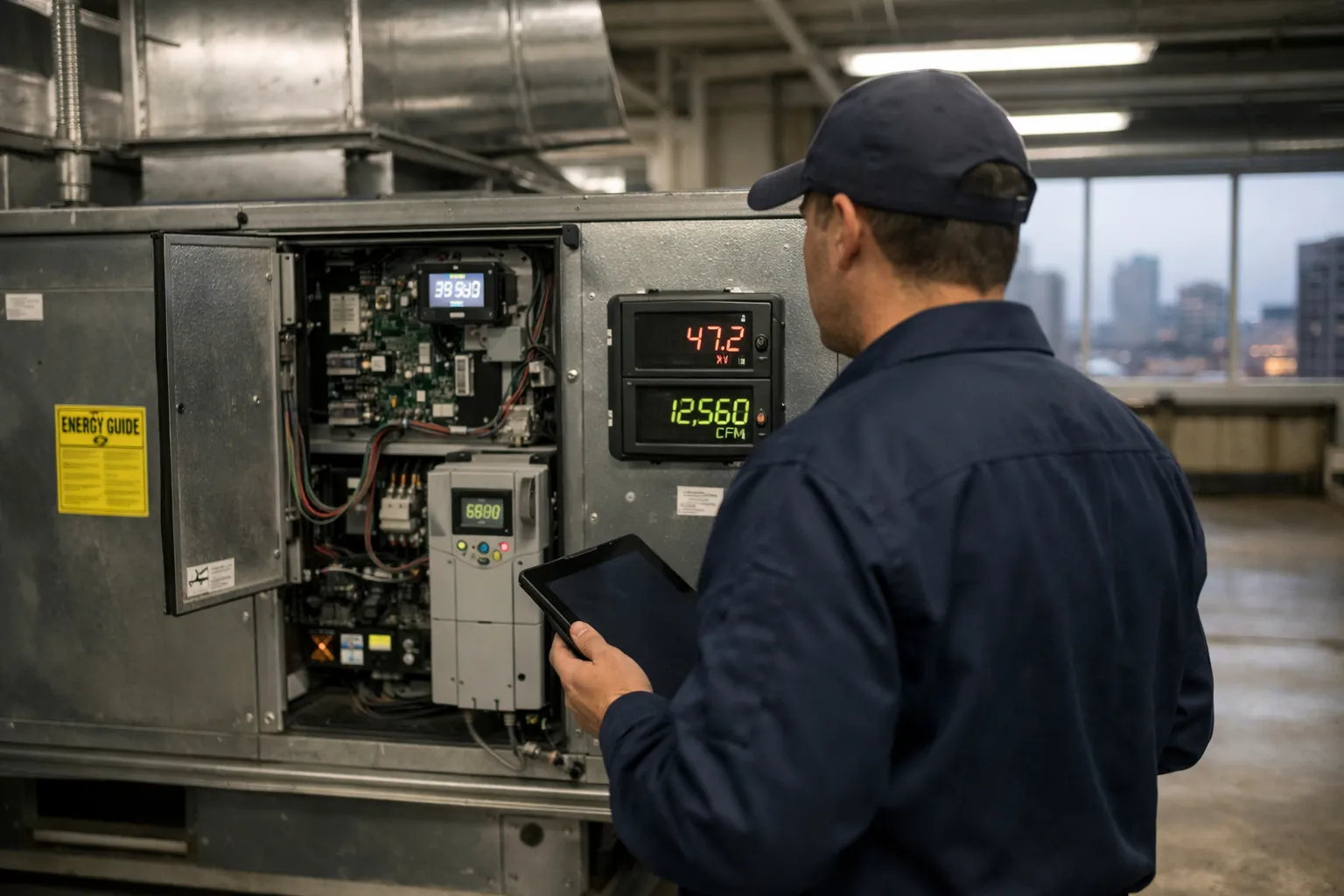
ASHRAE has approved the 90.1‑2026 update to its flagship energy standard for commercial buildings, a revision that industry stakeholders say will materially change how HVAC systems are specified, installed and commissioned. The Standard 90.1 triennial cycle has traditionally set the baseline for energy codes across jurisdictions; the 2026 edition tightens HVAC-related efficiency baselines, expands mandatory controls for air- and hydronic-systems, and updates compliance modeling to better reflect electrification and heat‑pump performance.
What changed in 90.1‑2026
The 2026 edition includes several specific changes that will directly affect HVAC equipment selection and control strategies. Key elements are:
- Tighter system efficiency baselines: Minimum prescriptive and performance-path baselines for rooftop units, air-handling units and packaged systems were lowered, while baseline fan and pump power assumptions were reduced — raising the bar for equipment IEER and fan/pump motor efficiency.
- Expanded mandatory controls: Demand-controlled ventilation, zone-level setback/scheduling, and continuous commissioning-ready metering requirements were extended to more building types and systems sizes than in previous cycles.
- Fan and pump power accounting: The standard clarifies how fan and pump energy are modeled in the performance path, including rules for variable-speed drives and fan power adjustment for pressure-independent terminal devices.
- Electrification and heat‑pump modeling: New test-based assumptions and performance curves improve modeling accuracy for air‑source and water‑source heat pumps across wider operating envelopes, reflecting field performance at low ambient temperatures.
- Commissioning and verification: Enhanced language requires verification of setpoints, control sequences and system staging for larger HVAC installations, and introduces clearer acceptance-test procedures tied to energy modeling outputs.
Why this matters now
Standard 90.1 is widely referenced — directly or indirectly — by state and local energy codes and by incentive program baselines. When ASHRAE updates 90.1, jurisdictions that reference the standard will have a new baseline to compare against; utilities and efficiency program administrators often update incentive technical requirements to match. For HVAC professionals, the immediate implications are practical:
- Designers must account for stricter baseline performance in early-stage modeling to capture compliance margins.
- Specifiers will see pressure to choose higher-efficiency compressors, plug fans or electronically commutated motors, and lower-fan‑power AHU designs.
- Controls contractors will need to deliver verified sequences and metering data to satisfy commissioning requirements.
- Owners looking to qualify for incentives should re-run models ahead of submission deadlines to ensure older proposals still meet program thresholds.
Market signals and supplier readiness
Manufacturers and distributors already signaled that product roadmaps were moving in this direction: variable-speed compressors, integrated heat‑pump modules rated for cold climates, and factory-integrated metering options have expanded over the past two years. The 90.1‑2026 changes are likely to accelerate adoption of:
- ECM-driven fan and pump packages with factory controls.
- Pre‑packaged rooftop and self-contained units with superior IEER and transient performance curves for accurate simulation.
- Factory-integrated telemetry and submetering to support continuous commissioning and performance verification.
Distributors and service contractors will need to retool inventory and training plans. Expect increased demand for controls engineers and certified commissioning agents who can translate model assumptions into testable acceptance criteria in the field.
Practical steps for HVAC contractors and designers
Actionable steps to prepare for 90.1‑2026 include:
- Update modeling templates: Revise performance-path and trade-off templates to reflect the standard’s new fan/pump assumptions and heat‑pump curves.
- Review specifications: Ensure equipment specs call out required control sequences, minimum motor efficiencies and integrated metering options.
- Train staff: Provide hands-on training for commissioning protocols and metering verification required under the new acceptance procedures.
- Engage early with owners: Discuss how the standard changes affect lifecycle cost, utility incentive eligibility and equipment payback.
- Coordinate with utilities: Reach out to local program administrators to understand if incentive tech requirements will be revised to match 90.1‑2026.
What to watch next
Adoption will vary by jurisdiction. Some states and municipalities incorporate the latest ASHRAE edition quickly; others lag or adopt modified versions. Contractors should monitor:
- State code adoption timelines and any jurisdictional amendments.
- Utility program updates that align incentive baselines to 90.1‑2026.
- Manufacturer product bulletins that provide new ratings and performance data aligned to the revised standard.
90.1‑2026 tightens the technical benchmark for commercial building HVAC energy performance at a time when electrification, resiliency and operational transparency are rising priorities. For HVAC systems professionals, the update is both a challenge — in the form of higher design and verification demands — and an opportunity: projects that meet the new standard will be better positioned for incentives, lower operating costs and future regulatory scrutiny.