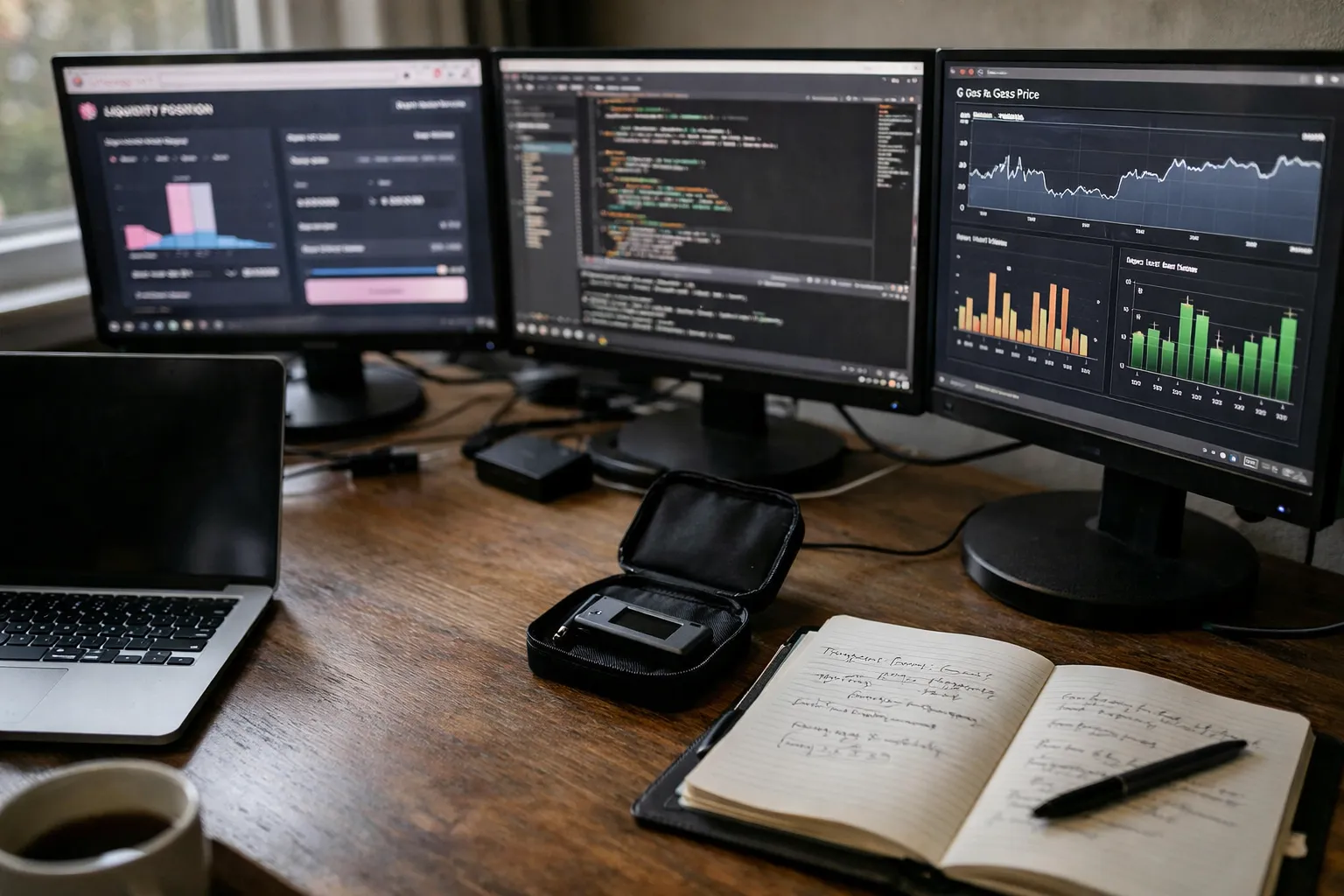
Concentrated liquidity on Uniswap v3 lets liquidity providers capture far higher fee yield than v2—if they can keep their position in-range. The operational burden of monitoring price, gas costs and impermanent loss has driven traders to automated rebalancers. This guide walks through designing, building and operating a gas‑efficient Uniswap v3 rebalancing strategy that is actionable for a crypto trading enthusiast.
What this guide covers (and what it doesn’t)
- This is a how‑to: strategy design, trigger math, architecture options (off‑chain bot vs. on‑chain keeper), gas optimization and risk controls.
- It does not provide a ready‑to‑deploy smart contract. Code examples are conceptual and meant to be adapted and audited.
- Focus is Uniswap v3 concentrated liquidity for single or two‑sided LP positions (e.g., ETH/USDC). Concepts apply to v3 forks but syntax and contracts differ.
Why automate rebalancing?
Uniswap v3 LPs earn trading fees only while the pool price remains inside their tick range. When price drifts out, the position becomes all one asset and fees stop. Manual rebalancing is viable for large moves or infrequent adjustments, but two practical frictions push automation:
- Timing: price can cross a boundary in minutes; human reaction times introduce loss.
- Gas & costs: frequent small updates are eaten by transaction fees; you need a rule set that respects execution costs.
Design choices: three axes
Every rebalancer lives at the intersection of:
- Range design — width and central price placement
- Trigger rules — when to rebalance (price thresholds, APR decay, time)
- Execution architecture — off‑chain bot + on‑chain tx, or on‑chain keeper/smart contract
1. Range design (tick width and center)
Range width determines how often you must rebalance and how much capital is active.
- Narrow ranges (e.g., ±1–3%) concentrate fees but require frequent rebalances and higher gas per effective yield.
- Wider ranges (e.g., ±10–20%) reduce rebalancing frequency but dilute fee capture and increase impermanent loss exposure.
- Centering the range around a moving reference (TWAP or VWAP) reduces frequent full‑range rotates when the market is trending.
Practical approach: choose a default width by backtesting on historical tick-level liquidity and volume for your pair. For volatile pairs like ETH/USDC, many active LPs start with 5–10% for a retail setup; for stable/stable pairs, 0.01–1% is common.
2. Trigger rules (the decision logic)
Good trigger rules balance expected earned fees since last rebalance against the on‑chain costs to perform the rebalance. Three complementary triggers work well together:
- Price distance trigger: Rebalance when price leaves X% of the central tick (simple and reactive).
- Fee accrual trigger: Rebalance when accrued fees exceed estimated tx cost * (1 + safety margin).
- Time/decay trigger: Force a rebalance after T days to harvest rewards and re‑center if volume is low.
Formulas you should implement:
- Estimate gas cost in stable units: GasCostUSD = gasLimit * gasPriceGwei * gweiToETH * ethPriceUSD
- Estimate required fee to justify tx: RequiredFeesUSD = GasCostUSD * (1 + margin) + MinimumProfitUSD
- If AccruedFeesUSD >= RequiredFeesUSD OR PriceDistance >= Threshold OR TimeSince >= T then rebalance.
3. Execution architecture
Two dominant architectures:
- Off‑chain bot + on‑chain transactions — monitoring and decision logic run off‑chain; bot submits signed transactions via an RPC provider, possibly with relayer/keeper tooling to reduce latency. This is flexible and easiest to integrate with private keys and proprietary logic.
- On‑chain keeper contract — an automation contract receives keepers (Chainlink Keepers, Gelato, own keepers) that execute rebalances. Safer for public strategies and allows permissionless execution but requires higher upfront auditing and careful economic design (who pays gas?).
Most traders use the off‑chain bot approach to start, then migrate critical functions on‑chain once rules are stable.
Step‑by‑step setup
Step 1 — Backtest range & trigger parameters
Use historical tick and swap data from The Graph or a node. Backtest these variables:
- Range widths to simulate time‑in‑range and fees earned
- Trigger thresholds (price distance %, minimum fee to rebalance)
- Gas price regimes (low, average, high) to estimate transaction frequency
Key metric to record: net annualized return after estimated gas and expected impermanent loss. Run sensitivity to volume drops and to a 50–200% increase in gas prices.
Step 2 — Select infrastructure
Infrastructure checklist:
- Ethereum node provider with high reliability (Infura, Alchemy, QuickNode) or your own full node
- Wallet with controlled private key storage (hardware for production)
- Monitoring and alerting: price feeds, mempool watch, tx confirmation monitoring
- Relayer/MEV protection options: Flashbots Protect or private RPC to reduce sandwich risk
- Gas oracle integration (ETH basefee + priority fee) to estimate probable confirmation time
Step 3 — Implement the decision engine
Core functions the bot must provide:
- Fetch current pool price and ticks
- Compute current position health: in‑range percent, underlying token balances if removed now, fees accrued
- Evaluate triggers using formulas above
- Build transaction bundle (remove liquidity, collect fees, swap one side if re‑centering requires single asset, mint new position)
Optimization: batch actions into a single multicall to reduce gas. E.g., use the v3 router + Periphery functions to decrease number of on‑chain calls.
Step 4 — Execution and gas‑smart tactics
Execution tactics to lower cost and slippage:
- Use a single atomic transaction for remove+swap+mint when possible to avoid intermediate exposure.
- Estimate and set priorityFee based on price sensitivity; don’t overpay during low urgency windows.
- When gas is high, defer non‑urgent rebalances by increasing the RequiredFeesUSD margin or widening ranges temporarily.
- Consider bundling multiple user rebalances into a single transaction (if running a product that supports multiple LPs).
Step 5 — Safety and risk controls
Essential operational guards:
- Maximum slippage caps on swap calls
- Emergency pause in the bot on RPC failure, stale price feed, or gas spikes
- Daily limits on total tx count or total capital rotated
- Automated backup signer for key compromise scenarios
- Regular audits if any on‑chain management contracts are used
Example: walk‑through numbers for ETH/USDC
Assume a simplified scenario for illustration:
- Position: $100,000 concentrated around $2,000 ETH
- Range width: ±5% (1,900–2,100)
- Average daily fees captured historically: 0.02% of notional for this volume and width (use your backtests)
- Gas to rebalance transaction: 200k gas
- Expected ETH price: $2,000, gas price scenario gives GasCostUSD = $40 per rebalance (example)
If accrued fees since last rebalance = Notional * 0.02% = $20 per day. If your RequiredFeesUSD is GasCostUSD * 2 = $80 (safety margin), then you need ~4 days of accrued fees to justify a rebalance on pure fee grounds. Combine that with a price distance trigger (e.g., when price hits the range boundary at ±5%) to avoid excessive waiting.
This example shows why fee‑based triggers should be combined with price thresholds and time caps: when the market moves fast you may need to rebalance even if accrued fees are small.
Advanced topics
Protecting against front‑running and sandwich attacks
Large remove+mint operations expose the bot to sandwich risk if executed via public RPC. Mitigations:
- Use Flashbots Protect or bundle transactions via private relays
- Split large operations into several smaller, randomized time windows (tradeoff: more gas)
- Limit slippage on swaps and evaluate miners’ potentials
Multi‑strategy orchestration
Experienced operators run an orchestration layer: position manager (per LP), a scheduler (time-based), a price feed adapter (on multiple sources), and an executor that routes through the cheapest relayer. This modular approach simplifies experimentation: swap range widths, add fee‑harvesting gates (gauge staking), or integrate third‑party vaults.
Common pitfalls and how to avoid them
- Ignoring gas volatility: Build gas ceilings and dynamic trigger margins to avoid churning during fee spikes.
- Underestimating slippage on re‑center swaps: Use limit orders where possible and simulate before executing live.
- Overfitting to historical data: Validate strategies on stress scenarios—fast trends, volume collapse, and sudden liquidity shifts.
- Relying on a single oracle: Cross‑check TWAPs with multiple feeds; use medianize functions where possible.
Operational checklist before going live
- Backtested rules across at least 6–12 months and three gas regimes
- Recovery and emergency pause flows tested
- Key management and rotation policies established
- Monitoring and alerting (slack/email/SMS) for failed transactions, gas spikes, and out‑of‑range events
- Insurance and counterparty considerations (e.g., if storing LP tokens or using custodial relayers)
Final recommendations
Automated rebalancing can materially improve returns for Uniswap v3 LPs, but success depends on marrying sound economic triggers with disciplined operational controls. Start simple: one pair, one width, and conservative trigger thresholds. Once live, collect telemetry—actual gas costs, time‑in‑range, and realized fees—and iterate. When your rules are stable, you can safely increase capital, add automation layers, or migrate parts of the system on‑chain for trust minimization.
Automation is not a magic profit button; it trades operational risk for execution efficiency. Treat it like any trading system: instrument your metrics, test thoroughly, and maintain robust failsafes.