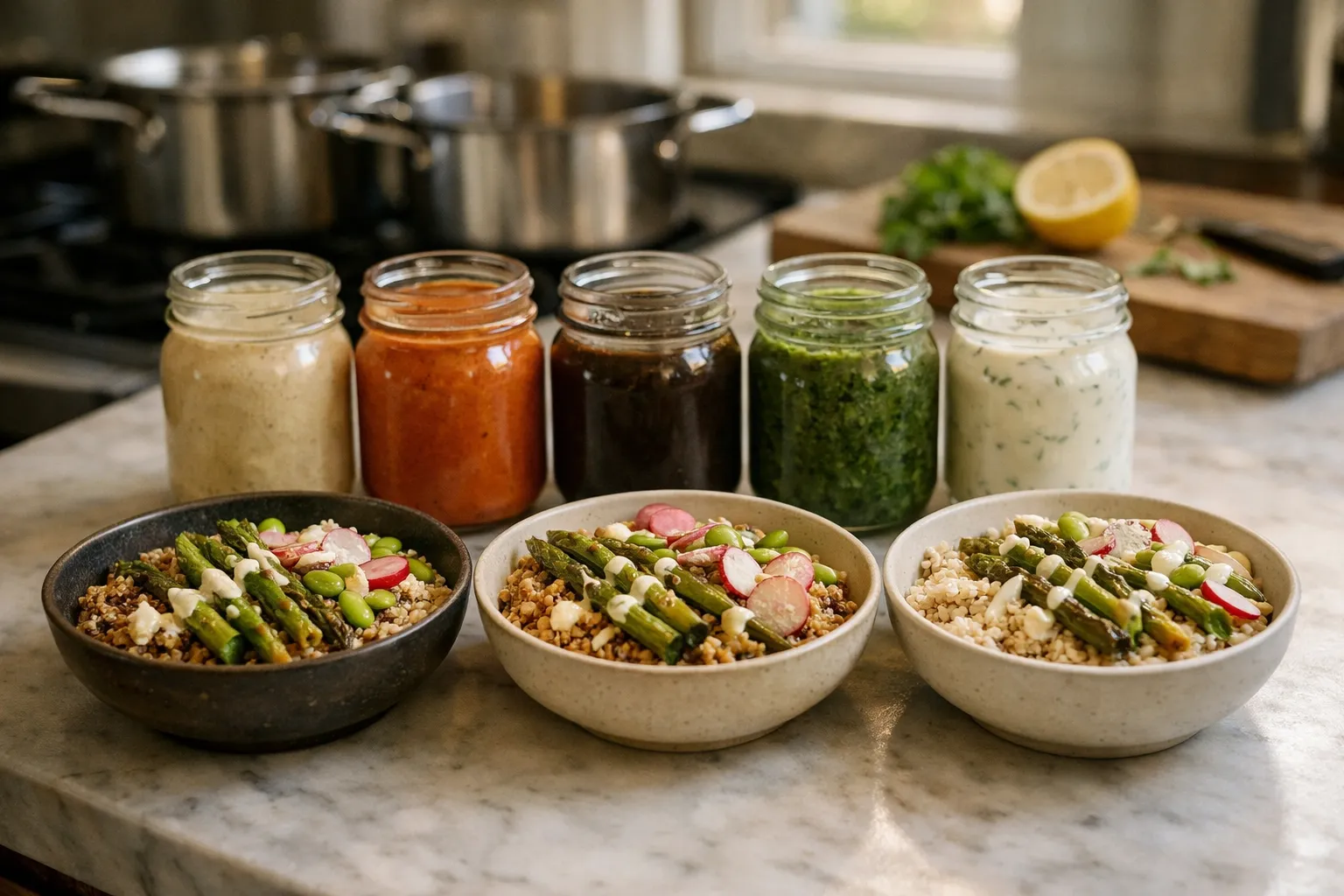
If you want weeknight dinners that feel intentional but don’t eat your evening, this updated guide shows how to batch-prep five versatile sauces and three reliable grain bases in one kitchen session. Targeted at home cooks and recipe enthusiasts, this July 2026 update adds current tools, storage best practices, seasonal pairing ideas and safety guidance so your batches stay fresh and flavorful all week.
Prerequisites & context: what to know before you start
Batch-prep is efficient when you plan ingredients, appliances and storage. Before you begin, note these practical points:
- Time & yields: Active hands-on time is ~60–75 minutes for the full session; total elapsed time 90–110 minutes when you run grains and sauce tasks in parallel. Each sauce yields ~2 cups; each grain batch yields about 6–8 cups cooked (6–8 servings).
- Food-safety baseline: Follow USDA guidance: cool cooked foods to refrigerator temperature within 2 hours and store at or below 40°F (4°C). Most refrigerated batches should be used within 3–7 days depending on composition (details below).
- Tools that speed the job (2026): high-speed blender (or reliable food processor), immersion blender, two burners or a multicooker with dual pots, silicone spatulas, fine-mesh sieve, digital scale, vacuum sealer or quality airtight jars and a rapid-cool tray to speed chilling.
Step-by-step workflow (efficient one-session plan)
Organize tasks so long-cooking grains run while you prepare sauces. Numbered sequence below is optimized for time:
- Start long-cooking grains first—set timers and reduce heat once simmering.
- Prep and roast any vegetables or nuts for sauces; while they cool, measure and chop herbs, garlic and aromatics.
- Blend sauces in batches—cleaning the blender between oil-heavy sauces helps maintain consistency.
- Finish grains, cool quickly (spread on a shallow tray or use a rapid-cool rack), portion, and store.
- Label jars with sauce name and date; date-marking reduces fridge guesswork later.
Shopping & prep checklist
- Ingredients: see each sauce and grain below. Buy the freshest herbs and lemons; for plant-forward bowls, purchase reliable tofu or a vacuum-sealed tempeh.
- Equipment: see tools above. Consider an insulated cooler with ice packs to speed cooling if your kitchen gets warm.
- Prep actions: rinse grains, zest lemons, toast nuts, roast red peppers (or buy jarred roasted peppers to save time), and measure oils and vinegars into small bowls so you can blend without interruption.
The five sauces (each yields ~2 cups)
1. Lemon‑Tahini Herb (bright, creamy; vegan)
- Ingredients: 1/2 cup tahini, 3–4 tbsp warm water (to thin), 3 tbsp fresh lemon juice + 1 tsp lemon zest, 2 garlic cloves, 1/4 cup packed parsley, 2 tbsp dill, 1 tbsp olive oil, 1 tsp maple syrup or honey, salt & pepper.
- Method & timing: 8–10 minutes. Blend in high-speed blender or food processor until silky, add water a little at a time for desired consistency.
- Why it works: tahini offers rich emulsification that coats grains; lemon brightens and helps the sauce stretch further.
- Storage: refrigerate up to 5–7 days; stir or thin with water before using.
2. Roasted Red Pepper Romesco (smoky, nutty)
- Ingredients: 2 roasted red peppers (jarred or home-roasted), 1/3 cup toasted almonds (or sunflower seeds for nut-free), 1 slice stale bread or 2 tbsp almond meal for GF, 2 garlic cloves, 2 tbsp sherry vinegar, 1/4 cup olive oil, 1 tsp smoked paprika, salt.
- Method & timing: 12–20 minutes (longer if you roast peppers). Pulse to a thick, spreadable texture; adjust oil for desired richness.
- Why it works: concentrated roasted pepper flavor elevates simple roasted veg and grains; swap bread for seeds to keep gluten-free.
- Storage: 4–7 days refrigerated; freeze portions in silicone ice cube trays for up to 3 months.
3. Soy‑Ginger Umami (savory; great with proteins)
- Ingredients: 1/3 cup low-sodium soy sauce or tamari, 2 tbsp rice vinegar, 2 tbsp toasted sesame oil, 2 tbsp grated ginger, 2 tbsp honey or maple syrup, 2 cloves garlic, 1 tbsp toasted sesame seeds, 1/4 cup neutral oil (optional for richer dressing).
- Method & timing: 5–8 minutes. Whisk or briefly blend; warming gently (not boiling) for 30–60 seconds can mellow sharpness.
- Why it works: bright acidity + toasted sesame give depth; reduce salt by choosing low-sodium soy/tamari.
- Storage: 4–7 days refrigerated; separate from hot proteins when storing bowls to prevent moisture migration.
4. Chimichurri (herby, zesty; grill-friendly)
- Ingredients: 1 cup packed flat-leaf parsley, 1/2 cup packed cilantro (optional), 3 tbsp red wine vinegar, 1/2 cup extra-virgin olive oil, 3 garlic cloves, 1 tsp red pepper flakes, salt.
- Method & timing: 6–8 minutes. Finely chop or pulse; let rest 15–30 minutes to meld.
- Why it works: bright acids and fresh herbs cut through richer grains and proteins; use lemon if you prefer brighter acidity.
- Storage: up to 7 days refrigerated. For longer life, cover the surface with a thin film of oil to limit oxidation.
5. Creamy Yogurt‑Dill (cooling; vegan swaps available)
- Ingredients: 1 cup plain thick yogurt (Greek or strained plant yogurt), 1/4 cup chopped dill, 1 tbsp lemon juice, 1 small garlic clove, salt, pinch sugar.
- Method & timing: 5–7 minutes. Blend or whisk until smooth.
- Why it works: cooling texture balances spicy or smoky sauces; a cashew cream or unsweetened thick plant yogurt works for vegan bowls.
- Storage: yogurt-based sauces keep 3–4 days. Vegan alternatives (if using properly reconstituted cashew cream) can last 4–5 days.
Updated sauce variations & 2026 trends
In 2026 home cooks are leaning into small-but-powerful alterations to keep bowls interesting without extra batch sessions:
- Acid swaps: use black vinegar or umeboshi plum vinegar for deeper umami in soy-ginger.
- Fermented boosts: add 1 tbsp miso or 1–2 tbsp quick-picke d kimchi juice to stretch and deepen flavors (miso adds salt—reduce soy accordingly).
- Freezer-friendly portions: freeze 2-tablespoon dollops of each sauce in silicone trays so you can thaw single servings quickly.
The three grain bases (batch yields & cooking)
Each batch below yields roughly 6–8 cups cooked. Cook grains concurrently where possible to save time.
Quinoa (light, fast)
- Ingredients: 2 cups quinoa, 4 cups water or stock, 1 tsp salt.
- Method: rinse well; bring to a boil, reduce, simmer 12–15 minutes, remove from heat and rest 5–10 minutes; fluff with fork.
- Why it works: neutral base that soaks up sauces; naturally gluten-free.
- Storage: refrigerate 4–5 days; freeze up to 3 months.
Farro (chewy, nutty)
- Ingredients: 2 cups pearled farro, 6 cups water or stock, 1 tsp salt.
- Method: simmer 20–35 minutes depending on pearling; test for tender chew; drain any excess water and rest.
- Why it works: hearty texture holds up to bold sauces and long reheating.
- Storage: refrigerate 4–5 days; freeze portions if you won’t use within that window.
Long‑grain brown rice (hearty, budget-friendly)
- Ingredients: 2 cups brown rice, 4 1/2 cups water, 1 tsp salt.
- Method: simmer covered 40–45 minutes, rest 10 minutes, fluff.
- Why it works: economical and filling; pairs well with robust sauces.
- Storage: refrigerate 4–5 days; add a tablespoon of water before reheating to restore moisture.
Assembling bowls: pairing ideas that feel new in 2026
Combine one grain + one sauce + vegetables + protein + crunch. Updated combos that reflect seasonal produce and plant-forward protein options:
- Quinoa + Lemon‑Tahini + charred corn, blistered cherry tomatoes, grilled tofu marinated in soy-ginger — finish with toasted sesame seeds.
- Farro + Chimichurri + roasted early-summer eggplant, lemony pickled shallots, pan-seared tempeh strips.
- Brown rice + Soy‑Ginger Umami + sautéed shiitake and oyster mushrooms, steamed broccolini, shredded rotisserie chicken (or seitan for vegan).
- Quinoa + Romesco + cauliflower florets roasted until deeply caramelized, wilted spinach, white beans; top with toasted sunflower seeds for nut-free crunch.
- Farro + Yogurt‑Dill + cucumber ribbons, dill-pickled red onion, smoked trout or smoked tofu, and quick-preserved capers.
Storage, safety & reheating — updated best practices
- Fridge windows: USDA-style guidance: yogurt-based sauces use within 3–4 days; most oil-based herb sauces and romesco keep 5–7 days refrigerated. If in doubt, err on the shorter side—labeling by date helps.
- Cooling grains fast: spread grains in a thin layer on a shallow tray or use a rapid-cool rack. The faster you reduce temperature, the lower the bacterial risk.
- Vacuum-sealing & sous-vide: sealing sauces and grains extends shelf-life by reducing air exposure; refrigerated vacuum-sealed portions often stay fresher longer (still follow 3–7 day guidance). For any shelf-stable approach, use tested canning or commercial methods—don’t improvise low-acid canning at home.
- Reheating: microwave 60–90 seconds for a 1–1.5 cup portion, stirring halfway. For proteins, reheat separately. Sous-vide reheating preserves texture for proteins and some vegetables.
- Freezing: freeze sauce portions up to 3 months (romesco and soy-ginger freeze especially well); thaw in fridge overnight. Note: emulsified sauces may separate slightly after freezing—whisk to re-emulsify.
Scaling & yield planning
- Double batches: multiply all ingredients and either use two pots or one very large pot to avoid boilovers. Use multiple blenders or blend in two batches to keep texture consistent.
- Portion planning: plan 3/4–1 cup cooked grain per bowl and 1–4 tbsp sauce depending on intended flavor intensity; if sauces are primary flavor, budget 3–4 tbsp per bowl.
- Minimize waste: freeze small portions (2 tbsp) in silicone trays or jar single-serving portions for lunches.
Common mistakes to avoid
- Over-salting sauces before tasting with salty proteins—hold salt until you’ve combined everything.
- Cooling grains slowly in a deep container—this lengthens the time in the bacterial growth zone. Use shallow containers.
- Assuming all sauces are freezer-stable—yogurt sauces can change texture; use vegan cashew-based alternatives if you plan to freeze.
Pro tips (advanced)
- Use acid strategically: a splash of high-acid vinegar or lemon added just before serving brightens flavors without needing more salt.
- Rotate a single quick condiment (e.g., pickled scallions, furikake, preserved lemon) to create distinct bowls from the same core set.
- Label jars with both a use-by date and suggested pairings — it saves decision fatigue midweek.
- Invest in quality jars: wide-mouth glass jars with reusable silicone seals make scooping and portioning faster and reduce cross-contamination.
FAQ
How long can I keep each sauce in the fridge?
As a rule of thumb: yogurt-based sauces 3–4 days; oil-and-herb-based sauces (chimichurri, romesco) 5–7 days; soy-based dressings 4–7 days. If a sauce smells off, shows mold, or changes color significantly, discard it. Date-marking jars removes guesswork.
Can I freeze cooked grains and do they change texture?
Yes. Quinoa, farro and brown rice freeze well for up to three months when cooled and packed in airtight bags or containers. Texture can be slightly drier after freezing; add a tablespoon or two of water when reheating to restore moisture.
Are there safety concerns with storing oil-based sauces with fresh garlic or herbs?
Storing garlic or fresh herbs submerged in oil at room temperature can create an anaerobic environment where Clostridium botulinum could grow. Always refrigerate these sauces promptly and use within the recommended fridge window (typically 5–7 days). For longer storage, follow tested canning or preservation methods.
How can I stretch a 2-cup sauce to cover more bowls without diluting flavor?
Use the sauce as a concentrated paste or finishing drizzle. Thin a small portion with water or lemon to make a lighter dressing, or combine a tablespoon of the sauce with plain yogurt or mashed avocado to increase volume while maintaining flavor depth.
What are good protein swaps for weeknight bowls in 2026?
Rotate between quick-cooking options: pan-seared tofu, tempeh, rotisserie chicken, canned beans warmed with spices, or seared sustainable seafood. Plant-based proteins like pea-protein seitan and pre-marinated tempeh continue to be convenient choices; always reheat proteins separately and store them in their own containers when possible to maintain texture.
Final thoughts
Batch-prepping five sauces and three grains remains one of the highest-return culinary habits: invest roughly 90–110 minutes once a week and you’ll have a flexible foundation for 8–10 dinners. The 2026 updates here focus on safer cooling, smarter portioning, freezer strategies and small ingredient swaps that keep bowls interesting without extra work. With these recipes, a few good tools and clear labeling, weeknight dinners can be fast, varied and reliably delicious.