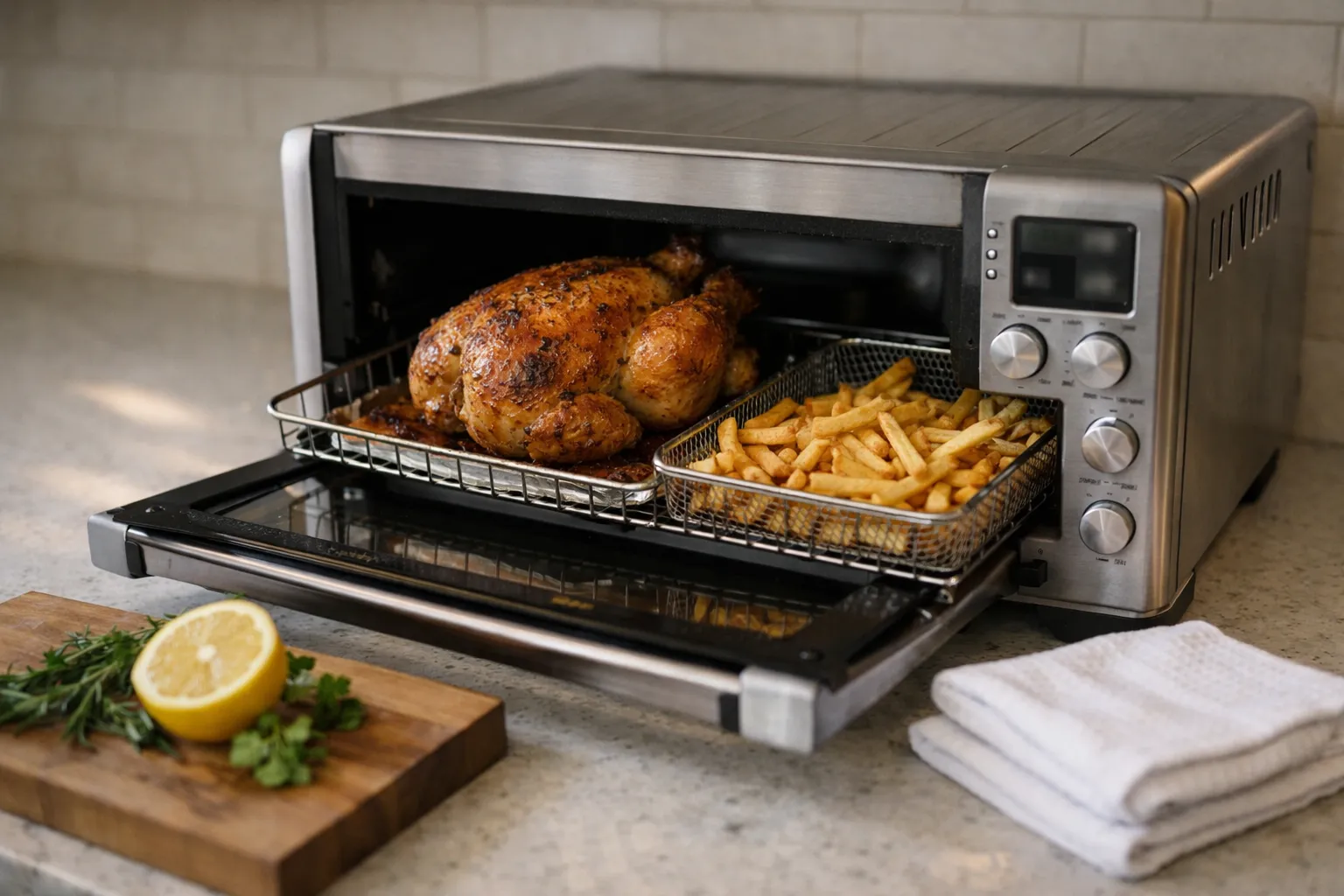
Overview: What we’re reviewing
The Breville Smart Oven Air Fryer (model BOV900) is a full‑size countertop electric oven with Breville’s Element IQ heating algorithm and an integrated air‑fry mode. It supports more than ten cooking presets (air fry, roast, bake, broil, dehydrate, proof and others), fits a 13‑inch pizza or two racks of sheet pans, and ships with an air‑fry basket, oven rack, baking pan and crumb tray.
Background: Who makes this and who it’s for
Breville (based in Australia, sold in North America under the Breville and Sage brands) positions the BOV900 for serious home cooks who want a countertop appliance that can replace—or supplement—a conventional oven in small kitchens and apartments. Since its initial rise to popularity, the small‑appliance market has shifted: through 2024–26 manufacturers emphasized smaller, Wi‑Fi‑enabled smart ovens and hybrid multicookers. We retested the BOV900 in June 2026 to see if its size, build quality and Element IQ still make sense for today’s kitchens.
Features analysis: Deep dive into capabilities
- Cooking modes: 10+ presets including dedicated air‑fry and dehydrate. Modes are reliable and easy to select with tactile dials and a small digital display—no smartphone required.
- Capacity: Full‑size countertop interior that takes a 13‑inch pizza, a quarter‑sheet pan on two levels, or a small spatchcock chicken. For families needing two‑rack cooking, this remains an advantage over most compact “mini” air‑fryer ovens.
- Heating and controls: Element IQ distributes power across five heating elements to manage preheat and browning. There’s no Wi‑Fi, no app, and no smart sensors beyond the built‑in thermostat.
- Accessories and cleaning: Air‑fry basket, oven rack and baking pan are included and dishwasher‑safe. The stainless interior is reasonably easy to wipe, but heavy splatters benefit from a soak with a mild degreaser.
- Energy and noise: High‑wattage elements mean fast preheat and shorter cook times versus compact models; the tradeoff is higher instantaneous power draw and moderate fan noise during convection/air‑fry cycles.
How we tested it (June 2026)
We used the BOV900 over two weeks in an urban two‑person household and a four‑person family kitchen, testing frozen and fresh air‑fry items (shoestring fries, breaded fish), roasting a 3‑lb spatchcock chicken, baking a 9‑inch sourdough loaf, toasting bagels, and dehydrating herbs. Tests emphasized temperature consistency, evenness across two racks, air‑fry crispness compared with basket fryers and compact smart ovens, ease of use, and cleaning time.
Performance: air fry, roast and bake
Air‑fry: The BOV900 continues to excel at delivering even, golden crusts without excess oil. In our tests it outperformed smaller basket fryers at avoiding sogginess on thicker cuts (home fries, breaded fillets) because of the oven’s larger convection volume and higher heat capacity. Cook times were typically 10–20% shorter than a conventional countertop convection oven and comparable to other full‑size toaster‑ovens with strong convection.
Roast and bake: For a 3‑lb spatchcock chicken and roast vegetables, the BOV900 produced consistent browning across two racks when pans were rotated once. In artisan bread tests the oven provided good oven spring and a crisp crust for single loaves; it still cannot fully replicate the deep Maillard coloration and steam dynamics of a full built‑in oven with a baking stone and dedicated steam source. For apartment bakers and most weeknight baking, results are solid.
Toast and bagel: Element IQ maintains consistent toast color and crunch. The bagel setting heats the cut side while toasting the exterior cleanly—reliable for breakfast routines.
Usability and day‑to‑day
- Controls: Tactile dials let you change modes quickly; some users miss app scheduling, which is now common in 2026 smaller ovens and smart multicookers.
- Preheat: Preheat times are fast—typically under 10 minutes to 400°F—thanks to higher wattage and the Element IQ algorithm.
- Footprint: This is a large appliance and dominates counter real estate. Plan for at least 6–8 inches clearance on the sides and back and avoid placing it under low cabinets to prevent heat damage.
- Cleanup: Removable racks and trays are dishwasher‑safe; the interior benefits from weekly wiping. Grease buildup behind the crumb tray is the most common maintenance point.
Pros
- Large internal capacity that reliably handles two‑rack cooking and 13‑inch pizzas.
- Consistent browning and dependable air‑fry crispness thanks to Element IQ and strong convection.
- Durable construction and useful accessory set included.
- No required app or cloud account—appeals to privacy‑minded cooks.
Cons
- Significant countertop footprint and heat output—unsuitable for cramped kitchens.
- No Wi‑Fi, remote scheduling, or integrated sensor cooking—features many 2025–26 buyers now expect.
- Higher instant power draw; not the most energy‑efficient option for occasional users.
- Not a full replacement for a built‑in oven for multiple loaves or large‑batch baking.
Pricing and value (June 2026)
As of June 2026 the BOV900’s typical street price ranges from about $299 on sale to $429 at full price, with common holiday discounts. That places it above compact smart ovens and many smaller 2‑in‑1 air‑fryer/toaster ovens, but below the cost of some professional built‑in ranges. The value proposition rests on capacity and consistent results; if you need two‑rack cooking and regular air‑fry/roast use, the per‑use cost can be competitive versus a full oven when you factor utility and heating time.
Who it’s for
- Home cooks who want one robust countertop appliance for air‑frying, roasting and everyday baking without relying on apps.
- Apartment dwellers and small households that lack a full oven but need genuine two‑rack capacity.
- Families who will use the larger interior regularly and can commit counter space.
Who should skip it
- Buyers with very limited counter space or who prefer compact, stacked appliances.
- Consumers who expect Wi‑Fi, sensor‑based guided cooking, or integration with smart home platforms.
- Serious bakers who want a steam or stone floor and the capacity of a full built‑in oven.
Alternatives (short list)
- Ninja Foodi line: Offers compact smart ovens with app features and smaller footprints; typically better if you want Wi‑Fi and guided programs but accept less interior capacity.
- Cosori / Instant Brands toaster‑ovens: Often cheaper, with many smart features in recent 2025–26 models; good for buyers prioritizing connectivity and lower upfront cost.
- Self‑contained multicookers (e.g., Instant Pot hybrids): Add pressure/steam/slow cook functions but lack oven‑style air‑fry and two‑rack capacity.
Verdict
Updated for June 2026: the Breville Smart Oven Air Fryer BOV900 still makes sense when capacity, build quality and consistent results matter more than app features. For apartment bakers, families who regularly use two racks, and cooks who prefer tactile controls, it remains a strong, practical choice. If you want the latest smart integrations, guided recipes, or a smaller footprint, modern compact ovens from Ninja, Cosori and Instant Brands offer compelling alternatives—often at lower price and with Wi‑Fi features Breville omits.
Bottom line: buy the BOV900 if you need reliable two‑rack performance and no‑nonsense controls; look elsewhere if counter space, cloud features or the lowest upfront cost are your top priorities.
FAQ
Is the BOV900 still worth buying in 2026?
Yes—if you value full‑size countertop capacity, consistent browning and robust air‑fry results without relying on apps. It’s less attractive if you want Wi‑Fi, sensor‑guided cooking or a smaller countertop footprint.
Can the BOV900 replace my built‑in oven?
It can substitute for many everyday tasks (roasts, weeknight baking, pizzas) and handles two‑rack cooking, but it won’t fully replace a full‑size oven for large batches, multiple loaves or professional‑style steam baking.
How does it compare on energy use?
Because it preheats and cooks quickly, total energy per dish can be efficient versus a conventional oven for small to medium jobs. However, its high wattage means higher instantaneous draw; for infrequent users a smaller appliance may be more energy‑efficient overall.
Any maintenance tips to keep it performing well?
Wipe the cavity weekly, remove and clean the crumb tray after heavy use, and soak racks and the air‑fry basket as needed. Avoid abrasive cleaners on the interior finish and clean spills promptly to prevent baked‑on grease.