
By James Crawford, Legal Affairs Reporter (turned kitchen explainer)
Introduction — what you’ll learn and why it matters
This August 2026 update shows exactly how to build a dependable 30-minute weeknight grain bowl bar that works with today’s appliances and packaged ingredients. This guide is for busy home cooks and small-host entertainers who want consistent results: quick cooking methods keyed to common 2026 appliances, three fail-safe sauces, updated food-safety and labeling steps you should not ignore, and three copy/paste dinner examples you can make tonight. You’ll finish knowing what to buy, how to shave minutes without losing texture or protein, and what to do if a food label or allergy concern becomes a legal issue.
Prerequisites & context: what changed since mid-2026
Two practical shifts make a difference in 2026:
- Appliance parity: Countertop air-fry ovens, inverter microwaves and multi-function “smart” ovens with steam-crisp or preset reheat cycles are now common in many households. That turns a 30-minute target into a reliable reality for small batches—you can roast, reheat and crisp without bouncing between devices.
- Better convenience proteins: Retail expansion of pre-cooked, vacuum-sealed pulses, retort-packed beans, and high-protein plant slices (tempeh/grain-protein blends and mycoprotein options) means you can hit protein targets with very little active cooking.
Food-safety basics remain unchanged: the CDC’s core rule—keep hot foods hot and cold foods cold—still governs safe service. Ben Chapman, food-safety specialist at North Carolina State University, emphasizes practical limits: “Stage hot holding above 140°F and cold holding below 40°F; minimize time at room temperature. Those simple controls prevent most bacterial growth problems.” Use those thresholds to plan a family dinner or a small bowl bar.
Step 1: Choose your 30-minute cooking method (pick one)
Pick a primary method and stick to it. Trying to run two from-scratch methods at once is what makes prep blow past 30 minutes.
Option A: Sheet-pan + air-fryer/steam-crisp hybrid (fast crisping)
- Preheat oven to 425°F (220°C) or set the countertop air-fryer/air-fry oven to roast. If using a smart oven, select the steam-crisp or roast preset for vegetables.
- Toss chunked vegetables (sweet potato cubes, broccolini, cauliflower florets) with oil, salt, and one bold spice (smoked paprika, harissa, za’atar).
- Roast 12–18 minutes; for small batches finish 2–5 minutes in the air-fryer or on the steam-crisp setting to get crisp edges without drying the interior.
- If adding fast-finish protein (salmon chunks, tofu cubes), slide it onto the pan for the final 8–10 minutes.
Why this works now: New countertop ovens let you move small trays from roast to crisp without large heat loss—restaurant texture in less time.
Option B: Stovetop skillet or wok (fast, flexible)
- Start with aromatics (garlic, ginger, scallion) in neutral oil for 30–60 seconds at medium-high heat.
- Add protein (ground meat, shrimp, sliced tempeh, pre-cooked vacuum-packed protein) and brown through.
- Add quick veg (bagged slaw, frozen stir-fry mix, pre-steamed broccoli) and finish with a high-impact sauce; total active time 10–15 minutes.
Why this still wins: Stovetop cooking lets you control browning and seasoning instantly; good contact equals better texture in less time.
Option C: No-cook + heat (15–20 minute bowls)
- Heat a ready grain pouch or prepare instant couscous (5 minutes) or microwave cauliflower rice.
- Use ready proteins: rotisserie chicken, canned salmon, pre-cooked lentils, vacuum-packed smoked trout, or retort chickpeas.
- Assemble with fresh and quick-pickled veg and one of the sauces below.
Why this remains the fastest: Retail packaging improved for texture retention; these proteins reheat quickly without falling apart.
Step 2: Build your “bowl bar” blueprint (the 5-component checklist)
Keep one item from each category on hand. Write the five choices on a sticky note or phone note to speed decisions when dinner is looming.
- Base (choose 1): brown rice pouch, quick-cook quinoa, farro, barley, microwaved cauliflower rice, shredded cabbage
- Protein (choose 1): canned beans, vacuum-packed lentils, smoked tofu, pre-grilled tempeh, rotisserie chicken, canned salmon, retort-packed chana
- Veg (choose 2): one cooked (air-fried sweet potato, roasted broccoli) and one fresh/pickled (cucumber, kimchi, quick-pickled red onion)
- Crunch (choose 1): toasted seeds, crushed tortilla chips, toasted panko, fried shallots, roasted chickpeas
- Sauce (choose 1): Lemon-Tahini, Ginger-Soy, or Herby Yogurt (templates below)
Why this helps: A fixed decision architecture reduces decision fatigue and prevents waste. Teams and families appreciate the predictability.
Step 3: Nail serving size (practical, not pedantic)
For most adults, target about 2 to 2.5 cups total. Practical framework (per bowl):
- Base: 3/4 cup cooked (150–170 g)
- Protein: 3–5 oz cooked meat/fish OR 3/4 cup beans/lentils OR 5–6 oz tofu/tempeh
- Vegetables: 1–2 cups (more is fine)
- Sauce: 2–3 tablespoons to coat (offer extra)
- Crunch: 1–2 tablespoons
Visual check: if a bowl looks gluey it has too much sauce; if separate and dry, add acid or a tablespoon of sauce before serving.
Step 4: Make one of these 3 “any bowl” sauces (all 5 minutes)
Each template yields roughly 6–8 tablespoons (2–4 servings). Swap sweeteners, vinegars, or oils to match what you have.
1) Lemon-Tahini Sauce (creamy, vegan)
- 3 tbsp tahini, 2 tbsp lemon juice, 1 small grated garlic clove, 1/2 tsp salt, 3–6 tbsp warm water, optional pinch cumin
- Whisk tahini, lemon, garlic, salt. Add warm water 1 tbsp at a time until pourable; adjust salt and acid to taste.
2) Ginger-Soy Bowl Dressing (bright, umami-forward)
- 2 tbsp soy or tamari, 1 tbsp rice vinegar, 1–2 tsp honey/maple, 1 tsp sesame oil, 1–2 tsp grated ginger, optional chili crisp
- Whisk and taste; dilute with 1–2 tsp water if too salty. Use tamari for gluten-free bowls.
3) Herby Yogurt Sauce (cooling, protein-boosting)
- 1/2 cup plain Greek yogurt, 1–2 tbsp lemon juice, 1 tbsp olive oil, 2 tbsp chopped herbs (dill, parsley, cilantro), 1/2 tsp salt
- Stir and rest 5 minutes for herbs to bloom. Thin with water to a drizzle consistency. For dairy-free, swap unsweetened plant yogurt or use lemon-tahini.
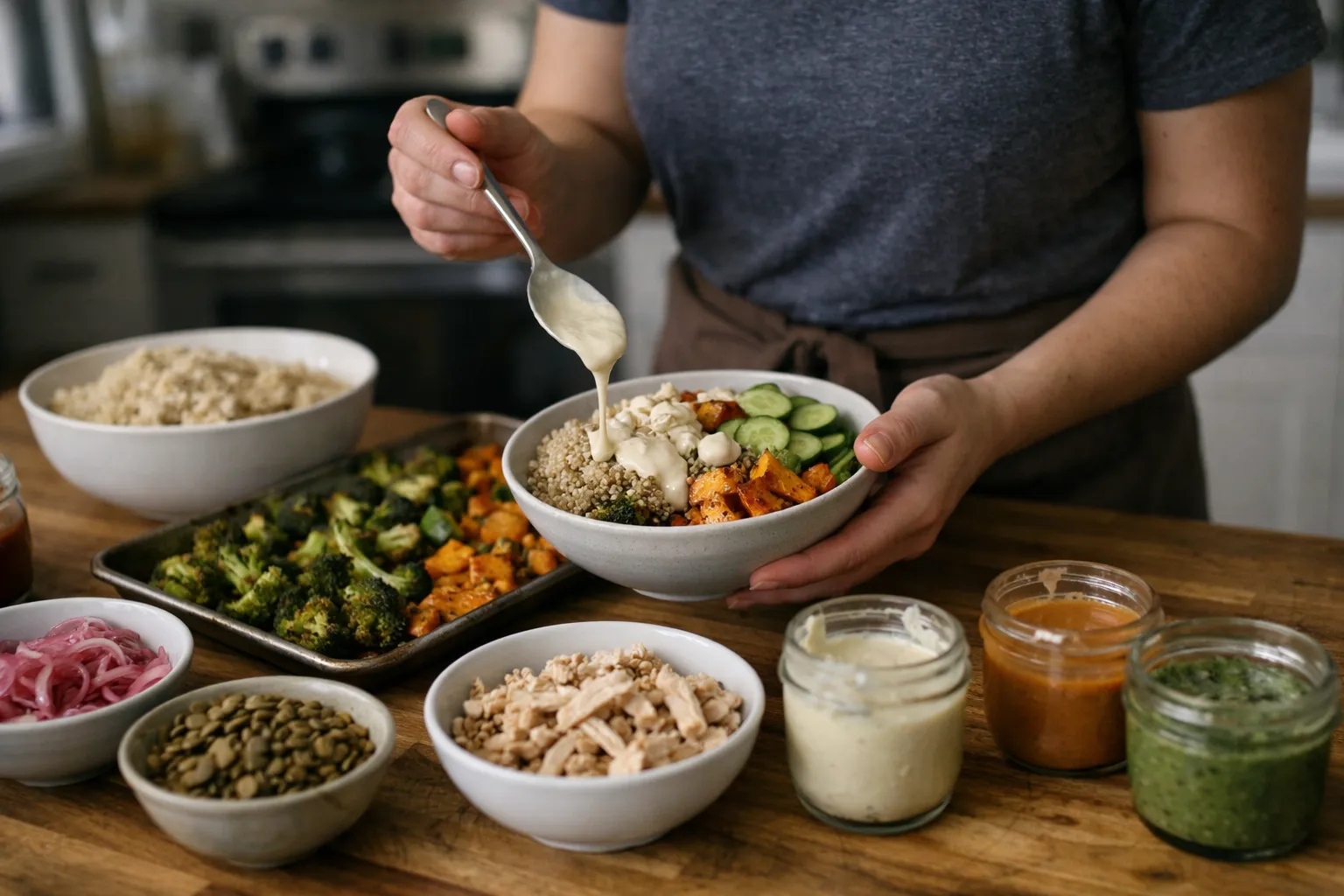
Step 5: Assemble like a restaurant (order and purpose)
- Warm base first: heated base helps sauce cling and releases steam that carries flavors.
- Protein next: place hot protein on the warm base so juices meld into the grain.
- Cooked veg one side, fresh/pickled the other: contrast in temperature, texture and acidity creates interest.
- Sauce in a ribbon: avoid drowning; serve extra on the side for picky eaters.
- Finish with crunch last: preserves texture; add herbs and finishing salt at the end.
For small gatherings, set sauces in labeled jars and provide small spoons—less mess, simpler allergy control.
Step 6: Three updated 30-minute bowl examples (copy/paste dinners)
Example A: Harissa-Sweet Potato + Black Bean Bowls (sheet-pan + air-fryer finish)
- Ingredients: brown rice pouch, sweet potato cubes, canned black beans (rinsed), bagged arugula, pepitas, lemon-tahini, harissa paste
- Method: roast sweet potato 18 minutes at 425°F; air-fry 3 minutes at 400°F for extra char. Warm beans and rice as directed. Toss beans with a spoon of harissa for heat.
- Serve: rice, beans, potatoes, arugula, sauce, pepitas.
Example B: Miso-Maple Salmon + Charred Broccolini (sheet-pan + steam-crisp)
- Ingredients: quinoa pouch, small salmon fillets, broccolini, cucumber, sesame seeds, ginger-soy dressing with a teaspoon miso and maple stirred in
- Method: roast broccolini 10 minutes, add salmon for final 8–10 minutes. If available, use steam-crisp to keep fillets moist and edges caramelized.
- Tip: use pre-portioned salmon or thawed frozen portions for speed.
Example C: Rotisserie Chicken Mediterranean Bowls (no-cook + heat)
- Ingredients: quick-cook barley or couscous, shredded rotisserie chicken, cherry tomatoes, quick-pickled red onion, cucumbers, labneh or herby yogurt, fried shallots
- Method: prepare grain, shred chicken, assemble, finish with herby yogurt and crunchy shallots.
- Dietary swap: use plant yogurt or tahini for dairy-free; swap quinoa for gluten-free.
Common mistakes (and how to fix them)
- Bowl tastes flat: Add acid—lemon, vinegar, or pickles—and a pinch of salt. A tablespoon of vinegar or a squeeze of lemon brightens most bowls.
- Everything is mushy: Add texture—toasted seeds, raw veg, or an air-fryer-crisped component.
- Grains clump: Salt cooking water; fluff with a fork and fold in 1 tsp oil or butter after heating.
- Protein is dry: Toss protein briefly in sauce before plating or slice thicker-cooked proteins against the grain to keep juices.
- Components sit out too long: Follow food-safety thresholds—hot above 140°F, cold below 40°F—and replenish from small hot/cold holding containers rather than leaving large trays at room temperature.
Pro tips for restaurant-quality bowls
- Season in layers: Salt at each cooking stage; finish with acid and flaky salt.
- Batch one component weekly: Cook a pot of grains and refrigerate in portioned containers—rotate proteins and sauces to keep meals interesting.
- 10-minute quick-pickle: Thin-sliced onions in 1:1 water:vinegar with 1 tsp salt and 1 tsp sugar—leave 10 minutes at room temperature for instant brightness.
- Use frozen smartly: Frozen broccoli, edamame and mixed veg are often flash-frozen at peak ripeness—roast or air-fry to restore texture.
- Date and label sauces: Most homemade sauces keep 3–5 days refrigerated; dairy-based spreads trend shorter—label jars with date and main allergen.
Your rights
You have the right to accurate food labeling and allergen information. In the U.S., the Food Allergen Labeling and Consumer Protection Act (FALCPA) requires packaged food to disclose the major food allergens (milk, eggs, fish, shellfish, tree nuts, peanuts, wheat, soy, and sesame). When serving guests, ask for ingredient lists on packaged items and decline to use any unlabeled product if allergies are a concern.
If you suspect a mislabeled product caused harm, document packaging (take photos), keep samples if possible, and record the date/time of illness and symptoms. Preserve receipts and batch codes. These steps matter if you consult an attorney—foodborne illness and allergen exposure can have legal remedies. For any legal action, consult a qualified attorney promptly; legal time limits and evidence preservation rules apply.
Next steps (what to do tonight)
- Pick one cooking method from Step 1 and commit to it—don’t try to run two new techniques at once.
- Check your pantry for one base, one protein and one crunchy topping. If missing, buy a microwave grain pouch, a can of beans, and a bagged slaw.
- Make one sauce from Step 4; store leftovers in a dated jar for up to 3–5 days depending on ingredients.
- If feeding people with allergies, keep components separated, label them, and provide serving utensils for each item. Keep hot items above 140°F and cold items below 40°F during service.
If you have a labeling question or suspect a product injury, consult a qualified attorney—this guide explains kitchen practice, not legal strategy.
FAQ
Can I make grain bowls without grains?
Yes. Use cauliflower rice, shredded cabbage, roasted winter squash or a large salad base. Replace the caloric density with a heartier protein—roasted tofu, tempeh, or beans—and choose a sauce with body (tahini or herby yogurt) to make the bowl feel substantial.
How long do homemade sauces keep in the fridge?
Generally 3–5 days refrigerated. Dairy-based sauces trend toward 3 days; acidic or high-salt dressings (tahini-, soy- or vinegar-based) often last longer. Date jars and smell before using; discard if off-odor or mold appears.
What’s the safest way to run a bowl bar for guests?
Keep hot items above 140°F and cold items below 40°F. Replenish small serving dishes from hot or cold holding sources rather than leaving large trays at room temperature. Label everything for allergens and provide separate utensils for each component.
Are frozen vegetables as good as fresh for bowls?
For most bowls, yes. Many frozen vegetables are flash-frozen at peak ripeness and retain nutrients and texture when cooked properly. Use higher heat (roast or air-fry) to restore texture and finish with acid or sauce to lift flavor.
How can I get extra crisp on roasted vegetables quickly?
After roasting, transfer small batches to an air-fryer for 2–4 minutes at 400°F, or use a broil/steam-crisp function for 1–2 minutes while watching closely. Don’t overcrowd pans—crowding steams vegetables and prevents browning.
Kitchen note: The single most important habit for weeknight bowls is planning one component ahead. Whether it’s a batch of cooked grains or a jarred sauce, that one prepared item reduces friction—and you’ll actually finish dinner in 30 minutes.
Final note: Use convenience smartly, keep sauces labeled and dated, and respect food-safety thresholds when serving. If you need legal guidance about allergen disputes or food-related injury, consult a qualified attorney. Otherwise: pick a method, pick a sauce, and build tonight’s bowl.