Advanced driver‑assist systems (ADAS) — lane keeping, adaptive cruise, hands‑free highway driving and automatic emergency braking — are now standard or optional across most makes in 2026. For enthusiasts who value safety and convenience, these systems can be a major buying factor. But ADAS adds complexity: different architectures, software versions, calibration needs, transferable warranties and insurance implications.
This guide walks you, step‑by‑step, through researching, inspecting, testing, documenting and negotiating the purchase of a car that relies on ADAS. The guidance applies to new and used buys: sedans, SUVs and light trucks equipped with systems such as GM Super Cruise, Ford BlueCruise, Tesla Autopilot/Full Self‑Driving, Honda Sensing, Nissan ProPILOT, and Tier 2 camera/radar packages from European and Asian makes.
1. Before you shop: research and decision points
Start by framing how you plan to use ADAS. That determines which features matter and which trade‑offs are acceptable.
- Daily highway driver: Prioritize reliable adaptive cruise with robust lane centering, lane change assist and hands‑free operation on mapped highways (e.g., Super Cruise, BlueCruise).
- City commuter: Focus on low‑speed systems — robust automatic emergency braking (AEB), traffic jam assist and accurate pedestrian/cyclist detection.
- Value buyers: Prefer proven camera+radar systems with low repair cost and wide parts availability; avoid solutions that depend on proprietary sensors with high replacement cost.
Key research steps:
- Compare vendor approaches: vision‑only (Tesla), camera+radar, lidar‑assisted or tightly mapped highway systems. Each has different strengths and failure modes.
- Check whether core ADAS features are hardware-locked or subscription-based for your model year. If a feature is subscription‑only in 2026, plan for ongoing cost or seek cars with features included.
- Read owner forum threads and recent tests for the specific model year. ADAS behavior changes significantly with software updates, sometimes year‑to‑year.
- Use NHTSA recall database (nhtsa.gov/recalls) and OEM technical service bulletins (TSBs) to look for ADAS‑related recalls or fixes tied to VIN ranges.
2. Documents and records to request from seller or dealer
Documentation is central to validating an ADAS‑equipped car. Ask the seller for:
- Service and calibration records: Records showing windshield replacements, sensor recalibrations, camera/radar repairs, and wheel alignments after ADAS‑relevant work. OEM shop invoices are best.
- Software update history: If available, logs showing major ADAS firmware updates and dates. Some OEMs include update history in service printouts or via the infotainment system.
- ADAS enablement receipts: Proof of purchase/activation for manufacturer paid features (hands‑free subscriptions, extended ADAS packages) and whether the feature transfers to a new owner.
- Recall completion proofs: Documentation proving any safety recalls — especially ADAS‑related — were repaired before sale.
- Pre‑purchase inspection (PPI) report: If buying used, a PPI from a shop experienced with ADAS is invaluable.
3. On‑lot/curb inspection checklist (physical and visual)
Before you start the engine, do a physical inspection targeted at ADAS components.
- Windshield condition and seals: Many camera systems are mounted behind the windshield. Look for aftermarket replacements without calibration sticker or missing OEM adhesive markers.
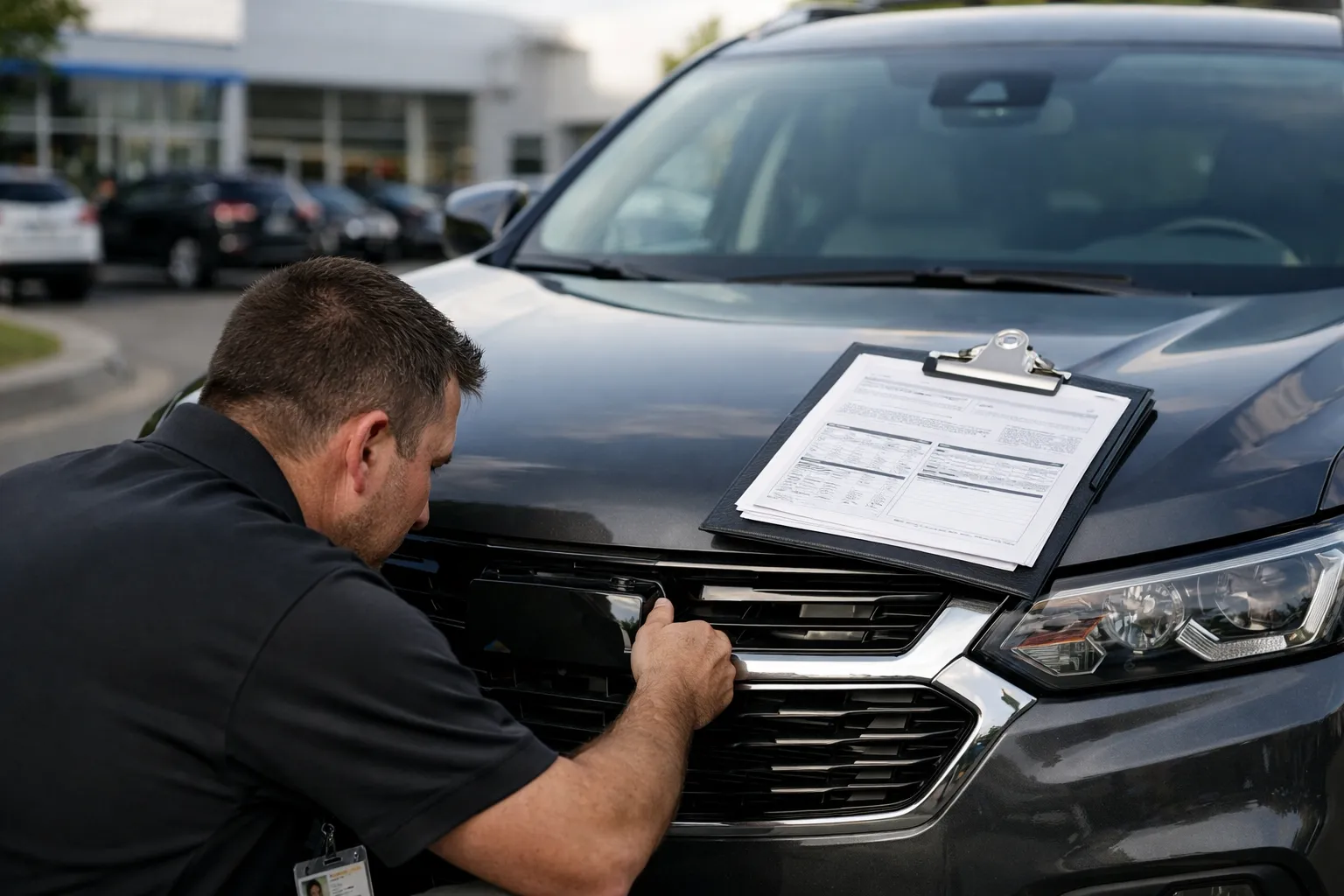
- Front fascia and grille: Inspect radar sensors (clear capsule or embedded behind grille) for damage, dents or aftermarket parts.
- Cameras and housings: Check for cracked housings, fogging, or misaligned trims near windshield camera modules or mirror housings.
- Sensors cleanliness: Mud or tape on sensors is a red flag. Ask seller why sensors were covered or blocked.
- Aftermarket modifications: Aftermarket bumpers, suspension changes or non‑OEM windshields often require ADAS recalibration. Verify any modifications were professionally handled.
4. A scripted test drive for ADAS (what to try and what to watch)
Plan a 30–45 minute test drive that includes highway and urban sections. Use this script to evaluate system behavior and consistency:
- Baseline controls check: Start the car and verify ADAS status messages on the instrument cluster/infotainment. Check for persistent warnings, yellow or red alerts, and check‑engine or ABS lights.
- Adaptive cruise control (ACC): Engage ACC at highway speeds. Note how the vehicle follows lead cars, responds to cut‑ins and accelerates back to set speed. Look for smoothness, false braking, or delayed responses.
- Lane keeping/lane centering: Observe lane‑keeping in varied lane widths and on gentle curves. Does the system pull or oscillate? Does it require frequent steering torque prompts?
- Hands‑on detection: If the system requires hands on the wheel, test how quickly it warns and how intrusive the alerts are. For hands‑free systems, test transitions entering/exiting mapped zones.
- Night and complex lighting: If possible, try low‑light conditions or bright sunlight with shadows. Note AEB false positives or failures to detect pedestrians or cyclists.
- Parking and low‑speed assists: Test parking sensors, rear cross traffic alert and automatic braking at low speed in a safe lot.
Document inconsistencies: time, location and behavior. If the system shows intermittent faults or requires constant steering corrections, budget for diagnostic work or a recalibration.
5. Technical checks an independent inspector should run
For used buys, have an ADAS‑experienced technician run the following checks during a PPI:
- OEM diagnostic scan for ADAS error codes and sensor health. This will reveal logged faults even if warning lights are off.
- Verification of camera/radar calibration status and records for recent calibrations (post‑windshield or front‑end work).
- Wheel alignment check — misalignment can degrade lane‑keeping and camera calibration.
- Functional verification of parking sensors and surround‑view cameras (if equipped).
- Test for structural or front‑end repairs that might have altered sensor mounting geometry.
6. Cost expectations and typical repairs (2026 price guidance)
Costs can range widely depending on OEM and sensor type. Typical 2026 ballpark figures (U.S. market):
- Windshield replacement and OEM camera recalibration: $250–$900 (calibration complexity and dealer vs independent shop influence price).
- Radar sensor replacement and recalibration: $600–$1,800 (radar modules and dealer labor drive cost up).
- Front camera assembly replacement: $300–$1,200 depending on make and if LiDAR is present.
- Software reflash or OTA update at dealer: free to several hundred dollars depending on warranty status and OEM policy.
Always ask for OEM parts pricing during negotiation and check if repairs are covered under remaining factory warranty or extended coverage.
7. Insurance and regulatory considerations
ADAS affects premiums and liability.
- Insurance discounts: Many insurers in 2026 offer discounts for verified AEB, lane‑keep and adaptive cruise. Request insurer pre‑approval letters or discount manuals and include them in your buying calculus.
- Claims and liability: Documented ADAS tampering, missing parts or unreported crashes that affected sensors can complicate claims. Insurers may require proof of proper recalibration after windshield or sensor work.
- State laws: Hands‑free rules vary by state. Some states require visual or audible monitoring; others ban certain ADAS behaviors. Confirm local regulations for the features you plan to use.
8. Transferability and subscriptions — what to confirm
Many OEMs now sell ADAS features as standard hardware with software locks or optional subscriptions. Before you buy, confirm:
- Which features are permanently enabled versus subscription‑based on that VIN.
- Whether subscriptions transfer automatically, require account transfer, or will terminate at ownership change. Ask for written confirmation from the dealer or a copy of OEM transfer policy.
- Whether there are known upcoming software changes or sunset policies that could alter feature availability.
If a key feature is subscription‑only and the seller won’t transfer or prepay it, factor the subscription cost into total ownership.
9. Red flags that should pause the deal
- Unclear or missing calibration/service records after windshield or front‑end repair.
- Persistent or historical ADAS error codes on a diagnostic report.
- Extensive front‑end repairs without OEM-level documentation; even quality repairs can disrupt sensor geometry.
- Seller admits to “disabling” or “covering” sensors to avoid warnings.
- Subscription features that cannot be transferred or lack clear pricing for activation.
10. Negotiation checklist and contract language to request
Use these items when structuring the deal or asking for repairs:
- Request a written clause in the purchase contract confirming all ADAS systems are functional and that any ADAS‑related recalls have been completed.
- Ask the seller to pay for a PPI from an ADAS‑experienced shop or to reduce the sale price by a repair estimate.
- For dealer sales, demand a printout of software/firmware versions and a promise to update to the latest OEM ADAS software before delivery, or a credit if you’ll handle it yourself.
- When subscription features matter, include language spelling out transfer terms or a credit equal to one year of the subscription price.
Final checklist before signing
- VIN‑specific NHTSA recall check completed and any recalls repaired.
- Service and calibration records provided and verified.
- Independent diagnostic scan shows no unresolved ADAS fault codes.
- Test drive demonstrated consistent system behavior in multiple conditions.
- Contract includes ADAS condition language and agreed repairs/credits.
- Insurance quotes reflect any ADAS discounts you expect to receive.
Buying a car with ADAS in 2026 adds both opportunity and complexity. These systems can meaningfully reduce stress and accident risk — but only if they’re functioning, properly calibrated and supported. Use the research, inspection and negotiation steps above to de‑risk the purchase and make an informed, confident buy.
If you’d like, we can generate a printable ADAS inspection checklist or a templated ADAS disclosure clause you can include in a purchase contract.