Overview
Enterprises revisiting ERP strategy in July 2026 face clearer trade-offs than in earlier cycles. The debate—stick with a vendor monolith or build a composable ERP from best-of-breed modules—remains central to cost, agility and compliance decisions. Since mid-2025, three developments have sharpened the calculus: (1) production-grade event streaming and observability tooling have matured, (2) AI is changing how teams handle integration and incident response, and (3) procurement and regulatory pressures (data portability, vendor resilience) increasingly favor modularity in some contexts. This update summarizes the state of play, current patterns, measurable signals to track, and precise recommendations for enterprise architects and procurement teams.
Background: what changed since the original analysis
The core definitions are unchanged: composable ERP assembles discrete services (ledger, procurement, inventory, payroll, tax, pricing, order management) connected via APIs, events and orchestration; monolithic suites provide end-to-end, tightly integrated modules from one vendor. What’s changed since early 2026:
- Event-driven architectures and managed streaming (Kafka-as-a-service, cloud-native Pulsar offerings) became operationally mainstream in large enterprises, reducing earlier reliability objections to eventual consistency.
- Integration platforms (iPaaS) matured to include AI-assisted mapping and automated contract testing; this lowers the labor cost of integration but shifts work into governance and policy control.
- Regulatory focus on data portability, supply-chain resilience and third-party risk has nudged procurement to demand composability clauses and data-exit plans as standard contract terms.
Data and evidence: real-world signals to weigh
The qualitative signals below are observable in procurement and architecture conversations across sectors in 2026:
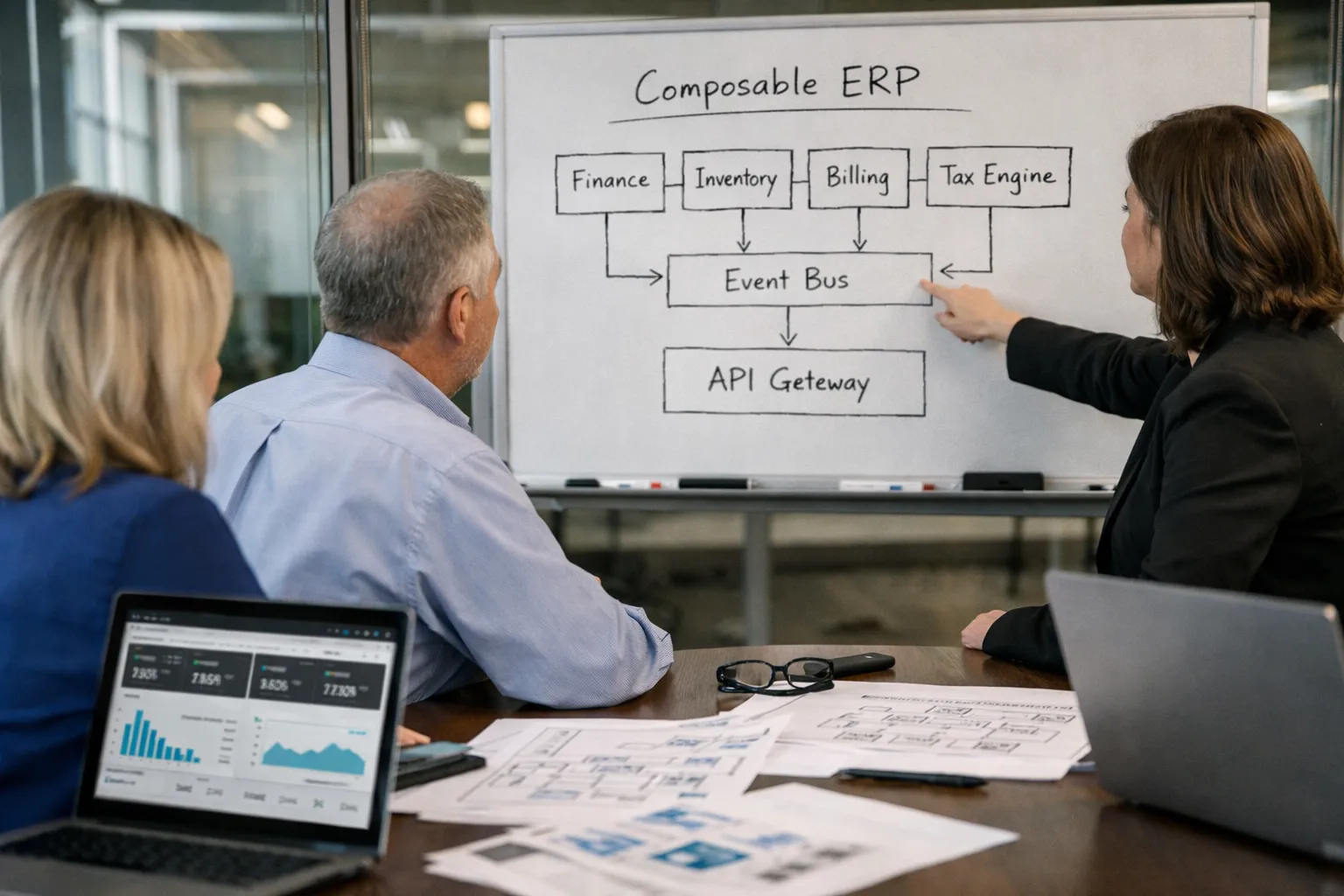
- Vendor pairing patterns: enterprises commonly retain a core financial ledger from a Tier‑1 vendor (SAP S/4HANA, Oracle Fusion, Workday Finance) while composing peripheral services: Avalara/Vertex for tax, Stripe Billing or Zuora for subscription billing, commercetools or Shopify Plus for commerce front ends, and ADP or localized payroll partners where needed.
- Integration fabrics are standardized: Confluent (managed Kafka), cloud provider streaming services, and iPaaS platforms such as MuleSoft, Dell Boomi and Workato are the recurring choices for orchestration and transformation.
- Observability platforms (OpenTelemetry-based traces, vendor APMs, and data-lineage tools feeding into Snowflake or Databricks) are now prerequisites—teams explicitly budget for SRE and observability licenses during procurement rounds.
- AI as an operational lever: LLMs are used to accelerate schema mapping, draft API contracts, and triage incidents; these tools reduce time-to-diagnosis but do not replace the need for API SLAs and deterministic tests.
Because vendor ecosystems and integration tooling matured, the relative cost of integration has shifted from a show-stopping unknown to a controlled line item—provided organizations invest deliberately in governance, observability and SRE. That shift is the most consequential market change of 2026.
Multiple perspectives: what stakeholders are saying
Architects: Favor composability when product differentiation or fast M&A-driven restructuring is a high priority. They emphasize "composable core" approaches—retain a lightweight core ledger; compose everything else.
Finance and compliance: Often prefer monoliths for centralized statutory reporting and audit trails. Their concern is not only features but auditability and vendor accountability for aggregated financial controls.
Procurement: Increasingly demands contractual composability clauses—data portability, API uptime SLAs, defined export formats and third-party dependency disclosure. Procurement teams report shorter negotiations when vendors accept these clauses.
SRE and Ops: Point to the need for centralized observability and runbooks. Their view: composability works if the organization treats integration as an operational product with dedicated SRE support, not a one-off IT project.
Integration: what works today (practical patterns)
- API-first contracts plus contract testing: Define OpenAPI or gRPC contracts, and automate contract tests in CI/CD so downstream modules break-fast rather than fail in production.
- Event-driven system-of-record alignment: Use managed streaming (Confluent, cloud-native alternatives) and change-data-capture (CDC) for reliable state propagation. Implement idempotency and versioned events to handle schema drift.
- iPaaS + API gateway: Use a hosted iPaaS for transformations and a gateway for auth, rate limiting, and observability. Centralize common policies (auth, encryption, PII masking).
- Federated data and data mesh practices: Apply Zhamak Dehghani-style domain ownership — each team publishes standardized metadata, lineage and SLAs so analytics teams can consume cross-domain reports without ad hoc ETL.
- AI-assisted mapping and observability: Use LLM tools to propose schema mappings and generate runbooks, but require human validation and automated tests before deployment.
Scalability trade-offs in 2026
Two updated trade-offs matter most:
- Cost granularity: Composable ERP lets you right-size individual workloads (billing-heavy subsystems can scale, while HR stays low-cost). But cloud egress, cross-region data replication and many small vendor fees add complexity to TCO models.
- Organizational scaling: Monoliths simplify cross-functional processes because the vendor owns cross-module flows; composable setups force clear domain boundaries and product teams—this is an organizational design choice as much as a technical one.
Implementation realities and hidden costs (updated)
New hidden costs and operational realities to budget for in 2026:
- Continuous API and event-schema governance: treat schema registry, deprecation windows and consumer-testing as recurring work.
- Cross-vendor incident choreography: runbooks and playbooks must include vendor support tiers and escalation ladders; expect multiple vendors to be engaged in a single outage.
- AI-tool validation overhead: LLMs may suggest mappings or remediation steps; teams must verify outputs for correctness and compliance.
- Data residency and export costs: multi-region, hybrid cloud deployments can produce non-trivial export/egress charges and compliance overhead.
Measuring ROI: updated metrics and an actionable approach
Metrics should be multidimensional and tracked per-module and for the integration fabric:
- Module-level TCO: license, cloud runtime, integration connectors, SRE hours, vendor support.
- Time-to-value (TTV) per slice: weeks-to-months for composable modules vs months-to-years for large monolithic rollouts—track business KPIs (DSO, fill-rate, payroll accuracy) tied to each slice.
- Operational MTTR and blast radius: mean time to detect/repair and number of downstream consumers affected by a failure.
- Feature velocity per domain: number of releases or regulatory country launches per quarter and cost per launch.
- Contractual exit cost: fees, data transform costs and time to export for each vendor—measure in a standardized "time-to-exit" and dollar estimate.
Run scenario-based models: compare a monolith baseline to a phased composable roadmap; include sensitivity for cloud unit costs, additional observability/SRE headcount, and vendor connector fees.
When composable is the right choice in 2026
- You need frequent, localized feature divergence (different product lines or country-specific processes) and a rapid cadence of launches.
- You have engineering and SRE capability to run distributed systems, CI/CD, and governance around APIs and events.
- You can quantify and accept the recurring cost of integration and multi-vendor operations because the business benefit (faster launches, reduced M&A carve-outs) outweighs it.
- Your procurement strategy includes active vendor lifecycle management and required composability contractual clauses.
When monolithic suites remain preferable
- Regulated, centralized finance or statutory reporting is the dominant requirement, and auditability plus a single vendor accountability model reduce risk.
- The organization lacks capacity to operate an integration fabric and prefers vendor-managed SLAs and end-to-end support.
- Cost models favor a bundled vendor license and lower internal engineering investment.
Practical recommendations for enterprise teams (updated checklist)
- Make integration-first decisions: define API/event contracts, monitoring SLAs and failure modes before buying modules.
- Pilot a bounded slice with measurable KPIs: order-to-cash for one product line or subscription billing for a single region, instrumented with observability and ROI tracking.
- Invest in an integration product team: platform engineers, API product managers, SREs, and a compliance owner to manage contracts and data residency.
- Use incremental ROI models: compare TTV, post-deployment operational costs and vendor exit costs per module before proceeding to the next purchase.
- Negotiate composability clauses: data portability, API availability SLAs, and clear hand-off points for support during incidents.
- Consider a hybrid "composable core": keep statutory finance in a monolith while compositing customer-facing and high-throughput functions.
- Adopt data mesh practices and register domain contracts; require lineage and schema metadata as part of vendor deliverables.
Implications
Through mid-2026 the strategic choice between composable ERP and monolithic suites is less binary. Technical maturity in streaming, iPaaS, observability and AI-assisted tooling reduces integration risk—but does not remove the need for sustained operational investment. Composability rewards organizations that can institutionalize integration governance, SRE practices and procurement discipline. Monoliths still provide a low-friction option for global finance and tightly controlled regulatory contexts.
Outlook: what to watch next
- Standardization moves: watch for industry consortia and common contract templates that reduce bespoke API negotiation overhead.
- Vendor behavior: Tier‑1 ERP vendors will continue to offer packaged "composable" connectors and more modular licensing—evaluate whether these are functional modularity or marketing repackaging.
- AI and automation: LLM-driven mapping and remediation will improve productivity but also require governance; measure both time saved and validation overhead.
- Regulatory changes: evolving data portability and third-party risk rules will affect exit-cost assumptions—keep legal and procurement close to architecture decisions.
How should teams start this quarter?
Begin with a two-quarter pilot: define contracts, provision a managed streaming backbone, adopt OpenAPI contracts and deploy a minimal SRE rota. Instrument TTV and MTTR for that pilot and use results to inform whether to accelerate composable procurement or consolidate around a monolith.
FAQs
Is composable ERP just a trend, or is it here to stay?
Composable ERP is a durable architectural approach for organizations that require functional differentiation, rapid M&A integration or isolated high-throughput workloads. Its staying power depends on whether organizations invest in integration governance, SRE and data practices. For enterprises prioritizing simplicity and centralized compliance, monoliths remain a valid long-term choice.
How much additional staffing should we expect for a composable approach?
Plan for an integration/product platform team (API product manager, platform engineer, 2–3 SREs depending on scale), plus ongoing API governance and vendor management. The exact headcount depends on volume and number of distinct vendors, but treat this as a recurring operational cost—not a one-time implementation expense.
What are the quickest wins to justify a composable pilot?
Target a high-impact, well-bounded domain: subscription billing for a single product line, order-to-cash for a test SKU, or a tax-engine replacement for one jurisdiction. These slices typically deliver measurable KPI changes (revenue recognition speed, invoice automation, tax accuracy) within 3–6 months.
Can we mix a monolith for finance with composable customer-facing systems?
Yes. The "composable core" hybrid is a pragmatic pattern: retain a robust, vendor-managed finance/statutory core while composing peripheral modules (commerce, billing, tax engines). This balances auditability and flexibility, provided you architect reliable integration and clear ownership boundaries.