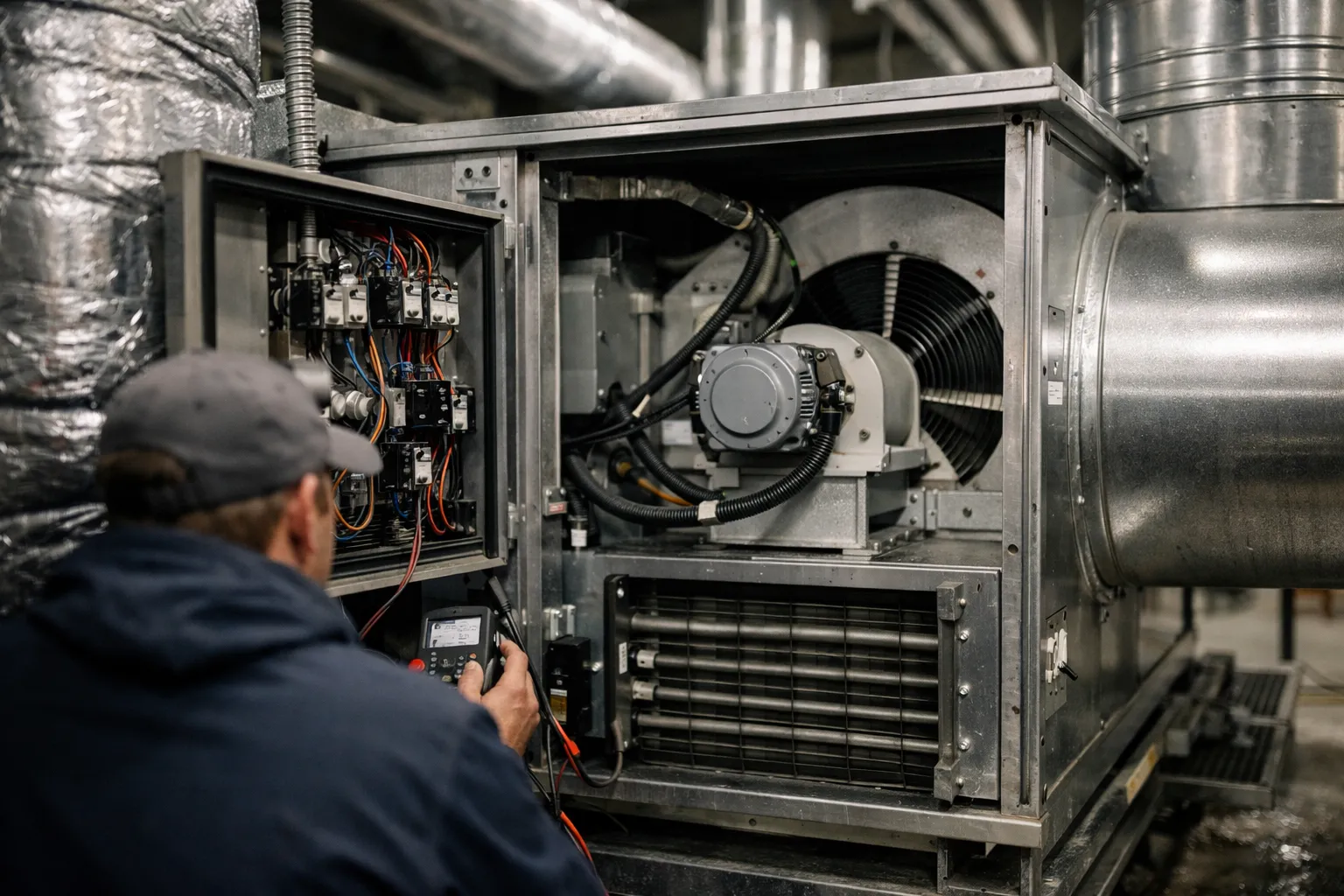
Electrified make‑up air units (eMAUs) are now a mainstream, code‑driven option for commercial kitchens aiming to eliminate onsite fossil combustion and capture recovered energy. This updated Sept 2026 guide brings the original July 2026 roadmap current: it adds practical guidance on low‑GWP refrigerants and A2L safety, recent market and incentive trends, proven controls advances (IoT and predictive BAS), and fresh commissioning and O&M priorities needed for reliable operation today.
Who this is for: HVAC system designers, consulting engineers, rooftop unit specifiers, facility managers, and HVAC enthusiasts responsible for commercial kitchen ventilation. You will get actionable steps for sizing, selecting, integrating, and commissioning eMAUs—plus the "why" behind each recommendation so you can justify choices to owners and AHJs.
Prerequisites and context — what changed by Sept 2026
- Market and policy: Through 2024–2026 utilities and state programs expanded electrification rebates for commercial kitchens; owners now commonly stack federal tax incentives (where applicable) with state/utility rebates and point‑of‑sale manufacturer discounts. Early coordination to capture incentives materially affects payback math.
- Refrigerants: Many manufacturers now ship commercial heat pumps with lower‑GWP, mildly flammable A2L refrigerants (e.g., R‑454B/R‑452B variants). That introduces code and AHJ safety requirements (leak detection, mechanical room considerations, and rooftop installation practices).
- Controls and digital ops: Remote commissioning, over‑the‑air firmware updates, and AI‑assisted BAS analytics for predictive defrost and fault detection are common. These reduce downtime but require cybersecurity and data‑access coordination with owners.
- Performance expectations: Inverter‑driven commercial heat pumps are delivering better COP at low ambient than five years ago, but real-world COP varies widely with defrost frequency, ERV strategy, and kitchen latent load.
Step 1 — Define project parameters and constraints
- Confirm hood schedule and peak exhaust CFM: Match peak hood exhaust and review hood type (Type I vs Type II). Document hood controllers (VFD or variable exhaust) and whether demand control ventilation (DCV) is installed.
- Operating profile and economics: Record hours at peak, medium, and idle cooking. Create an annual load profile—eMAU sizing and incentive eligibility often depend on annual consumption and peak demand.
- Site constraints and service capacity: Verify rooftop footprint, curb types, structural capacity, crane access, and electrical service available. Early electrical coordination avoids late-stage service upgrades that can delay incentives.
- Regulatory and AHJ checkpoints: Identify NFPA‑96 obligations, local mechanical code amendments, and AHJ policies on refrigerant types and rooftop A2L usage. Early AHJ conversations reduce rework.
Step 2 — Sizing: sensible load math and what to check
Use the familiar ventilation sensible heat equation, then layer in energy‑recovery and latent loads:
Q (Btu/h) = 1.08 × CFM × ΔT
Example (updated for Sept 2026): a restaurant with 4,000 CFM, outdoor design temperature 15°F, supply target 55°F (ΔT = 40°F):
- Q = 1.08 × 4,000 × 40 = 172,800 Btu/h ≈ 14.4 tons
Key additions to the classic math:
- Energy‑recovery: Subtract sensible recovered heat (e.g., a plate ERV with 55% sensible effectiveness reduces the heat pump sensible load by ~95,000 Btu/h in the example).
- Latent loads: Kitchens add moisture and grease—estimate latent capacity separately (lb/h) and confirm heat‑pump coil and ERV selection handle dehumidification without oversizing cooling capacity.
- Defrost and auxiliary heat: Size heat pump with headroom to maintain supply temperature during defrost; specify auxiliary electric or hydronic backup as needed to meet code‑required makeup air delivery during defrost.
Step 3 — Energy‑recovery strategy: updated guidance
Energy recovery remains the single biggest lever to reduce heat‑pump capacity and operating cost, but the tradeoffs in 2026 emphasize maintenance, IAQ risk, and ERV material compatibility with grease:
- Plate sensible exchangers: Still the default for Type I hoods because they isolate streams and are easy to wash. For high‑grease kitchens, specify stainless faces and accessible, removable cores.
- Enthalpy/enthalpy‑with‑desiccant: Useful in hot‑humid climates to control latent loads. Where desiccant media is used, require sealed housings and accessible media changeouts; avoid media that adsorbs grease.
- Rotary wheels: Efficiency is excellent, but odor transfer and grease buildup remain critical concerns. In 2026 many AHJs prohibit wheels on Type I exhaust without washable housings and enhanced filtration—confirm early.
- Heat pipes and run‑around loops: Lower maintenance risk and no cross‑contamination; they provide modest recovery and are a conservative choice where grease or odor control is paramount.
Step 4 — Heat‑pump configurations and refrigerant strategy
Options and updated considerations:
- Packaged DX eMAU: Rooftop unit with integrated heat pump. Pros: compact, factory controls. New consideration: many packaged units use A2L refrigerants in 2026—project teams must address leak detection, signage, and AHJ acceptance.
- Hydronic heat pump with AHU coil: Centralizes refrigerant in one location (indoor machine room) and sends hot water to MAU coils. Pros: allows use of low‑GWP refrigerants with lower rooftop refrigerant charge and simplified rooftop unit classification.
- Split systems: Rooftop air handler with remote condensing unit (or two-stage compressors) can help with rooftop charge limits and service access.
Design tips (2026):
- Specify inverter (variable‑speed) compressors and modulating valves to match variable hood ventilation and reduce short cycling.
- Require manufacturers to provide certified low‑ambient performance curves (capacity and COP down to the site's coldest design temperature) and include defrost energy and time‑in‑defrost assumptions in annual energy modeling.
- Plan for refrigerant class: if A2L is used, add gas detection, mechanical ventilation rates, and electrical classifications per local code; consider hydronic option where AHJ acceptance is uncertain.
Step 5 — Controls, integration, and digital operations
Controls remain critical; in 2026 the emphasis is on integrated, secure digital operation and predictive sequences:
- Hood interlock and DCV—supply must track exhaust and prevent negative pressurization. Require fail‑safe modes that default to sufficient makeup air if communications fail.
- Supply VFD and duct static feedback—modulate supply to maintain target static and avoid overpressurization of adjacent spaces.
- Defrost coordination—ensure defrost sequences are visible to BAS, and that auxiliary heat is staged to maintain supply during defrost. Require a minimum supply temperature margin for occupant comfort during defrost events.
- AI‑assisted predictive maintenance—use BAS analytics to predict coil fouling and flag rising compressor run hours or excessive defrost frequency. Include data‑privacy and cybersecurity requirements in the contract.
- Refrigerant leak detection and AHJ reporting—where A2L refrigerants are used, integrate gas detectors into the control system with staged alarms and automatic isolation sequences.
Step 6 — Filtration, grease management, and IAQ (practical details)
Layered filtration is non‑negotiable for longevity and IAQ:
- Prefilters (30–40% MERV or washable grease mesh) at hood capture large droplets; place them ahead of energy‑recovery and coils.
- Secondary filtration MERV 8–11 upstream of heat pump coil. If MERV 13 is required for IAQ, design extra fan capacity and larger filter racks to prevent excessive pressure drop.
- Specify removable, wash‑compatible housings for ERVs and coils where grease loading is high; require scheduled washdown access and wash hookup details.
- Condensate design: slope pans, multiple drains, and trapped/insulated drain piping. For cold climates, include heated drain pans or freeze‑protected traps.
Step 7 — Freeze protection and defrost strategies
In 2026, practical freeze protection includes both hardware and control strategy:
- Place heating coil upstream of ERV if ERV freeze is the primary failure mode; alternatively, sequence ERV bypass with preheat to protect cores.
- Use demand‑based defrost (only when necessary) rather than timed defrost to reduce energy and preserve capacity. Require manufacturers to provide defrost energy and time‑in‑defrost data for site modeling.
- Provide auxiliary heat sizing sufficient to meet makeup air setpoint during the longest likely defrost event plus an emergency safety margin defined with the owner.
Step 8 — Commissioning checklist (updated for 2026)
Commissioning must be explicit about digital systems and refrigerant safety:
- Airflow: measure supply and exhaust at full and typical loads; validate pressure relationships under varying hood states and confirm hood interlock behavior.
- Heating capacity: verify supply air temperature rise at design CFM, and test with ERV engaged and bypassed to confirm modeled outcomes.
- ERV effectiveness: measure entering/leaving dry‑bulb and wet‑bulb temps to calculate sensible and latent effectiveness. Record before/after cleaning baselines.
- Controls: test BACnet/IP or Modbus integration, hood interlocks, defrost coordination, gas‑detector interlocks (if A2L), and BAS alarm routing for remote alerts.
- Refrigerant safety: test gas detection points, alarm thresholds, and automatic isolation sequences. Provide AHJ with documentation of leak detection calibration.
- Cybersecurity: verify device firmware versions, change default passwords, and document remote access policies and data retention.
Common field pitfalls (2026 update) and how to avoid them
- Late AHJ engagement on refrigerants: Starting A2L discussions late causes costly rework. Avoid it by specifying refrigerant class in the contract phase and confirming AHJ acceptance early.
- Underestimating grease loading: ERVs and heat wheels still fail prematurely without robust filtration and wash access—factor higher maintenance costs into lifecycle estimates.
- Poor control sequencing for defrost: If auxiliary heat and defrost schedules aren't coordinated, kitchens can experience unsafe negative pressure or cold supply air—exercise sequences in commissioning.
- Neglecting data and cyber provisions: Remote features are valuable but require clear ownership of credentials, firmware updates, and logging to avoid service disputes.
Pro tips — advanced advice from recent projects
- When rooftop space is constrained and A2L is uncertain, consider a remote hydronic chiller/heat pump inside a mechanical room with small refrigerant charge to rooftop coils—this eases AHJ concerns and simplifies rooftop classification.
- Specify trend‑logging of coil face‑temperatures, filter DP, and defrost cycles for the first 12 months; use those logs to refine maintenance intervals and validate incentive claims.
- For high‑turnover kitchens, require quick‑release panels and walkways in the spec to prevent deferred maintenance caused by inaccessible equipment.
Real‑world example: updated 4,000 CFM rooftop eMAU (Sept 2026)
- Design exhaust: 4,000 CFM (Type I hoods), variable exhaust with hood demand control
- Climate: cold city, winter design 15°F
- Sensible heating load: 1.08 × 4,000 × 40°F = 172,800 Btu/h (~14.4 tons)
- Energy recovery: plate heat exchanger with 55% sensible effectiveness → heat‑pump sensible requirement ≈ 77,760 Btu/h
- Heat pump selection: inverter DX rooftop unit nominal 90,000 Btu/h capacity at design conditions, factory‑commissioned, using a low‑GWP A2L refrigerant per manufacturer standard; hydronic option included as alternate in bid for AHJ negotiation.
- Controls: integrated VFD supply fan, hood interlock, BAS via BACnet/IP, gas detectors tied to automatic isolation (if A2L used), filter DP alarms, remote monitoring subscription for first‑year warranty period.
- Filtration: washable grease mesh at hood, prefilter 30–40% MERV, secondary MERV 8 ahead of coil; specify larger filter surface area to keep DP 0.5" w.g. at rated flow.
Operations & maintenance — what to specify in contracts
Set owner expectations up front:
- Specify a first‑year maintenance contract that includes quarterly coil and ERV inspections and washdowns for Type I kitchens.
- Define KPIs to monitor: supply temperature stability (±3°F), annual kWh, seasonal COP, and defrost hours. Tie warranty milestones to logged performance.
- Include training sessions for owner staff on filter change, basic diagnostics, and emergency sequences (hood fail safe, gas detector response).
FAQ: Common questions
Can I avoid A2L refrigerants on rooftop eMAUs?
Yes—options include specifying hydronic heat pumps with small refrigerant charge centralized indoors or selecting manufacturers offering non‑A2L (higher‑GWP) options where AHJ acceptance is an issue. However, A2L refrigerants are becoming standard for improved efficiency and lower lifecycle GWP—plan for leak detection and AHJ coordination if you opt for them.
How do I size auxiliary heat for defrost events?
Size auxiliary heat to maintain supply setpoint during the manufacturer's worst‑case defrost time plus a safety margin (commonly 10–20%). Verify during commissioning by forcing defrost while measuring supply temperature. Also ensure the control sequence engages auxiliary heat quickly to prevent kitchen pressurization or occupant discomfort.
What are realistic COP expectations in cold climates?
Modern inverter commercial heat pumps typically show seasonal or site COPs between roughly 2.0 and 3.5 at commercial kitchen operating points, but real performance depends on defrost frequency, ERV strategy, and latent loads. Use manufacturer certified low‑ambient performance curves and include defrost energy in your modeling.
How often should ERVs and coils be cleaned in a busy kitchen?
Cleaning frequency varies by cooking volume, but plan for monthly visual checks and quarterly deep clean for high‑volume Type I kitchens. Use trend logs (filter DP and coil exit temperatures) to set service triggers rather than fixed intervals alone.
Are there specific commissioning deliverables I should require?
Require airflow reports at multiple hood states, supply temperature verification with ERV engaged and bypassed, ERV effectiveness calculations, control sequence verification (including defrost and leak‑detection tests), and 12 months of trend logging handed to the owner at project closeout.
Further reading and resources
- NFPA‑96: Standard for Ventilation Control and Fire Protection of Commercial Cooking Operations
- Local mechanical codes and AHJ guidance on refrigerant classification and rooftop installations
- Manufacturer installation, commissioning, and low‑ambient performance data sheets
Wrap‑up: As of Sept 2026, eMAUs are a practical way to decarbonize commercial kitchen ventilation—but success requires early AHJ coordination on refrigerant choices, a conservative energy‑recovery strategy for grease management, robust controls and digital monitoring, and an explicit commissioning and O&M plan. Address those decision points up front and you'll avoid the common field pitfalls that still derail otherwise well‑designed systems.