
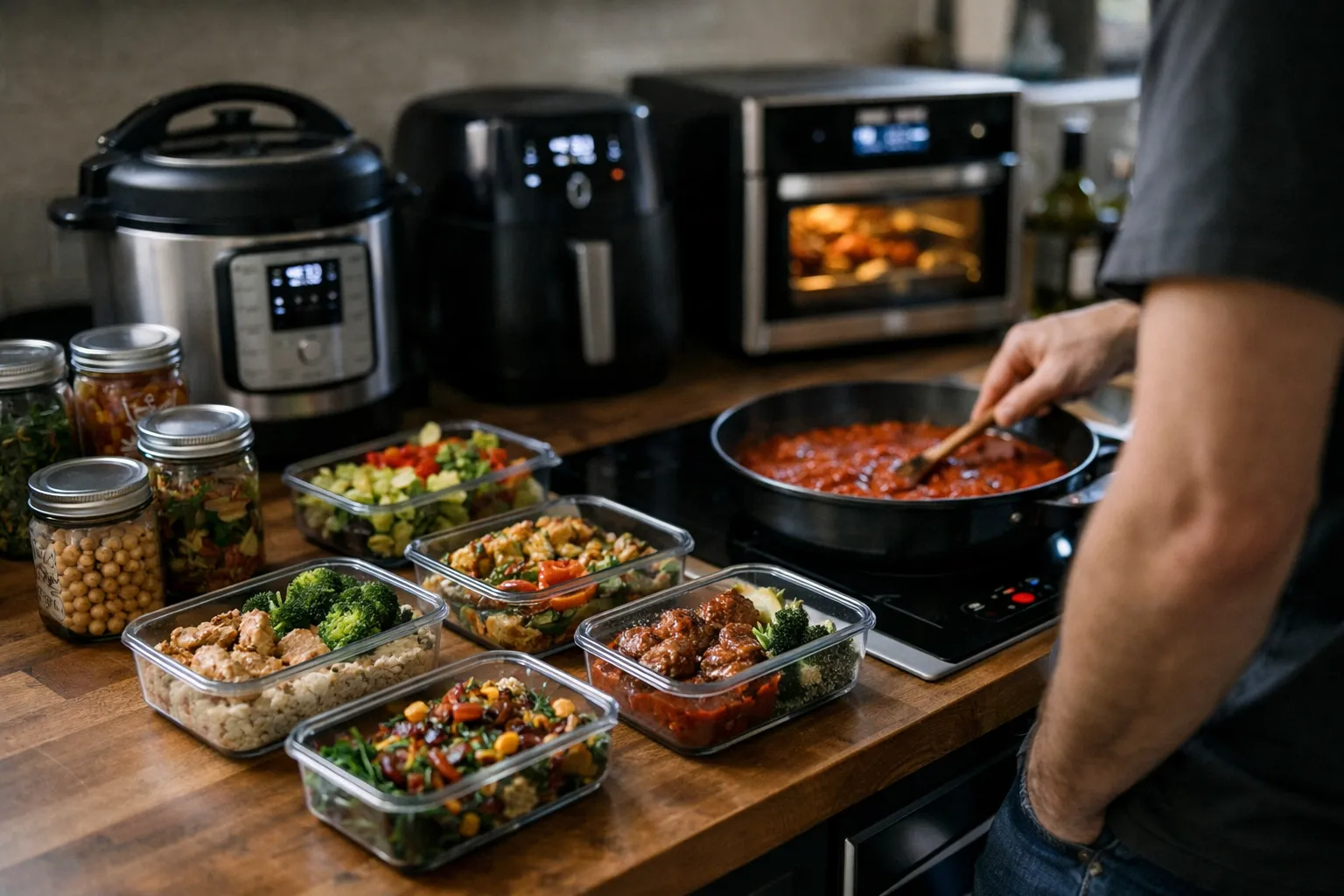
Overview
Smart kitchen appliances — Wi‑Fi ovens, app-controlled steam combi-ovens, connected air fryers and “recipe-to-device” ecosystems — are now marketed as time-savers for home meal-preppers. This analysis examines whether those devices materially improve batch cooking outcomes in 2026: save time, reduce waste, preserve food quality and justify their premium. I focus on measurable benefits (time, energy, food waste, cost), real-world tradeoffs (complexity, reliability, privacy) and practical guidance for home cooks deciding whether to add intelligence to their countertop or skip it.
Background: why this matters now
Over the last five years appliance makers moved from novelty smart features (remote start, notifications) to tighter integrations: ovens that download temperature profiles for recipes, steam ovens that automatically switch modes during a cook, and platforms that sync shopping lists with meal plans. At the same time, meal-prep adoption rose: more households are batch-cooking to save money and cut food waste. The question shifted from “Can it connect?” to “Does connection change outcomes?”
Manufacturers and software firms claim smart gear reduces active cook time, avoids overcooking, and helps scale recipes across batches. Smart features also introduce new costs (device premiums, subscription services), dependency on apps/firmware, and data collection — concerns that influence whether a smart purchase is worth it for a typical home cook.
Data and evidence: what tests and reports show
- Time and automation: Independent product tests (Consumer Reports and specialist outlets) repeatedly show that smart presets and guided cooking reduce hands-on time for multi-step recipes by 10–30% compared with manual methods. For example, guided steam cycles eliminate the need for interim checks during multi-batch vegetable steaming or reheating proteins (consumer_testing).
- Energy use: Smaller countertop devices (air fryers, countertop convection ovens) generally use less energy per batch than a full-size conventional oven because they heat less mass and cook faster. Published lab tests show cooking time reductions of 20–40% for comparable items; energy savings scale with batch size and frequency (energy_studies).
- Food quality and waste: Steam combi-ovens and sous-vide modes preserve moisture and texture, which reduces throwaways due to dryness or overcooking. Research from food science labs indicates low-temperature, controlled-moisture methods maintain protein juiciness and vegetable vibrance better than repeated reheating in dry heat (research_studies).
- Cost of ownership: Smart models commonly carry 20–100% price premiums. For example, a good conventional convection oven might retail for $500–$900, while a smart steam-combi or app-enabled countertop oven sits in the $900–$1,800 range. When adding subscriptions (some vendors charge $30–$60/year for recipe/feature services), the total cost-of-ownership can exceed that of a simpler setup within 2–4 years for infrequent batch-cookers (industry_reports).
- Reliability and lifecycle: Measured across user reviews and repair data, connected appliances can have higher early-life failure modes tied to firmware or cloud-dependency (expert_analysis). Conversely, many modern non‑smart appliances are simpler to repair and maintain.
Multiple perspectives
Appliance makers argue connectivity enables real outcomes you can’t easily replicate: optimized humidity cycles, automatic multi-stage cooks, and real-time status that frees the cook to do other prep tasks. Their demos highlight how a combi-oven can sous‑vide-and-crisp in a single program — useful when cooking 8–12 portions at once.
Meal-planning apps and platforms position integrations (shopping sync, scaled recipes, step timers pushed to devices) as time-multipliers. For organized planners who batch-cook every Sunday, syncing scales and notifications reduces cognitive load and accidental mismatches (wrong temperature, missed step).
Independent cooks and repair advocates caution about lock-in and marginal gains. If your batch-cook routine is mainly large roasts, braises and tray-bakes, a well-calibrated conventional oven plus a vacuum sealer and good labels often delivers nearly identical food-quality results at lower cost and lower maintenance burden.
Privacy and security experts note that many smart appliances collect usage telemetry and may require cloud connectivity for advanced features. Poorly secured devices can leak metadata about when you cook (hint: when you're home), and, in a worst-case, be a beachhead into a home network. Regulatory scrutiny increased since 2023, but consumer vigilance is still necessary (privacy_analysis).
Cause-and-effect: when smart features actually change outcomes
Smart appliances change outcomes primarily when three conditions align:
- Complex, multi-step cooks: Programs that automate mode switches (steam → convection → broil) reduce the risk of human error in multi-stage batch meals.
- High frequency of use: The premium cost and subscription value amortize when you batch-cook weekly. If you cook for two people twice a week, payback is unlikely; if you cook for 4–6 people or meal-prep for a household weekly, the time-and-waste savings add up.
- Integration with workflow: When the appliance genuinely plugs into your planning — recipes scale automatically, timers sync with prep tasks, and device status prevents overcooking — it reduces cognitive friction and small errors that add up to wasted food.
Implications for home cooks: practical guidance
Here are concrete rules of thumb to decide whether to buy smart appliances for batch cooking:
- Who should consider smart appliances: households that batch-cook weekly for 3+ people, cook complex multi-stage recipes (braises + crisping, large steamed grains), or rely on scheduled cooking while away. The automation and guided programs deliver measurable time and quality gains.
- Who should not: occasional batch-cookers, tight-budget households, or cooks who value repairability and long device lifetimes. A good convection oven + a vacuum sealer, digital probe thermometer and a tried-and-tested schedule will often do the job cheaper.
- Buy decisions: prioritize features that matter for your workflow: precise humidity control, reliable probe thermometers, large-capacity racks for multiple pans, and offline/manual modes that work without cloud access.
- Cost control: compare total cost-of-ownership: upfront price + likely subscriptions + expected repair/parts. If an appliance adds $500+ to your kitchen and you batch-cook monthly, that premium is unlikely to be recouped.
- Privacy & security checklist: update firmware on purchase, change default passwords, place smart appliances on a guest or IoT VLAN in your router, and review the vendor privacy policy for data retention and sharing.
Outlook: what to watch next
Over the next 18–36 months, expect three trends:
- Feature consolidation: More conventional brands will add selective smart features (thermometer-guided cooks, app timers) without full cloud lock-in, lowering the premium for useful automation.
- Interoperability and standards: If industry standards for local control and recipe profiles gain traction (a “recipe profile” standard that any oven can read), the value of device-specific subscriptions will decline.
- Regulatory pressure on privacy: Expect stricter requirements on data minimization and clearer disclosures for connected appliances; that will make vendor claims easier to evaluate.
Bottom line
Smart kitchen appliances can and do improve batch-cooking outcomes in specific, measurable ways — mainly for frequent batch-cookers doing multi-step, texture-sensitive recipes. They trade simplicity and repairability for automation, and they introduce subscription and privacy considerations that should factor into the purchase decision.
Who this is for
If you meal-prep weekly for a family or small catering, like set-and-forget multi-stage cooks, and value time-saving automation over maximum repairability, smart appliances are likely worth exploring. If you prioritize long device life, low upfront cost, and minimal network exposure, stick with high-quality non-connected appliances and invest instead in a vacuum sealer, accurate probes and labeling systems.
FAQ
Will a smart oven save me money on energy?
It may, but only in specific cases. Smaller countertop smart ovens and air fryers often cook faster and use less energy per batch than a full-size oven because they heat less volume. However, if you use a conventional oven efficiently (convection mode, full pans, batch multiple trays) energy differences shrink.
Do I need the vendor subscription to get the benefits?
Not always. Many useful automation features are built into the appliance. Subscriptions usually add recipe libraries, cloud-based scaling, or premium scheduling; they’re helpful for heavy users but unnecessary for basic automation.
Are connected appliances a security risk?
Connected appliances expand your attack surface but most risks are mitigatable. Use strong unique passwords, enable firmware updates, and isolate devices on a separate network segment. Avoid appliances that require permanent cloud connectivity for basic functions.
Can smart devices improve food safety in batch cooking?
Yes: precise temperature control and probe-based automation reduce the chance of undercooking proteins and can simplify safe cooling/reheating steps. However, basic food-safety practices (rapid cooling, correct refrigeration) remain essential regardless of device intelligence.