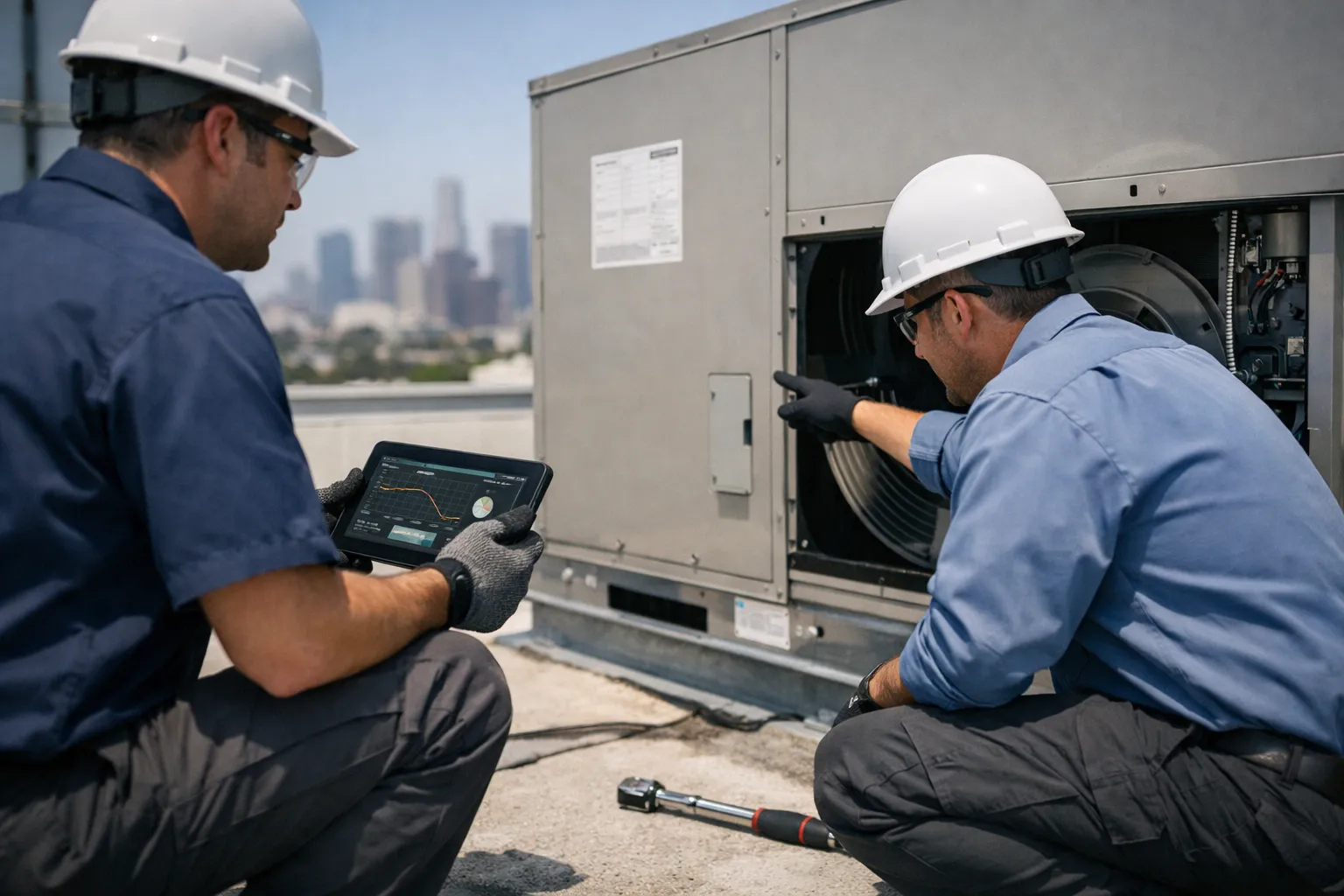
The U.S. Department of Energy this week finalized a sweeping update to energy‑efficiency and performance requirements for commercial packaged rooftop heat pumps and air‑conditioning units. The rule raises minimum efficiency baselines, tightens part‑load testing, requires variable‑speed fan motors on larger units and establishes new performance reporting and labeling expectations. The decision marks one of the most consequential federal moves affecting commercial packaged equipment in years and immediately reshapes product road maps, retrofit economics and contractor training priorities across the industry.
What the rule changes
- Higher minimum efficiency thresholds: DOE raised baseline efficiency levels across multiple capacities and climate zones, directing manufacturers to deliver higher steady‑state and part‑load performance.
- Part‑load and low‑ambient testing: New test procedures require manufacturers to certify units across a wider range of operating conditions, with special emphasis on integrated part‑load metrics and low‑ambient heat‑pump performance.
- Variable‑speed fan mandate: For rooftop units above specified tonnages, the rule requires variable‑speed (ECM/inverter-driven) supply fans to reduce fan energy at reduced loads and improve overall system IEER/part‑load behavior.
- Controls and reporting: Units must include standardized communications and performance logging features to enable system analytics and utility rebate verification; DOE will publish a certification database for compliance transparency.
- Refrigerant transparency: While not mandating a single refrigerant, the rule includes enhanced labeling and product reporting for refrigerant type and global warming potential (GWP), signaling regulatory scrutiny of refrigerant choice.
Why it matters
Commercial rooftop packaged units account for a large share of commercial HVAC energy consumption. By tightening both steady‑state and part‑load performance requirements, the DOE seeks to close the gap between test‑bench efficiency and field energy use in mixed‑load buildings. Variable‑speed fans and more representative test cycles reduce fan energy waste — a known source of discrepancy in legacy test methods.
For building owners and energy managers the rule promises lower operating costs over equipment life; for manufacturers and contractors it requires hardware redesigns, new component sourcing and an expanded focus on controls and commissioning.
Industry reaction and practical impacts
Trade associations and manufacturers have indicated they will evaluate the final text in detail, but early industry responses center on three themes:
- Product redesign and supply chain shifts. To meet higher part‑load requirements manufacturers are accelerating use of variable‑capacity compressors, advanced motor drives for fans, and integrated inverter controls. That will increase demand for inverter drives, power electronics and compact heat‑exchanger technology.
- Upfront costs vs lifecycle savings. Contractors and consultants predict higher sticker prices for compliant rooftop units. However, operational modeling shared within the industry suggests the lifecycle payback for many installations will shorten because of reduced energy use and maintenance differences tied to variable‑speed components.
- Training and commissioning needs. Variable‑speed fans and expanded control requirements increase commissioning complexity. Building owners and service firms will need training programs on setup, sequencing and fault detection for inverter‑driven systems.
Retrofits, incentives and the replacement market
The rule applies to new equipment manufactured after the compliance date; it does not force immediate replacement of existing rooftop units. Nonetheless, the change alters the economics of end‑of‑life decisions. Energy managers evaluating equipment replacement will now weigh higher baseline efficiency of new units against retrofit options.
Utilities and state programs are already expected to respond by retooling rebate priorities. Incentive administrators typically favor products that exceed federal minima; with the new federal floor elevated, rebates will likely shift to reward higher tiers, system‑level upgrades (controls, demand control ventilation) and integrated analytics for performance verification. That will influence procurement specifications in utility territories and for federally financed projects.
Installation and service implications
- Design changes: Rooftop unit sizing and ductwork selection may change to maximize part‑load efficiency; engineers must recheck system curves and fan laws when specifying units with ECM fans.
- Controls integration: Standardized communications and logging expectations mean BAS vendors and contractors must ensure interoperability and secure data pathways for compliance and rebate documentation.
- Spare parts and warranties: Owners should review spare part lists and warranties as variable‑speed fans and inverters introduce different failure modes than PSC motors.
What to watch next
Key near‑term actions and dates to monitor:
- Official compliance schedule and guidance: DOE will publish an implementation timeline and technical guidance documents clarifying test procedure updates and reporting formats.
- Manufacturer certification rollouts: OEMs will begin announcing compliant model lines and performance curves; look for certification listings in DOE’s appliance/equipment database.
- Utility and state incentive updates: Watch regional utility programs for revised rebate criteria and verification processes that may influence early adoption.
- Training and standards groups: Industry training providers, trade groups and standards bodies will update curricula and best‑practice documents; contractors should plan to invest in technician training.
The DOE update redefines expectations for commercial packaged rooftop equipment and signals a continuing federal push to reduce building energy use through equipment performance and smarter controls. For HVAC professionals, the change represents both a near‑term compliance challenge and an opening to redesign systems for lower operating cost and greater field reliability.