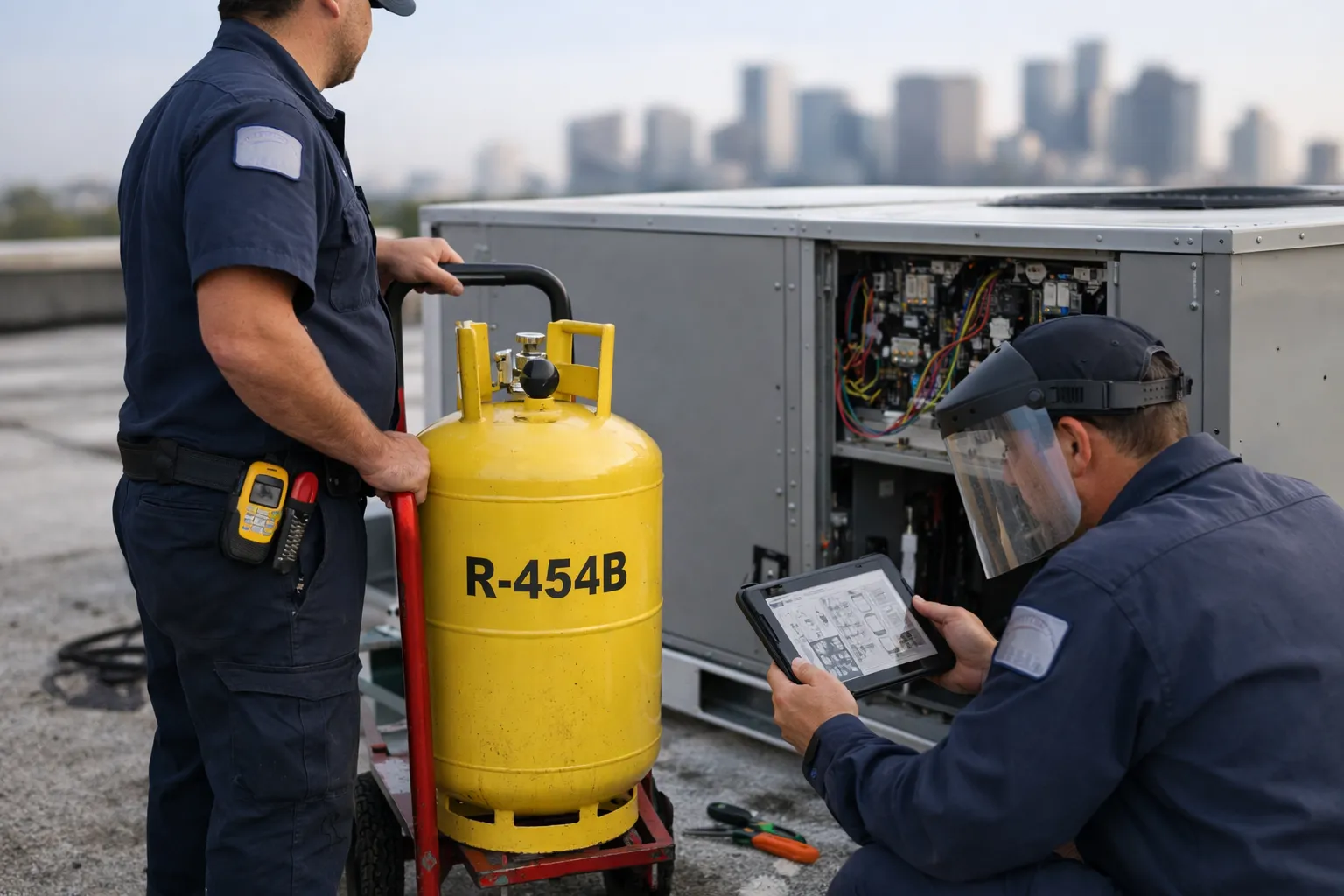
July 2026 — A draft update to the Environmental Protection Agency's Significant New Alternatives Policy (SNAP) published this month has prompted manufacturers and contractors to accelerate commercial heat‑pump deployments that use mildly flammable A2L refrigerants. The proposal, which opens a broader range of A2L refrigerant blends for use in large rooftop and split‑system heat pumps pending final rulemaking, is already reshaping product road maps, parts supply and field work practices across the U.S. HVAC industry.
What the draft does
The draft guidance under consideration clarifies which A2L refrigerants (characterized by lower flammability than traditional hydrocarbon refrigerants but still classed as “mildly flammable”) EPA will permit as acceptable alternatives for certain commercial refrigeration and HVAC end‑uses. While the agency is soliciting public comment through a 60‑day window and has not adopted a final rule, the industry response has been immediate: several original equipment manufacturers (OEMs) announced accelerated development of A2L‑compatible commercial heat pumps, and distributors reported surge orders for A2L service components and safety equipment.
Why it matters now
- Regulatory clarity: A SNAP designation narrows uncertainty for OEMs on which refrigerants they can certify and sell in the U.S., reducing the regulatory risk of investing in A2L platforms.
- Market acceleration: OEMs that already validated A2L designs internationally can scale U.S. introductions faster once pathways are defined.
- Field impact: Installers face new requirements for brazing, leak detection, ventilation, and brazed‑connection practices on systems using flammable refrigerants.
Immediate impacts for contractors and facility teams
Contractors we spoke with say the draft has three near‑term implications:
- Training and certification needs. Technicians must be trained on A2L‑specific safe‑handling: purging charge‑loss protocols, leak isolation strategies, and revised brazing procedures. Local jurisdictions commonly require updated certifications for flammable refrigerant work; contractors expect to invest in classroom and hands‑on training this fall.
- Tools and consumables. A2L work requires non‑sparking pumps in some jurisdictions, doubled‑checked recovery equipment rated for lower‑GWP blends, and upgraded personal protective equipment. Suppliers report higher demand for A2L‑rated service hoses, recovery machines with documented compatibility, and portable gas detectors calibrated for specific A2L blends like R‑454B and R‑32.
- Pre‑job risk management. Installers must revamp pre‑job scoping and permitting checklists to include volume of charge calculations, room classification analysis for indoor units, and coordination with local AHJs (Authorities Having Jurisdiction). Expect longer proposal lead times while teams perform required plan reviews for flammable‑refrigerant installations.
Codes and AHJ coordination
Wider deployment of A2L refrigerants depends on parallel code updates and AHJ adoption. Key codes—such as the International Mechanical Code (IMC), International Fire Code (IFC), and National Fire Protection Association (NFPA) standards—contain classifications and limits that affect permissible charge sizes and ventilation requirements. Several state and local jurisdictions are already revising mechanical code amendments to incorporate A2L allowances; others remain cautious, maintaining conservative charge limits or explicit prohibitions until they review manufacturer safety cases and manufacturer‑issued service guides.
Installers should expect to encounter a patchwork of rules during the transition: the same system may be permitted in one county with minimal mitigation and required to use refrigerant containment or remote condensing arrangements in another. Early engagement with AHJs and inclusion of alternative mitigation strategies in bids is now best practice.
Supply‑chain and OEM responses
While final SNAP approval is pending, several OEMs have publicly stated plans to broaden their U.S. portfolios to include A2L‑compatible commercial heat pumps—particularly variable‑speed rooftop units and modular scroll inverter systems—so they can meet tightening global HFC phase‑down schedules and customer demand for lower‑GWP options.
Distributors report two parallel supply pressures: a short‑term scramble for A2L‑rated service tools and cylinders, and a longer‑term reallocation of compressor and electronic expansion valve (EEV) production capacity to A2L‑specific variants. Contractors should plan for staggered lead times, pre‑order critical spares, and document cross‑compatibility before accepting projects that specify A2L systems.
Practical steps for HVAC teams
- Audit current stock: Identify which inventory items are compatible with A2L blends and flag items that must be replaced.
- Start training now: Enroll technicians in A2L safety and brazing courses; track certifications per jurisdiction.
- Review project spec language: Add clauses addressing refrigerant type changes, AHJ approvals, and potential schedule impacts.
- Engage AHJs early: Present manufacturer safety data sheets and risk‑mitigation plans during the design phase.
- Plan spares: Order A2L‑rated recovery equipment, hoses, and gas detectors ahead of peak retrofit demand.
What to watch next
Key near‑term milestones for the market are the close of EPA's comment period and any subsequent revisions to the draft, local code amendment rollouts through state code councils, and manufacturer product launch timelines tied to final SNAP determinations. For contractors and facility managers, the transition to A2L refrigerants in commercial heat‑pump systems will be less about a single technical change than a systems shift across training, tooling, permitting and supply‑chain planning.
For HVAC professionals, the immediate imperative is pragmatic: treat this draft as a forewarning, not a far‑off possibility. Early preparation—training staff, auditing tools, and engaging AHJs—will determine which firms capture the early wave of commercial A2L heat‑pump projects and which ones face avoidable delays and compliance headaches.