Introduction — what you'll learn and who this is for.
This July 2026 update gives engineering leaders, product managers, and privacy engineers a practical, production-ready playbook for redaction and pseudonymization in LLM pipelines. You’ll get an operational checklist, updated tooling recommendations, compliance context (GDPR, HIPAA, sector rules and the EU AI Act implications), and measurable validation steps to reduce regulatory, reputational, and security risk while preserving model utility.
Prerequisites & context — what to know before you start
Before designing transformations, inventory where LLMs touch data. Typical high-risk entry points in 2026 include: customer chatbots, claims intake pipelines, contract ingestion for automated review, and internal knowledge assistants. These use cases frequently process personal data, health or financial information, and business secrets—triggering obligations under data-protection laws and sector-specific rules.
Key contextual considerations as of mid‑2026:
- Regulatory focus has broadened. Enforcement actions and guidance increasingly target AI systems that process sensitive data; privacy teams now routinely include model pipelines in DPIAs (data protection impact assessments).
- Vendors and cloud providers offer built-in data controls (data retention settings, in-model redaction endpoints, and policy-as-code integrations). These reduce implementation burden but do not replace enterprise controls and auditing.
- Advanced privacy techniques—differential privacy, synthetic-data generation, and confidential computing (TEE-based processing)—are production‑ready for specific workflows but come with trade-offs in cost and latency.
Why redaction and pseudonymization still matter
Redaction (removing or masking sensitive tokens) and pseudonymization (replacing identifiers with tokens) remain core controls because they:
- Limit raw exposure of direct identifiers to third-party models and internal services
- Enable lawful processing without excess data sharing (data minimization)
- Create auditable trails for compliance teams and external audits
- Allow reversible re-linking where legally and operationally required (with strict access controls)
In practice, enterprises combine both approaches depending on business needs, risk appetite, and legal bases.
High-level strategy: when to redact vs pseudonymize
Decide per use case:
- Redact (irreversible) — Use when identifiers add no value (analytics, aggregated reporting). Lowers compliance risk but can reduce model context.
- Pseudonymize reversible — Use when outputs must be re-linked to a person (support escalations, casework). Requires KMS/HSM-backed key storage, strict access controls, and complete audit logs.
- Tokenized placeholders / partial pseudonymization — Use structured placeholders like [CUSTOMER:US_WEST_42] when relationship or role matters but the original value doesn't.
Architectural patterns (updated for 2026)
Three architectures remain standard; adopt one or compose multiple:
1. Preprocessing pipeline — recommended default
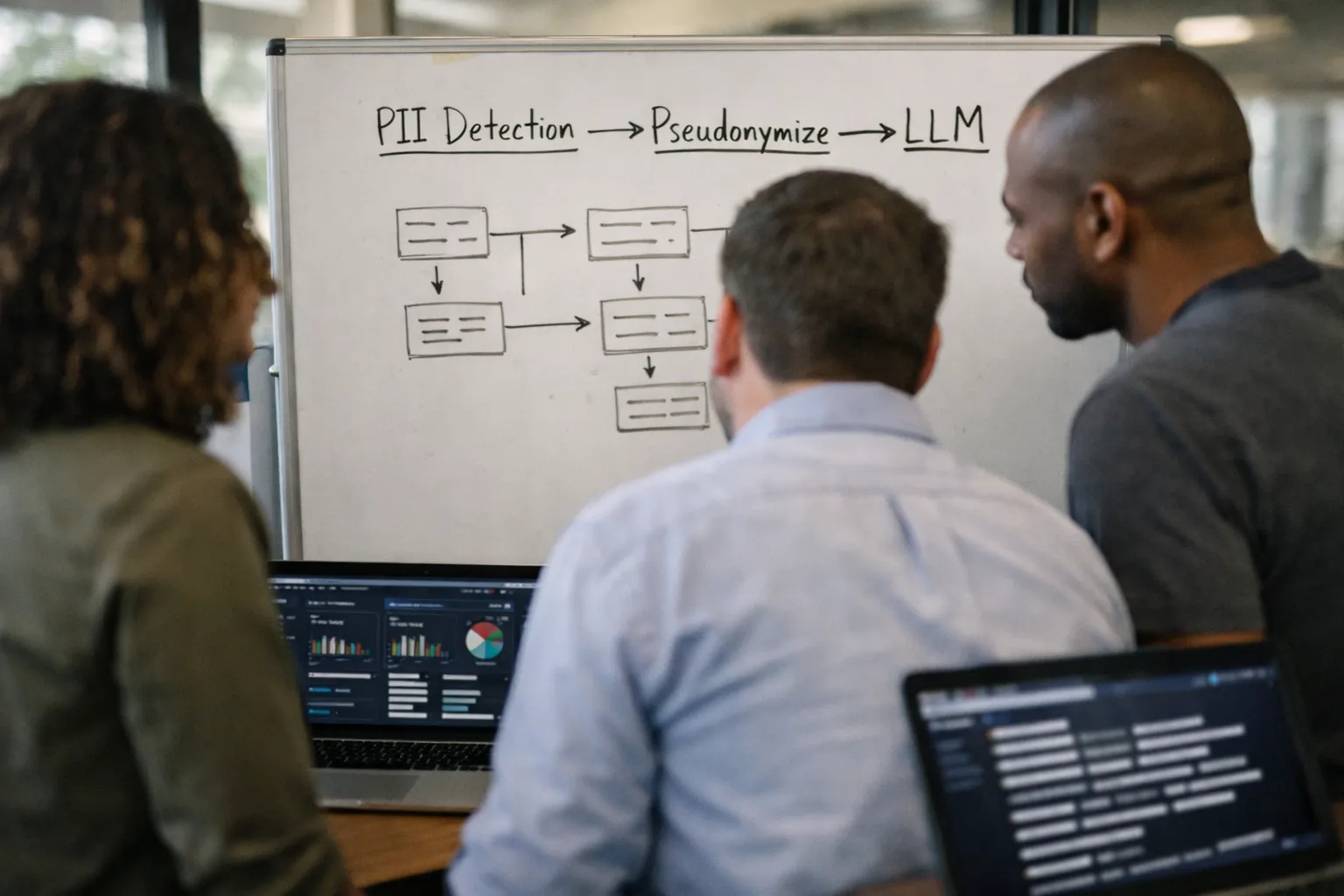
- Ingest → PII detection (ensemble) → Apply redaction/pseudonymization → Send sanitized data to model → Post-process / re-identify as authorized.
Why: raw PII never leaves enterprise boundaries to external systems. In 2026, orchestration frameworks (internal or third‑party) provide hooks to enforce this consistently across multi-vendor LLMs.
2. Inline model-safe tokens
Use when the model needs to reason about entity relationships. Example: replace "Jane Doe (acct 1234)" with "[CUSTOMER:ID_0001|region=EMEA|tier=premium]" to preserve attributes while removing raw values. This pattern reduces loss of relational context and is useful for downstream business logic.
3. Post-response masking — last resort
Running models on raw data and sanitizing outputs is riskier. It can be used only when models run in certified, isolated environments and you have highly reliable output-detection. Many enterprises avoid this for production customer data because models can paraphrase identifiers in ways detection tools miss.
Step-by-step implementation (updated operational checklist)
The following steps build a production-ready capability suitable for enterprise LLMs in 2026.
Step 1 — Inventory data flows and legal bases
- Map every LLM input source (chat, transcripts, file ingests, connectors) and downstream consumers (analytics, caseworkers).
- Document processing legal bases and retention (consent, contract, legitimate interest), and note sector rules (HIPAA for PHI, PCI for cardholder data, FINRA/SEC for financial services).
- Include model training, evaluation, and third-party vendor access (model providers, annotation vendors) in the inventory.
Step 2 — Classify sensitivity
Create a sensitivity taxonomy and map each field to a transformation policy. Typical classes:
- Direct identifiers: full name, SSN, account numbers
- Quasi-identifiers: DOB, ZIP, job title
- Sensitive attributes: health conditions, financial balances, biometric data
- Business secrets: contract terms, trade secrets
Step 3 — Choose and build the detection stack
Use an ensemble for robustness. In 2026, best practice is:
- Deterministic detectors for high-precision patterns (credit card, IBAN, SSN)
- Pretrained NER models, fine-tuned on your domain (spaCy/Hugging Face + labeled domain data)
- Managed DLP for baseline coverage (Google Cloud DLP, AWS Comprehend PII, Microsoft Purview)
- LLM-assisted detection for paraphrases and OCR noise, but run these detectors in a secured environment and validate outputs
Operational tip: run the ensemble in layers—pattern-first, ML second, LLM-assisted last—to minimize false positives while catching clever obfuscation (e.g., "J@n3 D0e" or "acct one-two-three-four").
Step 4 — Define transformation policies per entity
For each entity class, document the chosen transformation and rationale. Example table (illustrative):
- Name: pseudonymize reversible → [USER_000123]; re-identification allowed only with logged, multi‑approval call
- SSN: mask to last 4 digits (***-**-1234); store full in HSM-protected vault only if legal basis exists
- Medical free-text: extract ICD category, redact PHI spans, pseudonymize patient identifiers
Step 5 — Pseudonym mapping and key management
Reversible mappings are a sensitive control point. Recommended schema for mapping store (JSON example):
{
  "token_id": "USER_000123",
  "entity_type": "customer",
  "original_hash": "sha256(kms_salt + original_value)",
  "kms_key_id": "projects/prod/locations/global/keyRings/…/cryptoKeys/…",
  "created_at": "2026-07-01T12:00:00Z",
  "access_policy": "role:caseworker:can_reidentify",
  "ttl": "90d"
}
Best practices (2026): use HSM-backed KMS, separate duties between mapping store administration and re-identification approvers, log every re-identification with immutable storage, and apply automated policy checks before re-linking.
Step 6 — Integrate with your LLM orchestration
- Embed the transformation layer as a mandatory preprocessor in your orchestration (feature flags are OK for rollout but must default to on).
- Ensure consistent transformations across training, validation, and inference datasets to prevent leakage and evaluation skew.
- Include vendor-specific adapters so transformations are applied before sending data to any external API or hosted model.
Step 7 — Validate, test, and quantify risk
Metrics and tests to run:
- Precision & recall by entity class (target >95% precision for direct identifiers; measure recall separately because recall gaps create leakage risk)
- Detection robustness against adversarial inputs (paraphrase, OCR errors, multilingual inputs)
- Downstream model utility (intent-classification F1, summarization ROUGE/BLEU or human-evaluated quality)
- Re-identification attack simulations and measured re-identification risk (k-anonymity, re-identification score)
Use synthetic datasets and red-team exercises. In 2026, automated re-identification scoring tools have matured—use them as an objective signal in DPIAs.
Step 8 — Monitoring, audit, and incident response
Operational controls:
- Real-time alerts on detection anomalies (sudden drop in detected PII, atypical re-identification requests)
- Immutable audit logs for every transformation and re-identification call, exportable for auditors
- Periodic privacy impact assessments and annual external reviews for high-risk systems
- Incident playbook: freeze keys, revoke tokens, reprocess affected data, and notify regulators as required
Performance, utility, and trade-offs
Redaction lowers risk but can degrade model performance. Options to preserve utility:
- Use structured placeholders so models learn on pseudonymized patterns
- Preserve coarse-grained attributes (age bucket instead of DOB)
- Retrain or fine-tune models on pseudonymized corpora so they operate natively on transformed inputs
- Consider differential privacy for aggregate analytics and synthetic datasets for offline training
Cost and latency considerations: multi-layer detection increases CPU and API calls. Optimize with caching per document, batching, and running detection at edge for low-latency paths.
Tooling & vendor choices — updated pointers for 2026
Practical stack components commonly used in 2026:
- Detection: hybrid approach—Microsoft Presidio or open-source engines plus fine‑tuned HF token classifiers and pattern detectors
- Managed DLP: Google Cloud DLP, AWS Comprehend PII, Microsoft Purview as baseline for cloud-hosted data
- Key management: AWS KMS, Google Cloud KMS, Azure Key Vault with HSM-backed keys for highest assurance
- Confidential computing: use TEEs (Azure Confidential Compute, Google Confidential VMs) for highly regulated workloads
- Monitoring & audit: SIEM (Splunk, Datadog) and immutable WORM object storage for audit archives
Vendor selection checklist: contractual commitments on data use & deletion, right-to-audit clauses, and demonstrable technical controls for in-flight and at-rest protections.
Common mistakes and how to avoid them
- Over-reliance on regex: misses obfuscated or paraphrased identifiers. Use ML + rules.
- Inconsistent pipelines: different preprocessing for training and inference causes unexpected leakage or performance drift—use the same pipeline.
- Weak re-identification controls: allow re-linking only with multi-factor approvals, time-limited tokens, and full audit trails.
- Insufficient testing: skip adversarial testing at your peril—models and attackers evolve rapidly.
Pro tips
- Instrument a "policy-as-code" layer that translates legal rules into automated checks for every pipeline run.
- Cache PII detection results per document and persist a detection fingerprint to speed repeated processing and enable deterministic audits.
- Use synthetic datasets and DP mechanisms for model tuning to reduce reliance on production PII.
- Apply a "least privilege by design" approach to mapping stores: short-lived tokens, just-in-time re-identification, and mandatory approvals.
Rollout checklist (quick)
- Complete data-flow inventory and sensitivity classification
- Deploy ensemble detection on staging corpus and measure metrics
- Implement reversible mapping store with KMS/HSM and approval workflow
- Run adversarial and re-identification tests; measure utility impact
- Train staff and update policies; deploy behind feature flag
- Monitor for two weeks and perform external privacy assessment
Conclusion — the governance angle
Redaction and pseudonymization are technical controls and governance enablers. In 2026, combining ensemble detection, reversible mapping with strict access controls, and robust monitoring is the practical path to scale LLM capabilities without exposing sensitive data. Start with a constrained pilot (support transcripts or claims intake), measure detection and downstream impact, and iterate with privacy engineers and compliance teams.
FAQ
Do I need reversible pseudonymization for every LLM use case?
No. Use reversible pseudonymization only when business processes require re-linking to the original identity (case follow-up, legal requests). Where re-linking isn't needed, irreversible redaction or irreversible pseudonymization (salted hashes) is safer and simpler.
Can I rely on vendor DLP features alone?
No. Vendor DLP features reduce effort but should complement—not replace—your enterprise pipeline. You must control preprocessing, logging, and re-identification policies, and include contractual protections and audit rights with vendors.
How do I measure whether redaction hurts model performance?
Measure objective downstream metrics (F1, accuracy, ROUGE) on a labeled validation set that mirrors production, plus human evaluation for tasks like summarization. Compare performance on raw vs transformed inputs and consider retraining on pseudonymized corpora to close gaps.
Is differential privacy sufficient to avoid pseudonymization?
Not by itself. Differential privacy helps for aggregate analytics and model training by bounding individual contribution, but it does not remove the need to mask or pseudonymize identifiers in interactive inference pipelines where exact identity might be present.
What’s the quickest safe pilot to start with?
Start with support transcripts or claims intake where workflows already include case IDs and controlled re-identification. These pilots are high-impact, have clear success metrics, and expose early integration and governance issues.