The European Union has moved a step closer to requiring standardized digital building logbooks that mandate specific HVAC system data, a development that would reshape how contractors, building owners and equipment manufacturers document, service and retrofit heating, ventilation and air‑conditioning systems.
What the proposal covers — and why HVAC matters
The initiative, part of the European Commission’s broader building‑decarbonization agenda, seeks to create a single, interoperable digital record for each building describing energy performance, installed systems and key maintenance history. Unlike prior voluntary approaches, the draft guidance circulated to member states emphasizes structured, machine‑readable datasets for mechanical systems — explicitly calling out HVAC equipment, control logic, refrigerant type and major service events.
For HVAC professionals the rationale is straightforward: a consistent, accessible record reduces information loss at handover, speeds diagnostics for retrofit and decarbonization projects, and helps regulators and energy‑service providers verify compliance with efficiency and refrigerant rules.
Key HVAC data fields being proposed
- Installed equipment registry: make, model, production year, declared seasonal efficiency (SEER/SCOP/ETAs) and nameplate capacity.
- Refrigerant inventory: refrigerant family, charge volume, leak history and recovery/disposal records.
- Control and communications: BAS vendor, protocols supported (e.g., BACnet/IP, Modbus, OpenADR), firmware version and D‑SOH (device state of health) flags.
- Operational baselines and metering: baseline energy consumption for HVAC sub‑systems, key metered points (supply/return temps, compressor run hours), and time‑series links or pointers to datasets.
- Service and retrofits: date‑stamped service logs, major replacements (compressors, coils, fans), retrofit measures (e.g., inverter drives, heat‑recovery ERVs) and verification test results.
Timeline, scope and open questions
The Commission’s move is currently in the form of a draft act and implementing guidance that member states will need to transpose; timelines being discussed in industry briefings point to phased adoption over the next 12–30 months, with larger commercial and public buildings prioritized in early rolls. Final scope and compliance deadlines will depend on the legislative process and national transposition choices.
Several important open questions remain: what minimum dataset will be required for smaller residential buildings, how long data must be retained, whether private property transactions will trigger automatic logbook creation, and — crucially for HVAC vendors — what certification or attestation mechanisms will be accepted to prove data accuracy.
Practical impacts on contractors, OEMs and BAS vendors
The proposal creates concrete obligations and business opportunities across the value chain.
- Installers and service contractors will need to record richer handover documentation and maintain digital service logs. Expect customers and compliance inspectors to request standardized exports (CSV/JSON) or portal access as proof of work.
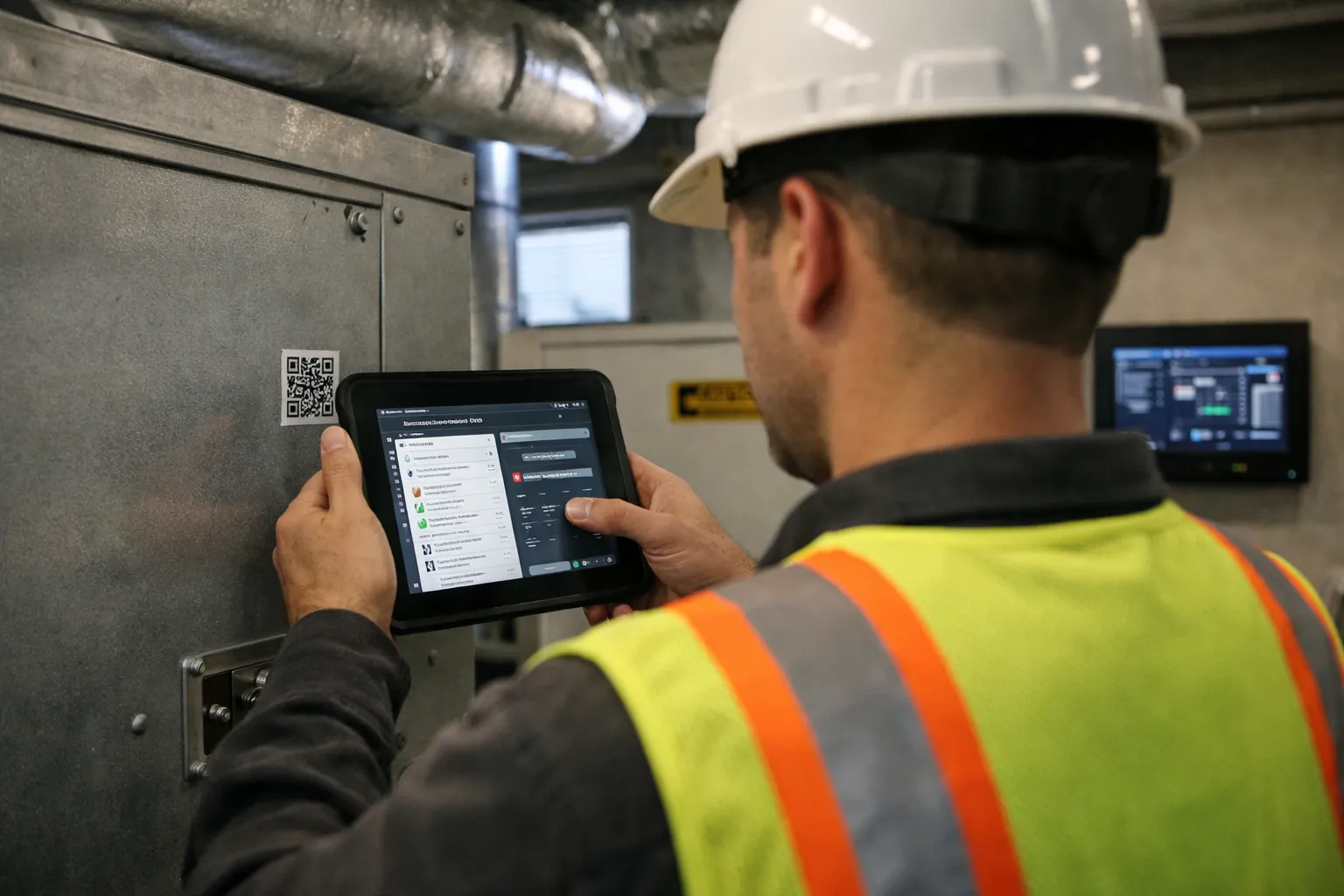
- Equipment manufacturers will face pressure to publish machine‑readable device descriptors and to embed unique device identifiers (UIDs) or QR codes on equipment for rapid cataloging into a logbook.
- BAS and software vendors will need to offer secure, exportable logbook interfaces and mappings that translate proprietary data models into the mandated fields. Interoperability layers and connectors will be in demand.
Cybersecurity and privacy considerations
Because logbooks will expose system topology and operational baselines, the proposal includes (in draft form) baseline cybersecurity provisions: authenticated access, role‑based permissions for service agents, and anonymization rules for data used in public reporting. HVAC professionals should prepare to coordinate with building owners on secure data transfer and retention policies.
What installers and contractors should do now
- Inventory current documentation workflows. Identify gaps: do your handover packets include refrigerant charge records, firmware versions and serial numbers in machine‑readable formats?
- Adopt a standardized export format. Start using JSON or CSV exports for service logs and nameplate data; ensure every completed job includes a digital handover file that maps to the proposed fields.
- Label equipment with UIDs or QR codes on new installations and major retrofits to ease future cataloging.
- Engage BAS vendors early about export capability; ask for an API or standard mapping to the draft logbook schema.
- Train field technicians to capture the new metadata points during installation and service calls (firmware, serials, refrigerant amounts, baseline temps).
Wider market consequences and opportunities
Standardized logbooks will lower transaction costs for energy‑performance contracting and can accelerate heat‑pump retrofits, performance verification for incentives and improved maintenance regimes. They also create new product opportunities: third‑party logbook platforms, certified data‑conversion services for legacy buildings, and compliance‑oriented audit firms.
At the same time, suppliers that lag on data readiness risk losing share to vendors that provide plug‑and‑play logbook exports and device descriptors. For installers, delivering a complete digital logbook may become a value‑added selling point in competitive tenders.
Conclusion — preparing for an information‑centric future
Whether or not the draft becomes mandatory in its current form, the EU’s push toward standardized digital building logbooks signals a shift: HVAC work will increasingly be judged not only on mechanical installation but on the quality and accessibility of its digital record. For HVAC systems enthusiasts, contractors and OEMs, the near‑term priority is simple: capture better data, in standard formats, and make it portable. Organizations that do this first will both reduce compliance risk and open revenue streams tied to long‑term building services.