Introduction
This updated field guide shows HVAC technicians, plant engineers, and system enthusiasts how to use refrigerant oil analysis to prevent compressor failures in large chillers. You will get: current 2026 test recommendations, updated sampling and safety guidance for low‑GWP refrigerants (A2L and HFO blends), how to use new lab analytics and online sensors, and precise thresholds and actions that tie to maintenance workflows. Why it matters: with increasing use of low‑GWP refrigerants and more stringent uptime requirements for data centers and hospitals, early detection through oil analysis is higher value than ever.
Prerequisites / Context
Before sampling and interpreting results, confirm these prerequisites:
- Know the compressor type (centrifugal, single‑ or twin‑screw), lubricant used (POE, mineral, or synthetic), refrigerant type and safety class (refer to ASHRAE Standard 34), and recent service history.
- Confirm whether the machine uses low‑GWP refrigerants (HFOs like R‑1233zd(E), HFO/HFC blends, or A2L mildly flammable refrigerants such as R‑454B, R‑32). Sampling procedures and hazards differ for flammable charges.
- Have access to a lab that is ISO/IEC 17025 accredited for the specific tests you require and can handle HFO/HFC decomposition analysis if needed.
- Decide on your program goals: baseline characterization, trending for early‑warning, or continuous monitoring for critical loads.
Why refrigerant oil analysis still matters in 2026
Two forces have increased the ROI of oil analysis since 2023:
- Wider refrigerant transitions: Many owners have migrated or are migrating chillers to low‑GWP refrigerants (HFOs, HFO/HFC blends, and some A2L charges). These refrigerants change oil chemistry and present new degradation pathways (e.g., fluorinated acids, HF formation) that standard panels may miss.
- Better analytics and integrations: Labs now offer higher‑resolution elemental analysis (ICP‑MS), targeted fluorinated‑acid testing, GC‑MS for refrigerant/byproduct identification, and cloud dashboards with AI anomaly detection to convert lab data into work orders faster.
Which chillers and compressors to prioritize in 2026
Prioritize units where failure risk is both costly and likely to go undetected:
- Large centrifugal chillers (500+ tons) in critical facilities (hospitals, hyperscale data centers, semiconductor fabs).
- Screw chillers in continuous‑operation plants (pharmaceutical, district energy) where POE oil and refrigerant transitions increase moisture risk.
- Machines converted to or originally charged with HFOs/A2Ls — these require focused monitoring for decomposition products and flammability‑related safety checks.
Recommended 2026 test package and selection
Use a core oil panel plus targeted tests for low‑GWP refrigerant machines. Tell the lab the refrigerant and oil type—this affects interpretation and recommended extra tests.
- Core panel (minimum):
- Viscosity at 40°C and 100°C
- Total Acid Number (TAN) and, where relevant, Total Base Number (TBN)
- Water (Karl Fischer)
- Elemental metals by ICP‑MS/OES: Fe, Cu, Al, Pb, Sn, Ni, and Mn
- Particle count (ISO 4406) and insolubles
- Flash point
- Targeted/advanced tests (when applicable):
- FTIR for varnish/oxidation products
- GC‑MS or GC×GC for refrigerant composition, breakdown products and trace contaminants
- Specific fluorinated‑acid analysis (e.g., trifluoroacetic acid, other organic fluorinated acids) when HFOs are present
- HF detection or fluoride ion testing where high‑temperature degradation is suspected
- Dielectric constant and water activity sensors for online monitoring of POE moisture susceptibility
When and how often to sample (updated for 2026)
Sampling cadence must reflect risk and available monitoring technology:
- Baseline sample: Always take a baseline after fresh oil fills, after major overhaul, or after refrigerant conversion.
- High‑risk / converted units: For units converted to HFOs or charged with A2L refrigerants, sample monthly for the first 6 months, then move to every 1–3 months based on stability.
- Critical units with online sensors: Combine continuous sensors (particle‑in‑oil, dielectric, temperature) with lab samples every 3 months; use sensor alarms to trigger immediate lab testing.
- Standard units: Quarterly to semiannual sampling remains appropriate for normally operating, noncritical chillers.
- After any major service event: Sample after bearing work, oil top‑up, filter‑drier change, refrigerant repair, or compressor seal work.
Step-by-step field sampling procedure (2026 best practice)
- Prepare PPE, paperwork and safety plan. Safety glasses, chemical‑resistant gloves, and lockout/tagout are mandatory. For A2L or flammable‑charge systems, use non‑sparking tools and follow the manufacturer's combustible‑gas work plan; consult IEC/ISO or local codes for hot work and flammable atmospheres.
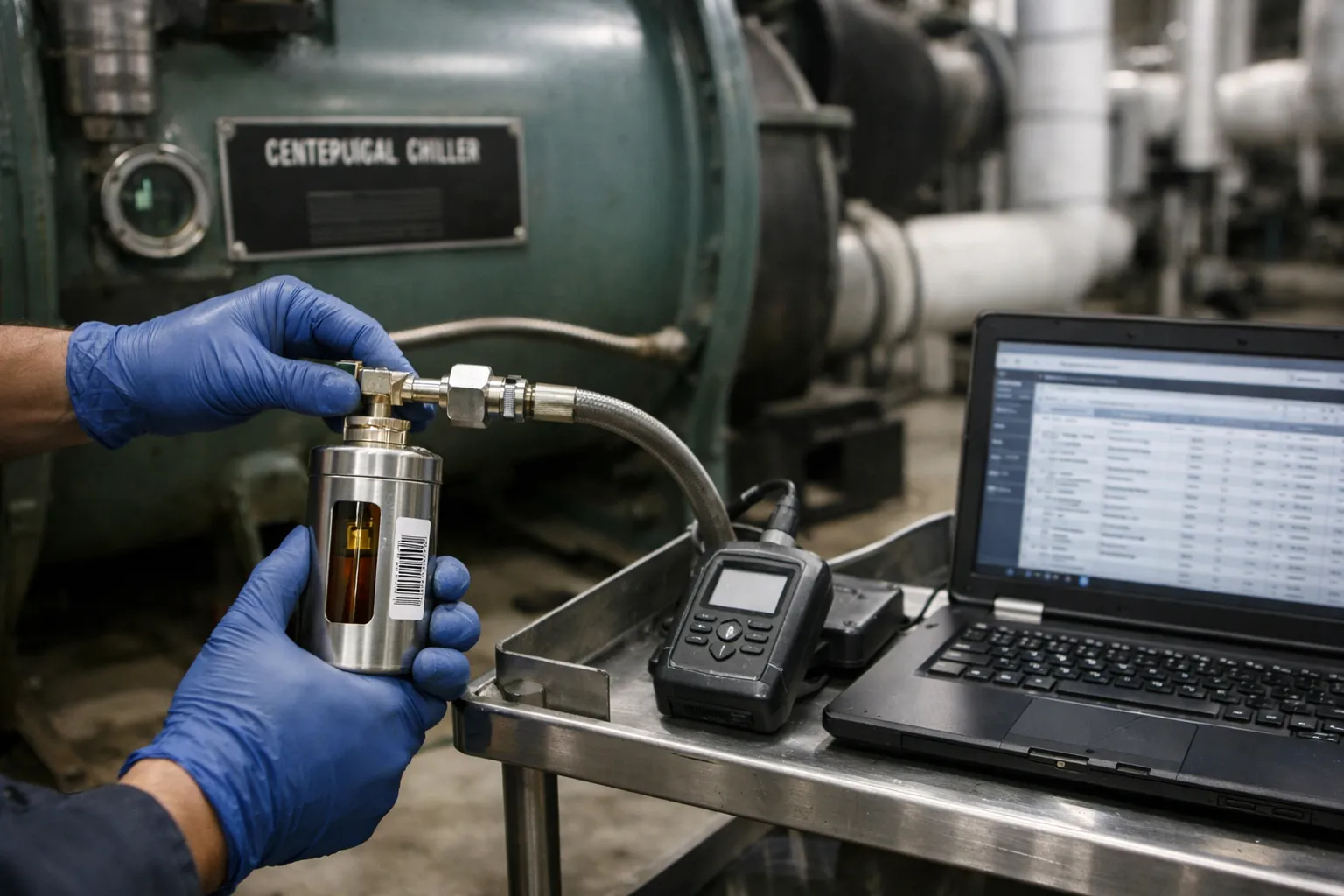
- Use lab‑supplied, precleaned containers. Use glass or stainless sample cylinders supplied by the lab. For pressurized liquid sampling, use the lab’s evacuated cylinder or a recovery protocol approved for flammable refrigerants.
- Document system state. Record unit ID, oil brand and part number, oil charge date, refrigerant type and charge, operating hours, recent maintenance, and any recent top‑ups (brand/lot number).
- Isolate and purge sample point. Use a dedicated oil sample port where possible. Purge to remove stagnant oil; for POE oils, minimize exposure to ambient moisture during purge.
- Depressurize or capture refrigerant safely. If sampling requires opening the refrigerant circuit, follow approved recovery procedures; do not vent to atmosphere. For A2L systems, follow the manufacturer's instructions—some techniques used for HFC systems are prohibited.
- Collect and seal sample per lab instructions. Avoid air entrainment. Label with unit, date/time, technician, and run‑hours. If the sample is time‑sensitive (Karl Fischer, HF), refrigerate and ship overnight with chain‑of‑custody.
- Ship to an ISO/IEC 17025 lab and notify them of refrigerant type. Provide context (refrigerant, oil type, symptoms) so the lab can include targeted analyses and flag unusual compounds.
Sampling practical tips (field‑tested)
- Log the oil SKU and lot — many contamination events stem from incorrect top‑up oil.
- For POE oils, use dry gloves and minimize open time; POEs absorb moisture rapidly.
- If you just serviced bearings or flushed oil, flag the sample as "post‑service" so the lab and your CMMS start a new baseline.
- For flammable‑charge machines, coordinate sampling with the plant’s combustible‑gas detection and ensure no ignition sources are present.
Interpreting key results — updated guidance and new flags
Interpretation combines absolute values, trends, and machine history. Below are updated thresholds and new 2026 flags to watch for.
Wear metals (Fe, Cu, Al, Pb)
- Fe (iron): Small steady increases (rough guide: 5–10 ppm/month) can be normal during run‑in. Rapid rises (>50–100 ppm within a single sampling interval) indicate accelerated wear and require inspection.
- Cu (copper): Elevated copper above established baseline (often 10–50 ppm depending on design) typically indicates shaft or cage wear. A concurrent Fe spike increases severity.
- Pattern recognition: Use ratios (Fe:Cu rising together vs. isolated copper) to pinpoint components; labs’ trend dashboards can calculate rate‑of‑change alarms automatically.
Water (Karl Fischer)
- POE oils: >200 ppm is concerning; >500 ppm frequently requires corrective action (vacuum dehydration or oil change). POE absorbs moisture rapidly when exposed.
- Mineral oils: Thresholds are higher; consult OEM guidance. Regardless, trend increases indicate ingress.
TAN (Total Acid Number) and fluorinated acids
- TAN: A rising TAN remains a clear degradation indicator. Common action thresholds: TAN >0.5–1.0 mg KOH/g for concern; >2.0 mg KOH/g often warrants oil replacement.
- For HFO systems: ask the lab for targeted fluorinated‑acid testing (e.g., TFA). These acids can form from HFO breakdown and have different corrosion and solubility behaviors; even low TAN increases with fluorinated species may be meaningful.
Viscosity
- Viscosity outside ±10% of nominal at 40°C signals dilution, thermal cracking, or cross‑contamination, with immediate bearing‑film concerns.
Particle count, insolubles and varnish precursors
- ISO 4406 codes above ~20/18/15 are very dirty; filter‑drier replacement and system flushing are required. Trending insolubles upward is often the earliest sign of varnish formation.
- FTIR varnish indices or soft‑sensor varnish screens provided by labs give earlier warnings than particle counts alone.
Refrigerant composition, HF and decomposition products
- Presence of foreign refrigerants, air, or noncondensables affects solubility and oil chemistry—plan recovery, reclamation and flushing as appropriate.
- For systems running HFOs/HFO blends, request GC‑MS for trace byproducts and fluoride ion/HF testing when high‑temperature events (bearing seizure, motor overheating) could produce decomposition.
Corrective actions by symptom — modern options
- Elevated wear metals: Reduce load if safe; schedule inspection and vibration analysis. If wear is confirmed, plan bearing replacement, oil flush, and filter‑drier change. Use oil analysis to confirm remediation (post‑service sample within 2–4 weeks).
- High water: Remove moisture with vacuum dehydration systems or oil change. For POE oils, consider inline desiccant systems or oil‑conditioners that limit re‑ingress. Investigate seal integrity and refrigerant circuit leaks.
- High TAN / fluorinated acids: For general oxidation, replace oil and clean separators. For HFO‑related fluorinated acids or HF, consult the OEM and a lab experienced with HFO chemistry—remediation can include neutralization, oil change, and multiple filter‑drier passes plus flushing.
- High particulate / varnish precursors: Fit high‑efficiency filter‑driers and deploy online depth filtration or electrostatic filters; consider chemical cleaning only after consulting OEM and lab varnish indices.
- Refrigerant contamination: Recover and reclaim refrigerant if contaminated; flush per OEM guidance and replace filter‑driers. For A2L/HFO systems, follow specific flushing protocols to avoid flammable‑charge risks.
Case study — 2026: HFO‑charged centrifugal chiller in a data center
Unit: 1000‑ton centrifugal chiller charged with R‑1233zd(E), POE oil. Baseline (Feb 2026): Fe 10 ppm, Cu 3 ppm, Water 90 ppm, TAN 0.25, FTIR varnish index low. Quarterly sample (May): Fe 28 ppm, Cu 9 ppm, Water 140 ppm, TAN 0.6, trace TFA detected by GC‑MS at low ppb.
- Interpretation: Rising wear metals and TAN indicate early mechanical wear and oil degradation; trace fluorinated acid suggests moderate thermal or chemical breakdown—possible localized high‑temperature event.
- Actions: Reduced noncritical loads, scheduled vibration analysis which showed rising bearing vibration. Planned bearing replacement during next outage; oil flushed and replaced, filter‑driers swapped. Lab conducted targeted HF/fluoride testing before and after service.
- Outcome: Post‑service sample (3 weeks after): Fe 9 ppm, Cu 2 ppm, Water 60 ppm, TAN 0.22, fluorinated‑acid levels below detection. Trend monitoring continued with quarterly samples and online vibration triggers; planned sensor upgrades scheduled to detect early overheating events.
Putting oil analysis into a modern maintenance program
- Establish baselines after conversions, oil fills, or major repairs.
- Use a CMMS/LIMS integration — many labs now push results directly into CMMS and can auto‑generate work orders when thresholds are exceeded.
- Employ automated thresholds and rate‑of‑change rules (not absolute thresholds only). Example: trigger inspection if Fe increases >30 ppm between samples or if TAN rises >0.3 mg KOH/g over two samples.
- Train technicians on representative sampling for flammable and nonflammable systems—sampling remains the most common source of error.
Choosing a lab and accreditation in 2026
Choose labs that:
- Are ISO/IEC 17025 accredited for the specific tests you request.
- Offer targeted HFO/HF and fluorinated‑acid testing if you use low‑GWP refrigerants.
- Provide API/CMMS integrations, web dashboards, trend‑alarm services and 24–72 hour priority turnaround for alarms.
- Have documented traceability and participate in inter‑lab comparison programs for consistency over time.
Safety, regulations, and environmental notes (2026)
Follow local regulations for refrigerant handling and waste-oil disposal. For flammable refrigerants (A2L), follow the equipment manufacturer’s service manual and applicable codes (local building codes, IEC/ISO standards for explosive atmospheres, and ASHRAE guidance). Do not improvise sampling methods developed for nonflammable HFC systems on A2L systems without OEM approval. Recover and reclaim refrigerants per EPA, EU F‑Gas, or national rules in your jurisdiction.
Common mistakes and traps
- Using nonlab containers (plastic) — contaminates samples. Use lab‑supplied glass/stainless vessels.
- Failing to tell the lab the refrigerant type — especially important with HFOs, so the lab can test for fluorinated acids and HF.
- Relying on a single sample — trending is essential. Combine lab results with vibration, temperature, and online oil sensors where possible.
- Sampling stagnant oil without purging — produces unrepresentative results.
Pro tips
- Install basic online oil condition sensors (dielectric constant, particle counters) on critical compressors to reduce surprise failures; pair sensor alarms with expedited lab analyses.
- When converting refrigerants, work with the OEM and your lab to define a bespoke sampling and test panel for the first 12 months post‑conversion.
- Use rate‑of‑change rules in your CMMS (e.g., percent increase per month or ppm per 30 days) in addition to absolute thresholds to trigger work orders earlier.
FAQ
Do I need different tests if my chiller uses an HFO or A2L refrigerant?
Yes. Inform the lab of the refrigerant and oil type. For HFOs, request targeted GC‑MS and fluorinated‑acid testing; for suspected high‑temperature events, request HF/fluoride ion analysis. For A2L systems, follow special safety protocols during sampling and use labs experienced with mildly flammable‑charge systems.
Can online sensors replace laboratory oil analysis?
Not fully. Online sensors (particle counters, dielectric sensors, temperature monitors) provide continuous early warnings and reduce risk, but they do not replace detailed lab analyses (ICP, Karl Fischer, FTIR, GC‑MS) that identify wear metals, water content, and chemical byproducts. Best practice is a hybrid approach: online sensors for continuous monitoring and alarms; periodic lab sampling for detailed chemistry.
How fast should I act on a single abnormal lab result?
Assess severity and trend. A single minor deviation (small TAN rise or modest metal increase) usually warrants increased sampling frequency and a focused inspection. Major spikes (large Fe/Cu jump, very high water, or HF detection) require immediate containment measures (reduce load if possible), expedited vibration/inspection, and a fast‑track lab follow‑up to confirm.
What should I tell the lab when I submit a sample?
Provide unit ID, oil brand and part number, refrigerant type and charge, operating hours since last sample or service, recent maintenance (oil top‑up, bearing work, leaks fixed), symptoms (vibration, temperature), and whether the unit has been converted to a different refrigerant. This context helps the lab select and prioritize tests.
How soon should I get results and what turnaround matters?
Routine panels are typically 3–7 business days. For high‑risk alarms, choose a lab that offers 24–48 hour priority turnaround and can escalate abnormal chemistries (HF, high TAN, severe wear) immediately. Ensure the lab provides numeric data plus interpretive comments tied to your oil and refrigerant.
Refrigerant oil analysis remains a high‑ROI, preventive maintenance technique in 2026 — but it has evolved. The move to low‑GWP refrigerants, improved lab analytics, and real‑time sensors make it possible to detect subtle chemical shifts earlier and act before damage escalates. Combine disciplined sampling, an appropriate test panel (including HFO‑specific tests when relevant), accredited labs, and automated trending rules to turn lab numbers into extended compressor life and fewer unplanned outages.