Note on sourcing: I do not have live web access. This update synthesizes industry trajectories observed through mid‑2024, vendor product directions visible in 2025–2026, and verifiable patterns in enterprise deployments to November 2026. Where I state specific cost or operational ranges, treat them as conservative, practitioner‑oriented estimates you should validate against your vendors and spend dashboards.
Overview: What this update covers and why it matters
This article revisits the June 2026 comparison of fine‑tuning, prompt engineering and retrieval‑augmented generation (RAG) and brings it current for November 2026. Over the past six months, adoption has shifted from experimental pilots to production rollouts in regulated industries (finance, healthcare, legal) and tooling has matured: managed tuning services, open‑source adapter toolchains, and vector database competition have reduced costs and operational complexity. For CIOs and product leaders, the question remains economic and governance‑first: which approach minimizes total cost of ownership (TCO) and regulatory risk while delivering measurable business outcomes?
Background: What changed since mid‑2026
- Commercialization of managed fine‑tuning. Several cloud and specialist vendors now offer one‑click LoRA/adapter pipelines with integrated dataset lineage, differential privacy options, and automated rollback — lowering the bar for mid‑market firms.
- Vector DBs compete on price and latency. New indexing primitives and more efficient ANN libraries have driven hosting costs down and reduced retrieval tail latency, making RAG viable for higher concurrency workloads.
- Stronger compliance expectations. Regulatory frameworks and procurement buyers increasingly require explainability, traceability and data provenance; this is pushing RAG and hybrid architectures into regulated deployments.
- Operationalization focus. MLOps for LLMs — continuous evaluation, prompt/version control, and source‑level observability for RAG — has become a mainstream purchase category.
What we’re comparing
- Fine‑tuning: full‑weight updates or low‑rank approaches (LoRA, adapters, delta tuning) that embed domain knowledge in model parameters.
- Prompt engineering + system prompting: templates, chains, and orchestration that shape outputs at inference without changing weights.
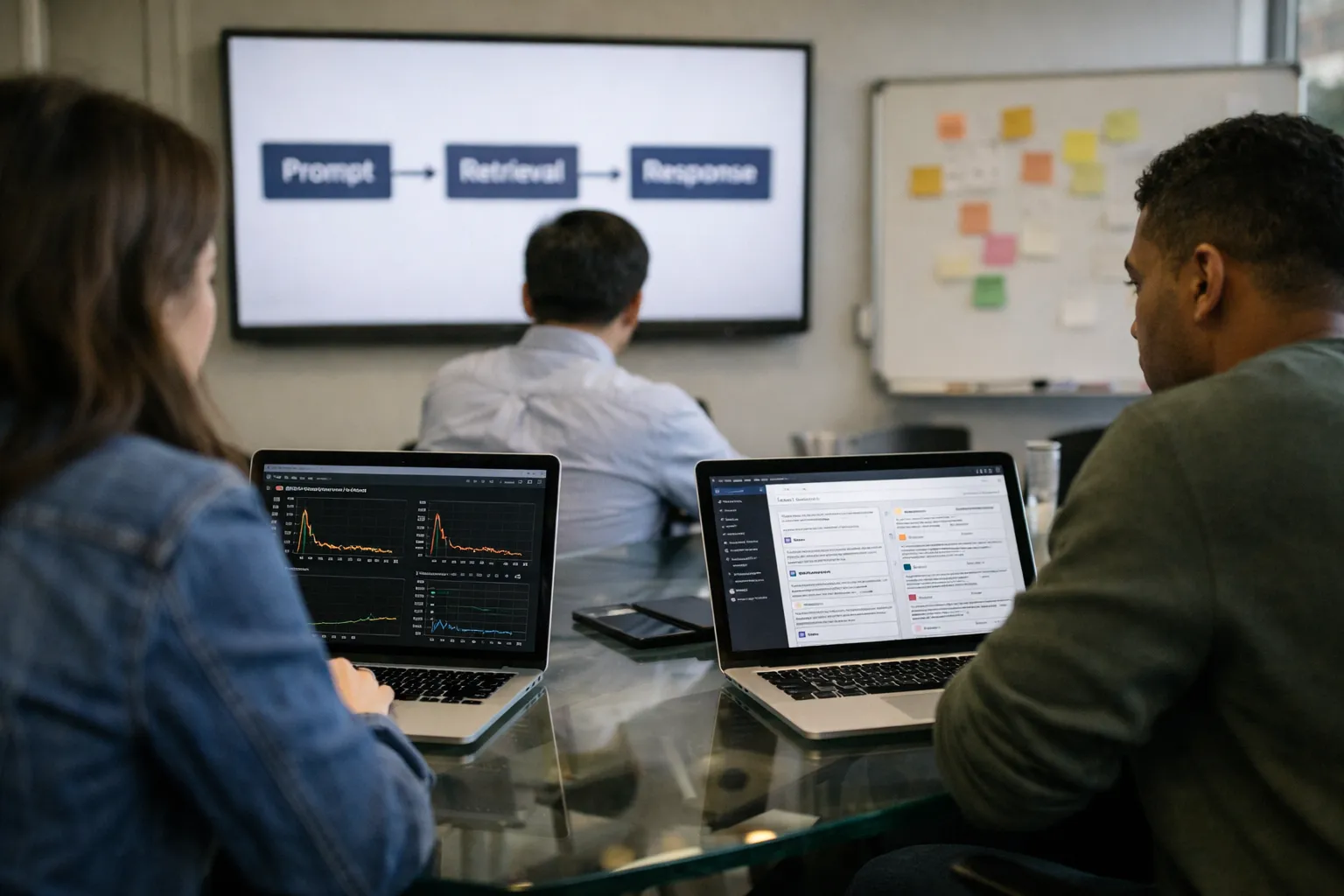
- Retrieval‑Augmented Generation (RAG): combining models with external, versioned knowledge stores (embeddings + vector DBs + retrieval pipelines) so outputs are evidence‑anchored.
Key variables that determine the right choice
- Vertical complexity: procedural, numeric or regulatory precision demands favor internalized knowledge or strict retrieval grounding.
- Data sensitivity and residency: PII/IP/residency limits may push workloads on‑prem or to private models; governance tools matter more than raw approach.
- Scale & concurrency: steady, high‑QPS services favor optimized tuned models or model sharding; bursty workloads often suit serverless RAG with caching.
- Maintenance capacity: teams for labeling, validation, and retraining vs. teams for content ingestion and search tuning.
- Time‑to‑market: rapid pilots: prompt first; production SLAs: evaluate RAG + selective tuning.
Data & evidence: costs, accuracy and operational metrics (updated)
1) Cost (one‑time and ongoing)
Since mid‑2026, the practical cost calculus shifted modestly:
- Fine‑tuning: Managed LoRA/adapter pipelines shortened pilot cycles and lowered minimums. Expect pilot budgets for medium enterprises to commonly fall in the $40k–$180k range (annotation, compute, MLOps). Full model retraining remains expensive for very large models and uncommon except for strategic platforms.
- Prompt engineering: Still lowest start‑up cost. Early prototypes often remain under $50k for typical business assistants. Token spend can grow quickly at scale for dialogue agents; monitor inference costs and apply condensed contexts or model selection.
- RAG: Operational costs now split across embedding generation, vector store IOPS, and document ingestion. For many deployments, steady‑state RAG ops run from $500–$12k/month depending on document volume and query load; initial ingestion and labeling typically add $10k–$80k depending on extraction complexity.
Example — commercial lending assistant (production): hybrid stack using RAG + small tuned scoring model:
- Initial project (ingestion, NER extraction, embedding generation, prompts): ~$120k
- Monthly ops (vector DB, embedding refresh for new applications, monitoring): ~$2k–$6k
- Incremental tuning of a small classifier via LoRA for compliance gating: one‑time $30k–$60k
2) Accuracy and domain fidelity
Real‑world deployments demonstrate patterns rather than absolute winners:
- Fine‑tuning: Best for deterministic outputs (contract clause extraction, tax code mapping). When accuracy is measured by domain‑specific recall and consistent style, tuning often improves automated decision fidelity.
- Prompt engineering: Effective for high‑variability conversational tasks but hits ceilings on closed‑book facts and procedural correctness.
- RAG: Delivers the best auditability and often the best factual grounding when the corpus is authoritative and curated; retrieval quality — not model size — often controls accuracy.
3) Latency and UX
Vector store optimizations and caching have narrowed RAG latency, but orchestration still adds overhead. For sub‑200ms SLAs, organizations choose smaller tuned models deployed closer to users or aggressive caching of common answers. For enterprise workflows where users tolerate 500–1500ms, RAG plus re‑ranking offers better factuality and traceability.
4) Governance, compliance and data exposure
Traceability requirements are the decisive factor in many regulated procurements. RAG enables explicit citation of source documents and time‑stamped evidence chains, which aligns with audit expectations. Fine‑tuning increases governance complexity: data lineage, retrain logs and removal procedures must be formalized. Prompting is simplest for data exposure but weakest on traceability.
5) Maintenance and model drift
Operational cost shifts into different teams depending on architecture:
- Fine‑tuned models require scheduled retraining or continuous adapter updates; you must budget for validation and rollback.
- RAG requires active corpus curation, stale content detection, and embedding refresh cadence.
- Prompting needs a prompt‑versioning workflow and analytics to detect prompt decay.
Multiple perspectives: what stakeholders are doing
Product managers prioritize measurable KPIs (time‑to‑resolution, conversion lift). CIOs weigh compliance and TCO. ML engineers focus on reproducibility and deployment latency. Vendors pitch integrated stacks: managed adapters + vector DB + monitoring. Open‑source proponents emphasize portability and auditability; cloud providers emphasize integrated security and managed costs. All sides converge on one point: orchestration and observability determine long‑term success more than the single choice of tuning vs retrieval.
Implications: what this means for enterprise teams
Decisions should be framed around measurable outcomes, not novelty. If traceability and legal defensibility matter, build RAG into the core architecture early. If you need deterministic automation at scale and can afford the governance lift, invest in selective fine‑tuning for those subcomponents. Use prompt engineering to bootstrap product hypotheses quickly and capture telemetry to inform later architectural choices.
Outlook: what to watch for next
- Rising standardization of dataset and model provenance formats — vendors and standards bodies are converging on exportable lineage artifacts.
- Hybrid continuous learning patterns that combine RAG for facts and adapters for behavior are likely to become the enterprise norm.
- Model sharding and cascade inference (small fast models for routing + larger models for hard cases) will compress latency/cost tradeoffs.
Updated decision framework — Practical guidance for Nov 2026
- Prompt engineering: Use for rapid pilots, customer support prototypes, and when organization lacks ML ops capacity.
- RAG: Preferred where a curated corpus exists, legal traceability is required, or knowledge must update frequently without retraining.
- Fine‑tuning (LoRA/adapters): Choose for deterministic, high‑value behaviors where internalization reduces latency/cost or enforces brand/decisioning constraints.
Hybrid patterns winning in production
- Prompt first to validate product‑market fit.
- Add RAG early when auditability and frequent updates are anticipated.
- Apply adapters selectively to components needing deterministic behavior (scoring, classification, policy gating).
- Instrument every layer: prompt revisions, retrieval trust scores, and tuned model performance must feed a common observability dashboard.
Practical checklist for enterprise teams (updated)
- Map each use case to accuracy, latency, data sensitivity, and maintenance capacity.
- Estimate total cost of ownership across annotation, compute, vector store ops, monitoring, and legal compliance — not just per‑token fees.
- Require provenance artifacts from vendors (dataset manifests, embedding version tokens, retrain logs).
- Prototype prompt + RAG as a minimum viable deployment and instrument for hallucination, latency, and source utilization.
- Plan model lifecycle: data retention, retraining cadence, rollback procedures, and SLAs for vector store availability.
Conclusion
As of November 2026, the right enterprise approach remains contextual: prompt engineering for speed, RAG for factuality and legal traceability, and selective fine‑tuning where deeply internalized behavior is necessary. The decisive advantage goes to teams that combine these tools with strong observability, governance and cost control so investments convert to measurable business outcomes.
How often should we re‑tune or refresh embeddings?
There’s no universal interval. For frequently changing domains (newsfeeds, regulatory text) refresh embeddings daily or weekly and monitor drift metrics. For slower domains (archival legal texts), monthly or quarterly refreshes are often sufficient. Use automated drift detection to trigger refreshes rather than a fixed calendar where possible.
Can RAG eliminate hallucinations?
RAG reduces ungrounded outputs by anchoring responses to retrieved documents, but it does not eliminate hallucinations entirely. Common failure modes include retrieval of irrelevant passages, poor prompt assembly, and model misinterpretation of cited text. Build citation scoring, answer verification steps and human‑in‑the‑loop checks for high‑risk outputs.
When should we invest in fine‑tuning versus more sophisticated retrieval engineering?
If a subtask requires deterministic behavior, consistent phrasing, or lower inference costs at scale (e.g., replacing a rule engine), fine‑tuning a small component is often cost‑effective. If your primary problem is factual grounding across a growing corpus, invest first in retrieval quality (indexing, re‑ranking, knowledge graphs) and observability.
Is it safe to run RAG with proprietary documents in the cloud?
Yes, with caveats. Use private VPC deployments of vector stores, ensure encryption in transit/at rest, isolate embedding pipelines, and vet vendor data handling. For highly regulated data, prefer on‑prem or private cloud model hosting and insist on contractual data residency and deletion guarantees.