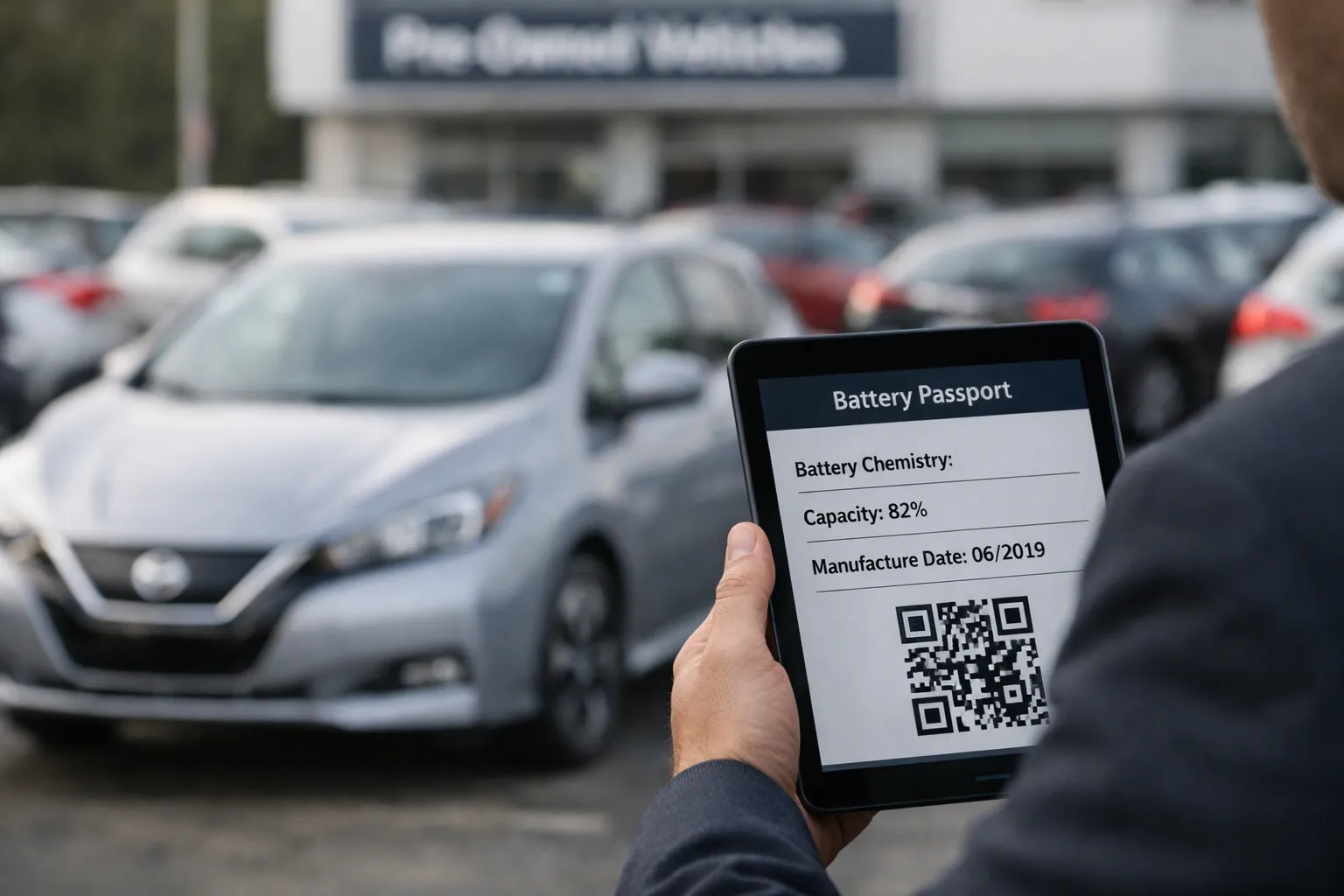
Who, what, when, where, why: As of July 2026, the European Union’s Batteries Regulation and its associated digital battery‑passport framework are materially affecting used electric‑vehicle (EV) supply into the United States. The passport — a standardized digital record tied to a specific battery pack — is now routinely issued for many new EVs sold in the EU and is appearing on an increasing share of used imports. That change gives U.S. buyers clearer battery history data but also creates new due‑diligence tasks around verification, warranty transfer and valuation.
Context: why this matters now
The EU Batteries Regulation, adopted in late 2023 with phased implementation through 2024–2026, requires manufacturers to supply detailed battery data for many vehicle and battery types. OEMs selling in Europe built systems to comply; several have extended those systems globally. Dealers, cross‑border resellers and online marketplaces have begun to surface passport data in listings. For U.S. buyers — a growing cohort interested in European imports and returned lease vehicles — that means access to previously opaque lifecycle information, and a market that increasingly prices that data into offers.
What the battery passport delivers, practically
The passport is a digital dossier specific to the battery pack. Typical, verifiable entries you should expect to see include:
- Battery chemistry and nominal and design capacity;
- Manufacturing identifiers (batch and serial numbers) and manufacturing country;
- Service records (module replacements, refurbishments) and warranty events;
- Recorded capacity or state‑of‑health (SoH) snapshots and, where available, time‑series charging and cycling data;
- End‑of‑life routing or recycling certificates and regional compliance marks.
Developments since the original July 2026 note
In the 12 months after the regulation’s main rollout, several practical changes have become visible to U.S. buyers:
- Major European OEMs — including Volkswagen Group, Stellantis, BMW and Renault — now issue passport data portals for EU retail vehicles; many include a QR link printed on invoices or service records.
- U.S. manufacturers and service networks (notably Ford and General Motors) have announced compatibility pilots or data‑export options to align with the passport model for vehicles sold in Europe and for global platforms.
- Online marketplaces that facilitate international listings — such as mobile.de, AutoScout24 and several specialist exporters — have added passport fields to listings, and a growing number of U.S. importers now advertise "passported" battery condition as a selling point.
- Insurers and appraisal services are beginning pilot programs to incorporate passport SoH metrics into residual‑value and replacement‑cost estimates.
Immediate retail effects buyers are seeing
- Price differentiation: vehicles with verifiable passport records that show minimal degradation often command narrower discounts versus new equivalents; conversely, missing or incomplete passports are increasingly used to justify larger markdowns.
- Cleaner pre‑sale disclosures: some dealers now include passport screenshots or a direct link to the passport in the online vehicle dossier.
- Simpler warranty checks: passports that log manufacturer service events make it easier to validate whether a pack is still covered and whether repairs were OEM or aftermarket.
Practical checklist for U.S. buyers — July 2026
If you’re buying a used EV that was originally sold in the EU or imported from Europe, take these steps:
- Ask for the battery passport or equivalent record. Request a live link, QR code, or screenshot that shows the battery serial number and the most recent SoH entry.
- Match identifiers. Verify the pack serial and batch numbers in the passport against the physical pack label (often in the service bay) or the vehicle’s service invoices.
- Request recent capacity data. Look for a percentage of design capacity or a capacity‑vs‑time graph; if only a single point is available, commission an independent roadside SoH scan.
- Confirm warranty transfer rules. Ask the OEM (or check the passport record) whether the battery warranty is transferable to a new owner and what documentation is required.
- Get independent verification when uncertain. If passport fields are missing or in another language, arrange a third‑party battery test from a recognized lab or service provider before purchase.
How passports change negotiation and valuation
Battery health is the primary technical driver of remaining EV utility. Passported evidence reduces valuation uncertainty and shifts leverage toward sellers for well‑documented cars, and toward buyers when the passport is absent or incomplete. Practical negotiation moves:
- Use passport SoH data as the baseline: if the passport shows 90% of design capacity, treat that differently than a 75% SoH reading.
- When passport data is incomplete, require an independent SoH test and factor potential mid‑term replacement or refurbishment costs into the offer.
- Consider an extended battery warranty or an escrow-style holdback tied to verified SoH if purchasing a high‑mileage import.
Limitations and remaining gaps
The passport improves transparency but does not eliminate risk. Important caveats in mid‑2026:
- OEMs vary in what data they collect and publish. Some passports provide detailed cycling histories; others provide only periodic SoH snapshots.
- Data portability remains uneven. Passports are typically hosted on OEM or regional registries; importing vehicles can require cross‑registry access or translated records.
- Counterfeits and mismatches are possible. Verify serial numbers physically and reconcile passport entries against service invoices and VIN records.
What this means for the market and for buyers
Short term, treat the battery passport as a material disclosure on par with a vehicle history report. Expect appraisal firms, insurers and service networks to further incorporate passport metrics into pricing and underwriting across 2026–2027. For buyers today: insist on seeing the passport (or an independent SoH test), verify identifiers, and clarify warranty transferability before you finalize an import or purchase.
FAQ — common buyer questions
Is a passported battery always in better condition?
No. A passport documents what is recorded; it does not guarantee low degradation. Use the passport to read the reported SoH and service history, and combine that with an independent SoH scan when valuation depends on battery condition.
Can I verify a passport if the record is in another language?
Yes. Ask the seller for a translated copy or a service invoice. Where necessary, reputable independent inspectors and some marketplaces will authenticate the passport and translate entries for buyers.
Does a passport ensure the battery warranty transfers to a U.S. buyer?
Not automatically. Warranty transfer rules are set by the OEM and may require proof of service or registration within a region. Check the OEM’s warranty terms and ask for documented transfer steps before purchase.
What if the passport shows module replacements or aftermarket repairs?
Documented OEM replacements are generally preferable; aftermarket repairs can affect warranty and long‑term reliability. If replacements are shown, confirm whether OEM parts and procedures were used and whether the work is reflected in the passport.
In July 2026, the battery passport is shaping how used EVs are inspected, priced and sold — especially in cross‑border trades. For serious buyers, mastering passport checks and independent verification is now a core part of the used‑EV buying playbook.