This updated July 2026 guide explains exactly how car-buying enthusiasts should prepare for, bid at and close purchases at public and online auctions. If you want under-retail pricing, rare finds, or project cars—and want to avoid costly surprises—this article gives the research steps, inspection checklists, fee math and tactics you need right now.
Prerequisites and context: what’s changed by mid-2026
Since 2021 the auction channel has continued to move online and to hybrid models. Platforms such as Manheim and ADESA still handle large dealer inventory flows; Copart and IAA remain primary salvage marketplaces; eBay Motors and Bring a Trailer continue to serve consumer consignment markets. New in 2024–2026 is wider adoption of AI-assisted damage scoring, higher volumes of off-lease EVs reaching wholesale channels, and more platforms offering integrated inspection and escrow services.
What this means for buyers: better pre-listing data (high-res photos, short inspection videos, automated damage indexes) but also more competition from remote, well-informed bidders. For enthusiasts seeking bargains, discipline and up-to-date checks (VIN, title brand, battery and ADAS condition) are more important than ever.
Step 1 — Pre-auction research (must-do)
- Get the full VIN and run multiple reports. Use CARFAX or AutoCheck plus the federal NMVTIS database (National Motor Vehicle Title Information System) to verify title brands (salvage, rebuilt, flood), odometer history and reported theft or total loss events. NMVTIS is the authoritative U.S. source for many branded-title entries.
- Check recalls and open service campaigns. Search the NHTSA recall database using the VIN. For late-model cars with ADAS or EV systems, unresolved recalls or software updates can affect safety and function.
- Read and compare condition reports and photo sets closely. Look for frame/floorrail photos, close-ups of wheel wells, trunk floors, and under-hood components. Platforms increasingly provide 360° or video walk-arounds—watch every clip at full speed and full resolution.
- Estimate repair and reconditioning costs using local quotes. For mechanical/structural work, get one or two local shop estimates; for OEM EV battery work and ADAS calibration, request quotes from certified EV shops or dealer-level calibration centers before you bid.
- Know state registration and inspection rules for branded titles. Salvage/rebuilt title processes still vary; check your state DMV site for rebuilt title inspection steps, emissions waivers, or paperwork requirements.
Why check multiple sources?
Auction listings can omit a past brand or understate damage. Cross-referencing NMVTIS, CARFAX/AutoCheck, seller photos, and third-party inspection reports reduces the chance you’ll buy a car with an undisclosed problem.
Step 2 — Understand fees, taxes and total cost
Hammer price is the headline—but the full cost includes platform buyer fees, document fees, transport, repairs, sales tax and storage. Auctions and consignment sites publish fee schedules—read them.
- Buyer fee / premium: typically a fixed fee or percentage added to the hammer price. On consumer consignment platforms it can be a few hundred dollars; on salvage and dealer auctions it can scale with sale price.
- Administrative & gate fees: title processing, administrative transaction fees and card-processing charges often come after the sale.
- Transport, towing and storage: salvage lots may require winch-equipped flatbeds and charge per-day storage if you don’t remove quickly.
- Sales tax & registration: due at title transfer per your state law and should be included in your bid ceiling.
Action: create a spreadsheet that adds the hammer price + buyer fee + transport + estimated reconditioning + tax. Your maximum bid is the price that still gives you your target margin (or an acceptable cost basis).
Step 3 — Inspect in person or hire a third-party
Inspection reduces uncertainty. Options in 2026:
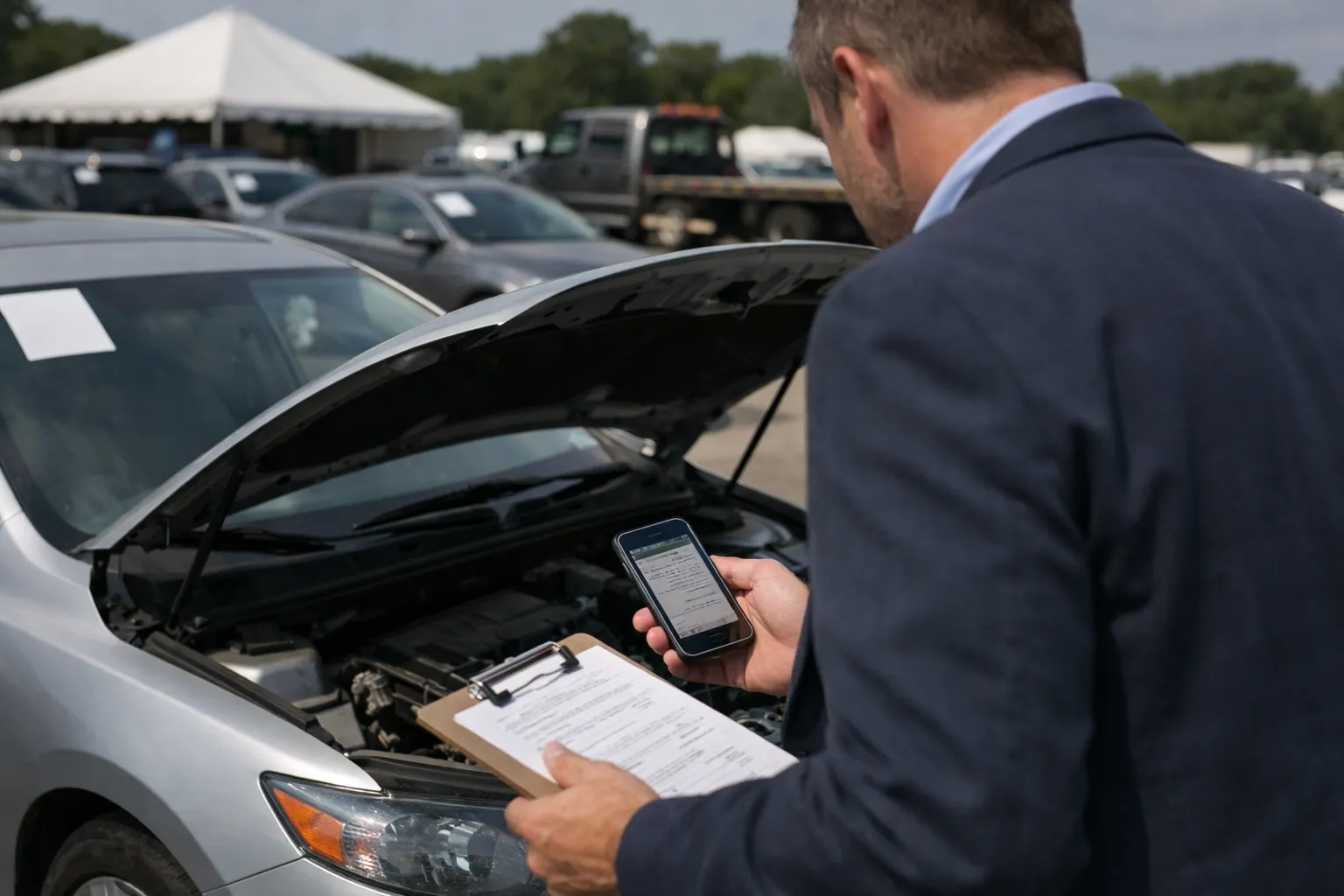
- In-person: still best when possible—bring a magnet for paint checks, a flashlight, a phone to start/record, and a friend to help. For EVs, ask to see the 12-month charge history display or recent battery health report if provided.
- Third-party inspections: nationwide services (independent inspectors, and some platforms’ certified inspectors) will perform a pre-bid inspection for a fee. For distant buys, pay for a full, photographed inspection and a video walk-through.
- AI/automated condition indexes: some platforms surface an automated “damage index” generated from images. Use it as a flag—not a sole decision maker—and confirm with human inspection when value or risk is high.
Inspection checklist (priority items): VIN plate and VIN stamping match; frame rail or structural member damage; evidence of flood (silt, mildew smell, replaced carpet); airbag deployment; battery health indicators for EVs; coolant/oil leaks; ADAS sensor cracks or misalignment; tire condition. For salvage lots assume “as-is.”
Step 4 — Bidding strategy
- Set a hard ceiling and stick to it. Emotional bidding is the most common cause of poor buys.
- Use proxy/maximum bids when available. Let the platform auto-bid to your ceiling rather than escalating in the final seconds.
- Time your bids strategically. On live-streamed auctions, earlier bidding can set expectations; for silent or extended auctions, bidding later can avoid drawing counter-bids.
- Watch for shill-bid patterns. Unexplained quick outbids or identical increments across multiple lots can indicate non-genuine interest—if it looks off, tighten your threshold or walk away.
- Consider broker access for dealer-only lanes. If a lot is dealer-only, using a reputable broker can expand access; check broker fees and their track record first.
Step 5 — Payment, title and timing
Auctions enforce strict payment windows—commonly 24–72 hours after the sale. Typical points:
- Accepted payment methods: ACH/wire transfers, certified checks, credit cards (often only for fees), or platform escrow solutions. Confirm acceptable forms before bidding.
- Title transfer: confirm whether the auction will mail the title or release it to pick-up; salvage titles can require additional state paperwork and inspection steps.
- Pickup deadlines and storage fees: many lots charge daily storage after a short free window—factor this into your logistics plan.
Step 6 — Transport, delivery and initial post-purchase steps
- Arrange transport ahead of time—salvage lots often require specific equipment (winch, ramp) and verified carriers.
- At pickup, complete a walk-around and attach photos to the carrier bill of lading noting any new or pre-existing damage.
- Immediately book mechanical and ADAS calibration checks, and for EVs schedule a battery diagnostic with a qualified EV shop.
- Keep all receipts and documentation for registration, insurance and resale.
Special considerations for EVs and ADAS-equipped cars
Mid-2026 market notes:
- Battery health is central. Common used-EV costs: cell/module-level work and software recalibration can be expensive. Before you bid, ask for the available battery state-of-health readout, warranty transferability, and any recent charging history photos or logs.
- High-voltage handling: salvaged EVs require trained transporters and shops. Confirm carrier capability and the receiving shop’s EV certifications.
- ADAS sensor & software issues: physical sensor damage and software mapping can both render features non-functional. Recalibration at OEM or certified calibration centers can range from a few hundred to several thousand dollars depending on sensors and lane-mapping needs—get at least one quote before bidding.
- Telematics & subscriptions: some OEM connectivity features and telematics subscriptions may not transfer automatically. Ask whether functions like remote start, subscription services or OEM concierge services will carry over.
Financing and insurance
Traditional lenders still generally avoid salvage-title loans. Options:
- Cash purchases: simplest and fastest for auction closes.
- Floorplan or specialty lenders: some lenders finance clean-title auction buys but typically require additional paperwork and inspections.
- Insurance: get quotes before you bid. Salvage or rebuilt titles limit coverages for many carriers; specialists can underwrite rebuilt-title cars at different rate tiers.
Red flags — when to walk away
- Missing or inconsistent VIN information across listing, photos and title documents.
- Title brand differs from the listing’s description (e.g., “minor damage” but branded salvage).
- Seller prevents inspection or requires removal within an unreasonably short window.
- Obvious flood indicators, structural repairs with poor photos, or unexplained gaps in ownership/odometer history.
- EVs listed without any battery health data when the battery is a primary value driver.
Practical example: updated sample calculation (July 2026)
Example: You plan to bid on a clean-title 2019 midsize EV with a $12,000 hammer price posted on an online consignment site.
- Buyer fee & transaction charges: $450
- Transport (150 miles, flatbed): $300
- EV battery diagnostic & minor HV repairs: $700
- ADAS sensor calibration (if needed): $650
- Sales tax & registration (state-dependent): $900
Total outlay = $12,000 + $450 + $300 + $700 + $650 + $900 = $15,000. Compare that to comparable private-sale prices and your target margin. If comparable retail is $17,500–$19,000 and the vehicle checks out on VIN/recall/battery, the purchase could be worthwhile. Always verify quotes for battery/ADAS work in your region before finalizing the math.
Common mistakes to avoid
- Bidding without the full VIN or skipping NMVTIS/CARFAX checks.
- Underestimating salvage title paperwork requirements and inspection timelines in your state.
- Failing to secure a tow/transport option ahead of time, resulting in high storage fees.
- Relying solely on platform-generated AI scores without a human review for high-value lots.
- Ignoring EV battery or ADAS costs when bidding on modern vehicles.
Pro tips from experienced buyers
- Use a short “test” bidding routine on low-cost lots to learn timer behavior and platform quirks before pursuing high-value cars.
- Ask sellers for supplemental photos of specific areas (battery, frame rails, ADAS sensors) before bidding; sellers often comply.
- Keep a running spreadsheet of typical regional transport quotes and a list of certified EV/ADAS shops to speed post-sale work.
- Consider building a relationship with a local auction broker or inspector who can act fast on buys you win remotely.
- When buying for restoration or parts, prioritize inventory completeness (matching engine/transmission, keys, modules) over cosmetic condition.
Resources and next steps
Before you bid: register on the platforms you prefer, read fee schedules, and if possible attend a live auction as an observer. For market pricing and trends, consult regular industry publications and data sources such as the Manheim Used Vehicle Value Index and NHTSA recall pages; for title brands, check NMVTIS. For complex or high-value buys—especially EVs or cars with advanced ADAS—consider hiring a broker or certified inspector.
Final takeaway
Auctions remain a productive channel for enthusiasts in July 2026, but success depends on rigorous VIN and title checks, realistic fee-and-repair math, careful inspection (or third-party inspection) and disciplined bidding. With the right prep—especially for EV battery and ADAS issues—you can find rare models and substantial savings without unnecessary risk.
FAQ
Can I get financing for a car bought at auction?
Traditional lenders typically require clean titles and may decline financing for salvage or rebuilt-title vehicles. Some specialty lenders and floorplan providers will finance clean-title auction purchases, but they usually require inspections and additional paperwork. If you need financing, confirm lender requirements and pre-approval before bidding.
How do I check if an EV’s battery is healthy before I bid?
Ask the seller or platform for any available battery diagnostic readouts, recent charging logs, or a battery state-of-health report. If those aren’t available, hire a third-party inspector who can perform an on-site battery diagnostic or request a post-sale battery check as a contingency prior to payment if the platform allows.
Are online auction “damage scores” reliable?
AI-generated damage or condition indexes can be useful screening tools but should not replace human inspection. These algorithms can miss structural issues, flood damage indicators, or sensor misalignment. Use automated scores as a red flag system and verify flagged items with a human inspector.
What should I do if the VIN on the title doesn’t match the VIN on the car?
That’s an immediate red flag. Do not complete payment or pickup until the discrepancy is resolved. Contact the auction, request documentation explaining the mismatch, and check NMVTIS and state DMV records. If the seller cannot provide a satisfactory explanation, walk away.
How quickly do I need to pick up a car after purchase?
Pickup windows vary by auction and lot type; common timelines are 24–72 hours before storage fees apply. Salvage yards may clear unpicked cars quickly. Arrange transport before—or immediately after—the sale and confirm the lot’s pickup policy to avoid added costs.