Cooking whole fish is one of the highest‑value skills a home cook can add to their repertoire: it stretches your food budget, delivers stronger flavor, and opens up “nose‑to‑tail” uses (stocks, collars, cheeks). This updated July 2026 guide is for home cooks and enthusiasts who want current sourcing and safety advice, efficient butchery technique, and practical cooking templates for immediate use. You’ll get updated market checks, tools and handling practices reflecting how seafood retail and traceability have evolved in 2026.
Prerequisites and context: what changed by July 2026
Since 2024 the biggest shifts affecting home cooks are greater on‑shore traceability (QR codes and vessel tracking), wider retail availability of pre‑iced whole fish, and stronger consumer interest in nose‑to‑tail seafood. Sustainability guidance continues to be provided by Monterey Bay Aquarium’s Seafood Watch and NOAA FishWatch; additionally, Global Fishing Watch has become a public reference for vessel‑tracking that consumers and some retailers cite when verifying origin.
Two practical implications for you:
- Expect more information at the point of sale (QR codes showing catch date, port and method). Use that data when deciding on raw consumption or aging.
- Seasonal availability is shifting in some regions due to warming water and fishery adjustments; ask your fishmonger about current local seasonality rather than relying on last year’s assumptions.
Before you shop: sourcing and sustainability (July 2026)
Where you buy still matters. Reliable sources in 2026 include trusted local fishmongers, well‑run grocery seafood counters, community‑supported fisheries (CSFs) and online suppliers that publish catch method, vessel/landing port and a harvest date.
- Check independent resources: Monterey Bay Aquarium Seafood Watch, NOAA FishWatch, and Global Fishing Watch for vessel patterns. If a supplier displays a QR code, scan it and confirm harvest date and method before you buy.
- Prefer clear sourcing claims: hook‑and‑line, pole, handline, artisanal gillnet (where regulated) and well‑managed trawl fleets are generally preferable to unspecified “wild‑caught.” For farmed fish, look for Best Aquaculture Practices (BAP), Aquaculture Stewardship Council (ASC) or equivalent certification.
- Ask these three vendor questions: When and where was this landed/caught? Has it been kept on ice continuously? Was it previously frozen (important for raw uses)? Suppliers who handle seafood for raw service will tell you the freeze date and method when asked.
Which species to buy whole — updated picks and why
Match species size, fat content and bone structure to your cooking plan:
- Roast whole: branzino (European bass), red snapper, rainbow trout, or small porgies — medium, firm fishes that hold shape.
- High‑heat grilling: whole mackerel, bluefish, and small porgies and jacks — oily flesh resists drying.
- Filleting for pan or poach: cod, haddock, pollock — firm white flesh that flakes cleanly.
- Large species (salmon, tuna): consider steaks or ask the fishmonger to portion; keep in mind parasite management for raw use.
New in 2026: you’ll now see an increasing availability of regionally sourced alternative species (e.g., local sea bass substitutes and smaller pelagic species) as fisheries adapt to changing stocks. Talk to your fishmonger about lesser‑known local options — they are often cheaper and very flavorful when cooked whole.
Tools and mise en place — what to have in 2026 kitchens
Minimal, high‑utility tools:
- Fillet knife (flexible, 7–9 in / 18–23 cm) and a boning/chef’s knife for larger cuts
- Fish scaler (hand or electric) or the back of a chef’s knife
- Kitchen shears; needle‑nose pliers or a dedicated magnetic bone tweezer set for pin bones
- Two large, non‑porous cutting boards (one for whole fish, one for fillets)
- Crushed ice or a shallow tray with ice for short‑term chilling
- Probe thermometer (target finished internal temp guidance below)
- Sanitizer: hot soapy water and a kitchen sanitizing solution (follow label instructions)
Tip: many home cooks now keep a small magnifying light or phone camera handy when pin‑boning to make bones easier to see.
Buying checklist at the market — updated checks
- Eyes: clear and dome‑shaped, not sunken
- Gills: bright pink to red and free of slime
- Skin and scales: shiny and tight; flesh should spring back to the touch
- Smell: clean and briny — not sour, metallic or ammonia‑like
- Label/QR: confirm landing/harvest date, method, and whether it has been kept on ice
Step‑by‑step: Cleaning and gutting a whole fish
- Sanitize workspace: Work on a non‑porous board; have waste bowl, clean towels and running cold water nearby.
- Rinse briefly: Run cold water over the fish and pat dry. Avoid soaking, which can leach flavor.
- Scale: Hold the tail, use a scaler or the back of a knife and scrape from tail to head. Rinse away loose scales as you go.
- Optional fins: Trim dorsal and pelvic fins with shears if they interfere with handling or presentation.
- Open the belly: Insert a tip of the knife at the vent and cut toward the head, keeping the blade shallow to avoid puncturing organs.
- Remove entrails: Scoop out the entrails with your hand or a spoon. Discard or reserve clean bones/heads for stock; keep viscera out of the working area.
- Clean cavity: Rinse the inside, scrubbing the bloodline along the spine with your fingers or a clean cloth. For small fish, remove the membrane by pulling with fingers.
- Trim the head if desired: cut behind the gills with a sharp chef’s knife; many roast whole fish with the head on for flavor and presentation.
Why this order matters
Keeping the fish cold and minimizing water contact preserves flavor and texture. Removing bloodlines and entrails promptly reduces off‑odors and improves shelf life.
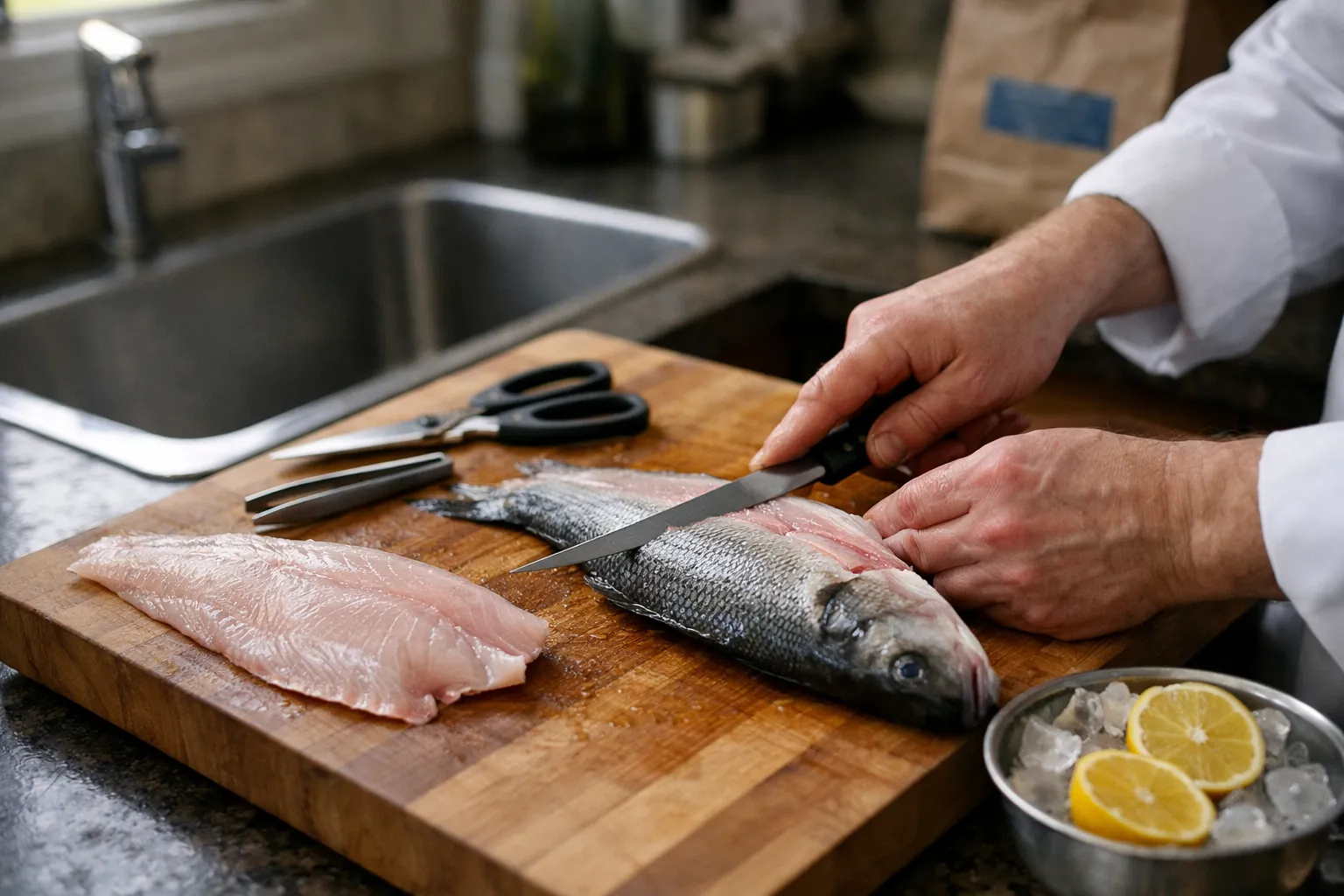
How to fillet a fish — efficient, repeatable strokes
- Position the fish on its side. Make an angled cut behind the gill plate to the backbone without cutting through.
- Lay the blade flat and run it along the backbone toward the tail with long, smooth strokes; maintain slight upward angle to stay over the ribs.
- When you reach the tail, cut through the skin to free the fillet. Repeat on the opposite side.
- Skin removal (optional): hold the tail end, slide the knife between skin and flesh at a shallow angle; pull skin taut and saw gently.
- Pin‑bone removal: feel along the fillet with your fingers to locate bones and remove them with tweezers in the direction they point.
Yield estimates: most round fish return roughly 40–60% usable fillet weight. Example: a 3 lb (1.4 kg) sea bass generally yields 1.2–1.6 lb (0.55–0.75 kg) of fillets.
Safety, storage and freezing — updated guidance
- Refrigeration: Keep whole or filleted fish on ice or in the coldest fridge area (ideally 32°F–38°F / 0–3°C). Use within 1–2 days for best quality.
- Freezing: Wrap fillets tightly; vacuum seal when possible. For best texture, consume fatty fish in 2–3 months and lean fish within 3–6 months. Freezers should be 0°F (‑18°C) or colder.
- Parasite and raw consumption: If you plan sashimi, crudo or ceviche, buy fish that your supplier certifies was handled for raw use (frozen or processed according to applicable food‑safety regulations). When in doubt, cook it.
- Histamine (scombroid) risk: certain species (tuna, mackerel, bonito) can develop histamine if improperly chilled. Buy from reputable vendors and keep cold from the market to home.
- Cross‑contamination: Keep raw fish, equipment and cutting boards separate from ready‑to‑eat foods and sanitize thoroughly after handling.
- Cooking temperature: The FDA still advises fish be cooked to an internal temperature of 145°F (63°C) in the thickest part. For delicate preparations, use a thermometer and judge doneness by flaking and opacity.
Cooking methods and quick techniques
Match fish to method and size; small adjustments make a big difference.
- Whole roasted: Score the skin to promote even cooking; stuff cavity with aromatics (citrus, herbs) and roast at 425°F (220°C). A general rule is ~12–15 minutes per inch of thickness at the backbone but rely on feel and a thermometer.
- Pan‑seared fillet: Pat dry thoroughly, season, then sear skin‑side down in a hot oiled pan until crisp. Finish in a 375°F (190°C) oven if thicker than 1 in (2.5 cm).
- Grilled whole: Oil skin and grate, use medium‑high heat and a fish basket for fragile species. Oiled paper (butcher paper) or parchment under the fish reduces sticking on commercial grills.
- Steaming/poaching: Use gently simmering aromatic liquid (court‑bouillon or court bouillon substitute) for moist, delicate textures — good for sablefish and cod.
- Dry‑brining: For whole fish to be roasted, try a 30–60 minute dry brine (salt lightly) to tighten the flesh and enhance browning.
Three practical recipes — updated templates
1. Roast branzino with lemon and herbs (serves 2–3)
- Prep: Scale, gut and rinse 2 branzino (8–10 oz / 225–280 g each). Score both sides three times.
- Season: Rub outside and cavity with 1 tbsp olive oil, 1 tsp coarse salt and pepper. Stuff cavity with 4 lemon slices, 4 thyme sprigs, 2 parsley sprigs and 1 crushed garlic clove.
- Roast: Preheat oven to 425°F (220°C). Roast on a rimmed sheet for 12–18 minutes until skin is crisp and the flesh flakes.
- Finish: Rest 2–3 minutes, squeeze fresh lemon and serve with pan juices.
2. Pan‑seared cod with brown butter and capers (serves 2)
- Prep: Two 6–8 oz (170–225 g) skin‑on cod fillets, patted dry and seasoned.
- Cook: Heat neutral oil in a skillet, sear skin‑side down until crisp (3–4 min). Flip, add 2 tbsp butter and baste until opaque and cooked through (2–3 min).
- Sauce: Remove fish; brown another 2 tbsp butter until nutty, add 1 tbsp drained capers and 1 tbsp lemon juice; spoon over fish.
3. Grilled whole mackerel with chili‑vinegar (serves 2)
- Prep: Scale and gut two mackerel (8–10 oz each). Score sides to help heat penetrate.
- Grill: Brush with oil, salt lightly, and grill over medium‑high heat 3–4 minutes per side until blistered and cooked.
- Sauce: Whisk 2 tbsp rice vinegar, 1 tsp sugar, 1 tsp chili flakes and 1 tsp soy; drizzle over fish at service.
Troubleshooting & common mistakes
- Fish smells “off”: If it smells sour, metallic or like ammonia, don’t cook it — discard or return to vendor.
- Fillets tearing: Use a sharper, flexible knife and long smoothing strokes; stabilize the fillet with your free hand.
- Sticking to the pan: Ensure the pan and oil are hot and the fish is completely dry before searing.
- Overcooking: Fish cooks quickly; rely on a thermometer or check the thickest part for flaking and a translucent‑to‑opaque transition.
- Raw‑use uncertainty: If your vendor can’t provide a harvest or freeze date for raw consumption, cook the fish instead.
Pro tips for confident home fish butchery
- Start small: Practice on inexpensive whole trout or bream before moving to larger species.
- Use bones and offcuts: Freeze heads and frames and make fish stock within a month. A concentrated fish fumet can transform soups and risottos.
- Build a relationship with your fishmonger: They can advise on seasonality, portioning and aging (some whole fish benefit from a short dry‑age on ice for texture).
- Traceability matters: Scan a QR code if provided and keep a photo of the label — it’s useful for tracking quality and communicating with the vendor.
- Practice knife care: Keep fillet knives sharp and stropped; a dull knife causes tearing and unsafe handling.
Final notes
Buying and cooking whole fish in 2026 means paying attention to provenance, chasing freshness and using a few consistent techniques. The modern advantage is more information: scan labels, ask direct questions, and use vendor traceability tools when available. With practice you'll save money, enjoy better flavor and get full value from the whole animal.
FAQ
How can I tell whether a fish was handled for raw consumption?
Ask the vendor for a harvest and freeze date and the freeze method; suppliers who prepare fish for sashimi/crudo will tell you whether the fish was frozen according to regulatory guidance or has been continuously iced and processed to safe‑raw standards. If the vendor cannot provide this, do not eat the fish raw.
Is a probe thermometer necessary for cooking fish at home?
Not strictly necessary, but a probe thermometer removes guesswork and prevents overcooking. The FDA guideline of 145°F (63°C) is a common benchmark; for home use, many cooks check for opacity and flake‑ability rather than aiming for a single temperature.
Can I freeze whole fish or should I fillet first?
Both are fine. Freezing whole helps protect flesh; wrap tightly and freeze immediately. Filleting before freezing saves time later and reduces the risk of freezer burn when vacuum sealing fillets. Label with date and use within recommended periods for best texture.
What’s the best inexpensive fish to practice on?
Freshwater trout, small sea bream, or whole mackerel are inexpensive, forgiving and excellent for learning scaling, gutting and simple roasting or grilling.
Where can I verify sustainability claims shown on a vendor’s QR code?
Cross‑check species recommendations and fishery status with Monterey Bay Aquarium’s Seafood Watch, NOAA FishWatch (U.S.), and use Global Fishing Watch to view vessel activity if the QR code supplies a vessel identifier. Certification bodies like MSC and ASC provide validation pages for certified products.