
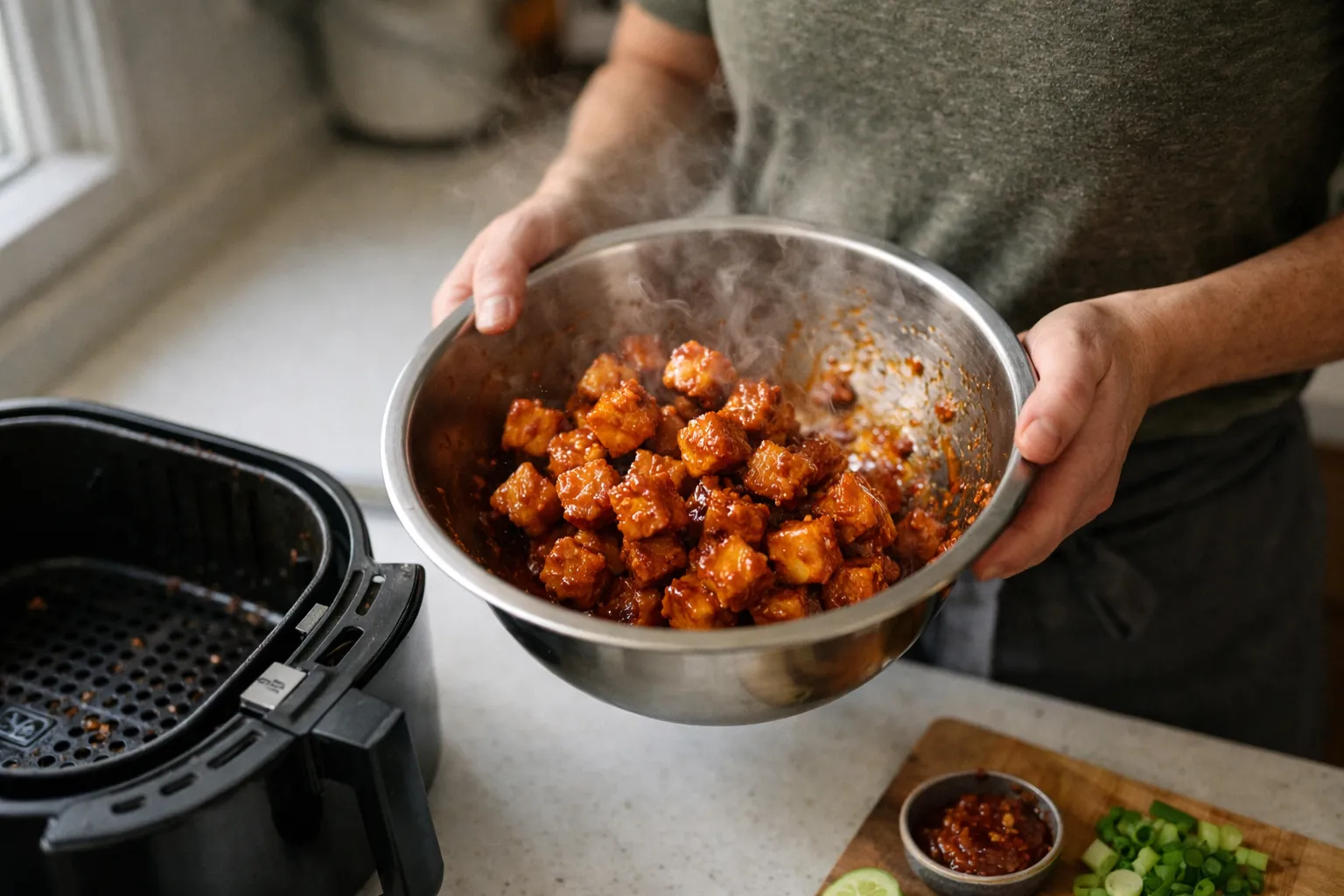
Tofu that’s crisp on the outside, tender inside—and stays crunchy after saucing or reheating is still one of my favorite weeknight wins. This June 2026 update keeps everything home cooks loved about the original method and adds fresh, appliance‑aware tweaks, marketplace notes, and safety guidance based on the tools and ingredients you’re actually finding in stores this year. This guide is for home cooks and recipe enthusiasts who want reliable, repeatable results from their air fryer.
Maria note: My grandmother’s kitchen taught me that texture makes food sing. She’d say, “Crunch is worth the trouble”—and for tofu, a few small decisions (press, starch, space, timing) make the difference between a one‑bite wonder and a soggy disappointment. I’ve tested the steps in different air fryers and on busy weeknights so they work when you need them to.
Prerequisites & Context: What Makes Tofu Crispy (and What Kills It)
Crisp happens when the surface dries and a thin shell forms that browns instead of steaming. Two technical points matter:
- Surface moisture: water creates steam which prevents browning.
- Dry coating: starch or a light “dry batter” forms a shell that dehydrates into a crisp crust when hot air circulates.
Three practical developments through 2026 that change technique:
- Vacuum‑packed “super‑firm” and high‑protein tofu is even more common in grocery chains—these often arrive ready to pat dry, which saves time.
- Air fryers now routinely include precise presets (preheat, crisp/reheat, multi‑rack convection) and app controls—knowing your unit’s airflow pattern matters more than an extra minute of cook time.
- Starch blends—particularly tapioca/rice blends and refined potato starches—are now marketed specifically for frying and crisping, offering subtle texture choices beyond cornstarch.
What ruins crunchy tofu: internal water (it steams), overcrowding (air can’t circulate), saucing too early (wet sauce dissolves the crust) or using a steam/crisp cycle incorrectly.
Basic equipment: an air fryer (basket or oven style), clean towels or a tofu press, a large bowl for tossing, a wire rack for finishing or holding, and an instant‑read thermometer (USDA recommends reheating to 165°F / 74°C for safety).
Step 1: Choose the Right Ingredients (Why 2026 Choices Matter)
Ingredient choice is the single biggest determinant of success. Here’s what to look for in 2026 and why it matters.
- Tofu: If you can, buy vacuum‑packed “super‑firm” or high‑protein tofu for time savings. Brands vary by region; if the block feels dense and not watery to the touch, you can usually skip heavy pressing and go straight to patting and cutting.
- Oil: Use 1–2 teaspoons of a neutral, high‑smoke‑point oil per block (avocado, refined grapeseed). Air fryers need far less oil than pan‑frying; the oil’s job is to help the starch bond and conduct heat to the coating.
- Starch: Cornstarch is reliable. Potato starch gives a glassier sheen; tapioca/rice blends add chew. In 2026 you’ll find labeled “fry starch” blends—feel free to experiment, but always apply a thin, even dusting.
- Seasoning: Kosher salt + garlic powder is the baseline. Add white pepper, smoked paprika, or a pinch of ground ginger for lift. If you add soy/tamari, keep it minimal (½–1 tsp) to avoid extra moisture.
Serving reminder: A 14–16 oz (396–454 g) block yields roughly 2–3 main portions. For four adults, plan two blocks and cook in batches.
Step 2: Manage Moisture — When to Press (and When You Can Skip It)
Don’t skip this step for older style water‑packed extra‑firm tofu—pressing removes internal water so the coating adheres and the interior stays tender rather than rubbery. If your tofu is vacuum‑packed and feels firm, light patting is often enough.
-
1. Drain and blot: Pour off packing liquid and pat with paper towels until the surface feels matte, not slick.
2. Press 15–25 minutes: Wrap in a clean towel and weight it with a skillet or a weighted board. A tofu press shortens this to 10–15 minutes and is useful when you cook frequently.
3. Re‑blot: After pressing, pat again. The block should feel dry to the touch.
Pro tip: If you’re in a hurry and using vacuum‑packed high‑protein tofu, slice the block and press individual slabs quickly between paper towels for 5–7 minutes—this speeds moisture removal while preserving texture.
Step 3: Cut for Crunch — Size, Shape, and Why It Changes Everything
Cut size governs crust‑to‑center ratio. For most air fryers I recommend ¾‑inch cubes (about 2 cm). They brown quickly without drying out the middle.
- Slice into ½–¾ inch slabs, then cut into cubes or rectangles.
- For extra edge surface, cut rectangles or tear the tofu into irregular pieces—those jagged edges hold more coating and create more crunch.
What it should look like: Even pieces that are similar in size cook evenly. If pieces vary widely, smaller ones will overcook and get chewy.
Step 4: Season and Coat — The Dry Batter That Keeps
This updated coating balances modern starch blends and the lower oil needs of contemporary air fryers.
Per 1 block (14–16 oz):
- 1–1½ tbsp cornstarch, potato starch, or a 50/50 tapioca–rice starch blend
- 1–2 tsp neutral oil
- ¾ tsp kosher salt (reduce if adding soy/tamari)
- ½ tsp garlic powder
- Optional: ½–1 tsp soy sauce/tamari (keep minimal)
- Toss tofu with oil first so starch adheres evenly.
- Add salt and dry seasonings; toss gently.
- Sprinkle starch and toss until pieces look lightly dusted—matte, not goopy.
Visual cue: Cubes should look dusted and dry. If you see gummy patches, add a pinch more starch and separate pieces with your fingers.
Step 5: Air‑Fry the Right Way — Settings, Timing, and Loading
Air‑fryer features vary. The key variables are heat, airflow, and spacing.
- Preheat: If your model recommends it, preheat 2–4 minutes to 400°F (205°C). A hot starting surface helps set the coating quickly.
- Single layer with gaps: Arrange tofu with space between pieces. Overcrowding causes steam and sogginess.
- Cook at 400°F (205°C) for 12–18 minutes: Shake or flip gently at 8–10 minutes. Check at 12 minutes for a deep golden edge and a dry surface. For very powerful units lower to 385°F (196°C) and add 2–3 minutes if needed.
- Multi‑rack tips: Use a wire rack and rotate racks mid‑cook if your model has multi‑level air channels. Avoid steam/air‑wash cycles while crisping.
Done cue: A tap on the cube should give a light, slightly rattly sound. The surface will be matte and set, not powdery.
Step 6: Sauce Without Sacrificing Crunch (Practical 2026 Options)
Two restaurant tricks remain the most reliable: a light glaze followed by a quick re‑crisp, or serving sauce on the side.
Option A — Glaze then re‑crisp (best for sticky sauces)
- Toss tofu with 1–2 tablespoons of a thick sauce per block (e.g., gochujang–maple, reduced garlic‑soy).
- Return to air fryer 2–4 minutes at 400°F (or use the crisp preset) to set the glaze—most modern units can finish this faster than older models.
This gives a lacquered surface while preserving crunchy edges. For vegan glazes use maple syrup or brown rice syrup where recipes call for honey.
Option B — Dip and drizzle (best for maximum crunch)
- Keep tofu dry and crisp; serve sauce on the side or drizzle sparingly just before serving.
Sauce ideas: Gochujang–maple, thick garlic‑soy reduced to a glossy finish, lemon‑tahini thickened so it won’t penetrate the crust. If a sauce is thin, reduce it on the stovetop for 3–5 minutes or add a small starch slurry to thicken.
Step 7: Scale, Store, and Reheat (Food Safety + Texture)
Batch cooking: Cook multiple blocks in separate batches. Crowding is the most frequent cause of failed crunch at scale.
Short holding: Keep finished tofu on a wire rack so steam escapes; don’t cover tightly for more than 20–30 minutes.
Storage & safety: Refrigerate within 2 hours in an airtight container for up to 3–4 days. Reheat to an internal temperature of 165°F (74°C) per USDA guidance.
Reheat for crisp: Air fryer at 375–400°F (190–205°C) for 3–6 minutes restores crunch best. Avoid microwaving unless texture doesn’t matter.
Common Mistakes (and How to Fix Them Fast)
- Chewy or rubbery tofu.
Why: Pieces too small or overcooked; insufficient oil/coating.
Fix: Cut larger pieces (¾–1 inch), add a teaspoon more oil in the coating, and check at 12 minutes. - Pale, dusty tofu.
Why: Too much starch, not enough heat or oil.
Fix: Toss with oil first, preheat the air fryer, and reduce starch slightly next time. - Soggy tofu.
Why: Wet tofu, crowded basket, or saucing too early.
Fix: Press longer, cook in batches, or use “glaze then re‑crisp.” - Coating falling off.
Why: Surface too wet or rough handling mid‑cook.
Fix: Pat dry; toss gently at the halfway point rather than stirring vigorously.
Pro Tips for Restaurant‑Quality Results
- Try different starches: Potato starch gives a glassy finish; tapioca‑rice blends add chew. Test small batches to match the texture you prefer.
- Torn pieces are delightful: For bowls and salads, tear tofu to create more surface area for coating.
- Season in layers: Salt in the coating, then finish with flaky salt after cooking for balanced seasoning.
- Thicken thin sauces: Reduce on the stovetop or use a small cornstarch slurry to avoid sogginess when glazing.
- Know your fryer’s airflow: Some models have hot spots. Rotate or move pieces mid‑cook for even browning.
Dietary Modifications
- Gluten‑free: Use tamari and gluten‑free starches; check labels for cross‑contact if highly sensitive.
- Vegan: Use maple syrup or brown rice syrup in glazes; avoid honey and dairy finishes.
- Lower‑sodium: Cut salt in the coating and use aromatics like smoked paprika, citrus zest, and garlic for flavor.
- Oil‑free (best‑effort): Omit oil but expect less browning—use slightly more starch and a hotter initial burst to set the coating.
Why This Still Matters in 2026
Plant‑forward eating is mainstream, and home cooks expect restaurant textures at home. The air fryer is a tool that can deliver that texture quickly and with less oil than pan or deep frying. Understanding how tofu’s moisture, a thin dry coating, and your specific air fryer work together gives you control—so you can make crunchy tofu any night of the week without guessing.
FAQ
Do I really need to press tofu before air‑frying?
If you buy water‑packed extra‑firm tofu, pressing 15–25 minutes is the simplest way to ensure crisp results. If you bought vacuum‑packed super‑firm or high‑protein tofu that feels dense, you can usually skip extended pressing—just pat very dry and proceed.
What temperature should I reheat tofu to for safety?
Reheat until it reaches an internal temperature of 165°F (74°C), the USDA recommendation for reheated foods. The air fryer restores crisp much better than a microwave; 3–6 minutes at 375–400°F usually does the trick.
Can I marinate tofu first and still get it crispy?
Yes, but keep marinades short or concentrated. If you marinate, pat pieces very dry before coating; consider a brief, high‑impact marinade (10–20 minutes) followed by a starch dusting. For the crispiest result, season the coating and serve sauces on the side.
Which starch gives the crispiest crust?
Cornstarch is the most reliable. Potato starch often yields a glassier, very crunchy finish; tapioca/rice blends add chew and are especially good if you like a slightly elastic bite. Use a light, even dusting—too much starch can look pale and powdery.
How do I scale this recipe for a crowd without losing crunch?
Cook in batches and keep finished pieces on a wire rack in a warm (not closed) oven if you must hold them briefly. Crowding is the main cause of soggy tofu; two baskets or two batches are better than one overcrowded basket.
Maria’s last tip: If you take one thing from this guide, let it be this: space is a secret ingredient. Give tofu room in the basket, choose the starch that matches the texture you crave, and use your fryer’s crisping or reheat preset thoughtfully—then watch how fast everyone reaches for “just one more piece.”