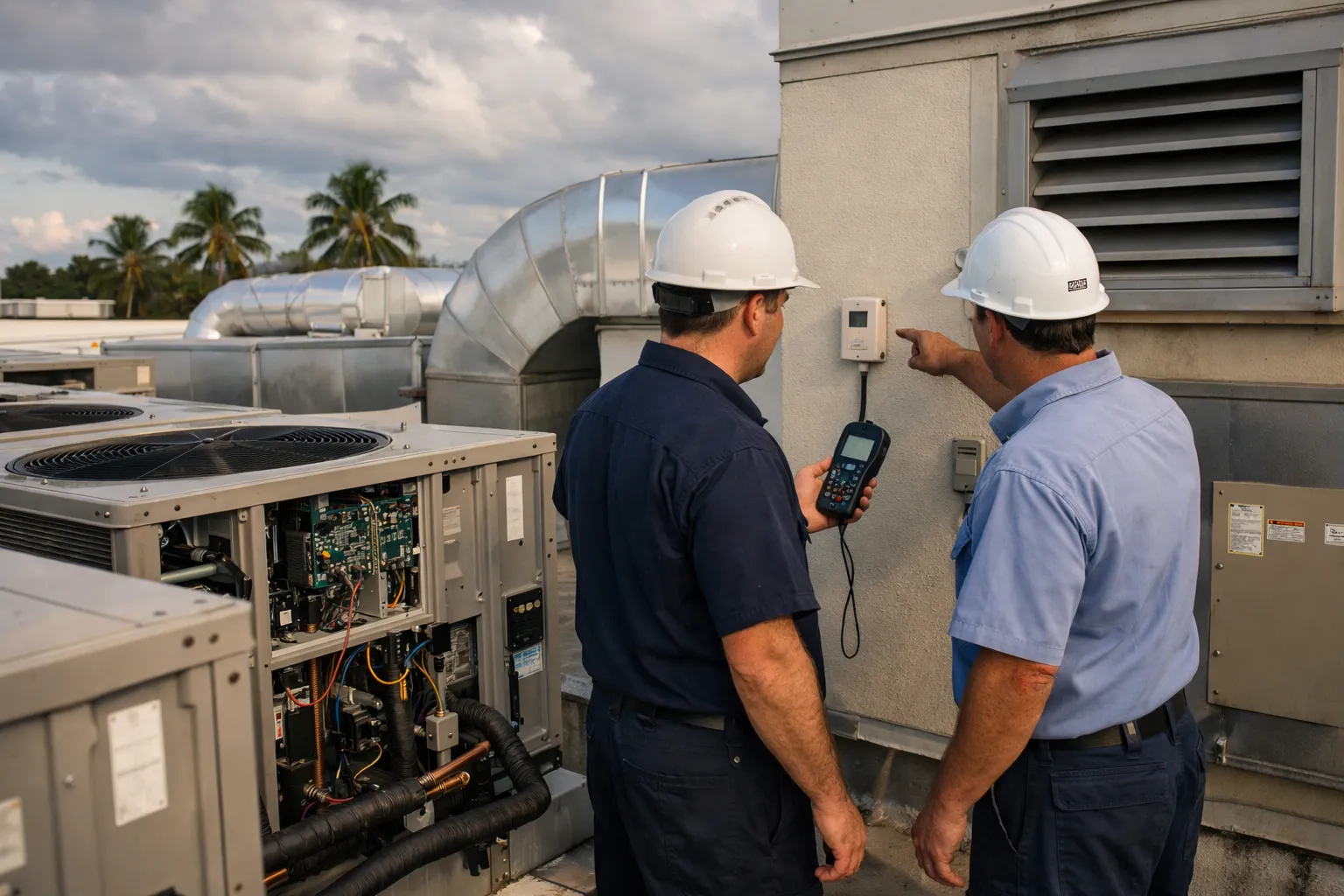
As commercial buildings in the U.S. Southeast and Gulf Coast accelerate heat‑pump retrofits—driven by electrification incentives and decarbonization goals—designers and operators confront a persistent problem: latent load control. Heat pumps improve sensible cooling and efficiency, but they often deliver less latent capacity at part‑load and higher coil leaving air dewpoints than legacy chilled‑water systems sized for humid climates. Left unaddressed, elevated indoor dew points cause occupant discomfort, IAQ issues and mold risk.
Why humidity becomes the limiting factor
Two physics facts underlie the challenge. First, latent cooling is driven by coil surface temperature: you remove moisture only when the coil surface is below the air dew point. Modern variable‑speed heat pumps optimize efficiency and often run with warmer coil temperatures at partial load, reducing latent removal. Second, as systems downsize or add economizer modes and ventilation changes, the sensible/latent ratio (S/L) shifts—often increasing latent fraction from outside air in humid climates. The result: rooms can feel clammy even when dry‑bulb temperature targets are met.
Typical symptoms seen in retrofits
- Setpoint‑compliant spaces with persistent relative humidity (RH) in the 60–70% range.
- Short cycling of compressors with insufficient runtime for condensate formation.
- High occupancy zones or kitchens where latent loads spike during events.
- Increased mold complaints and IAQ remediation work orders after electrification.
Options for latent control: tradeoffs and analysis
No single solution fits every project. Below are the common approaches, with benefits, limitations and where they make sense.
1) Dedicated Outdoor Air Systems (DOAS) with decoupled sensible cooling
Overview: A DOAS conditions ventilation air to handle latent loads independently of zone sensible cooling. The DOAS typically uses a DX or heat‑pump coil sized for latent removal and supplies dehumidified air at lower dew points; terminal units then handle space sensible load.
Pros: Best holistic control over ventilation‑related humidity; good IAQ; allows heat pumps to operate at higher coil temps (improving efficiency).
Cons: Capital and footprint for separate units; requires careful control sequencing and integration with existing BAS; improper sizing means either over‑dehumidification or inadequate performance.
When to use: Buildings with significant ventilation-driven latent loads (hospitality, labs, fitness centers) or where occupancy patterns vary widely.
2) Dedicated mechanical dehumidifiers (DX or desiccant)
Overview: Standalone dehumidifiers (refrigerated DX or desiccant) directly target latent removal. Refrigerated units are common for moderate humidity; liquid or solid desiccant systems are used where very low dew points or continuous dehumidification are needed.
Pros: Targeted latent control without modifying core HVAC; fast response; can be staged by zone.
Cons: Refrigerated dehumidifiers become inefficient at high ambient temperatures and high dew points; desiccant systems have higher first cost, require regeneration energy (often gas or electric), and higher maintenance.
When to use: Retrofit scenarios with localized humidity problems (server rooms, indoor pools, museums) or where DOAS is impractical.
3) Reheat (electric or hydronic) after overcooling
Overview: Overcooling air to reduce moisture and then reheating to space temperature is a straightforward technique used historically in DOAS designs.
Pros: Reliable control of RH; familiar design approach.
Cons: Energy penalty—reheat reverses some of the cooling energy and can raise operational costs. Less attractive where electrification aims to reduce site energy or where grid emissions are high at peak times.
When to use: Small zones where precise humidity control is critical and energy cost is secondary to IAQ (e.g., critical labs, pharmaceutical spaces).
4) Enhanced heat‑pump controls: dew‑point control and compressor modulation
Overview: Modern variable‑speed heat pumps can be controlled to prioritize dew‑point reduction—running longer, at lower condensing temperatures or with staged fan speeds to increase latent removal.
Pros: Low incremental capital cost if controller and sensors are available; maintains single‑system simplicity.
Cons: May reduce overall system efficiency and increase runtime; not as effective as dedicated latent equipment when latent loads are large.
When to use: Mildly humid climates or projects with modest latent load increases after retrofit; good as a first step during commissioning.
5) Hybrid approaches and passive measures
- Energy‑recovery ventilators (ERVs) can reduce moisture ingress while recovering energy; choose low‑leakage, pressure‑balanced ERVs with performance verified at the expected outdoor conditions.
- Desiccant wheels integrated with DOAS provide continuous low‑dew‑point air with electrical or thermal regeneration.
- Smart sequencing: limit ventilation during peak exterior humidity (with IAQ backup sensors), pre‑cool/pre‑dehumidify during lower‑cost hours, or use occupant scheduling to avoid conditioning unoccupied spaces.
Decision framework: how to choose
Use a simple matrix based on three project characteristics:
- Latent load fraction (estimated from climate and ventilation rates)
- Space sensitivity (mold/IAQ risk, occupant comfort importance)
- Cost constraints (capex, utility rates, incentive availability)
Guidance:
- If latent fraction is high (>30% of peak cooling load) and spaces are sensitive: prioritize DOAS + dedicated dehumidification or desiccant DOAS.
- If latent fraction is moderate and costs are constrained: enhance heat‑pump controls and add targeted DX dehumidifiers in trouble zones during commissioning monitoring.
- If ventilation loads are dominant but overall loads modest: an ERV + DOAS hybrid often gives the best cost/IAQ balance.
Controls, sensors and commissioning: where projects fail
Two implementation domains often make or break humidity outcomes:
Sensors and control logic
Accurate humidity and enthalpy sensing is essential. Use Class‑A RH sensors (±2–3% accuracy), place sensors away from supply diffusers, direct sun and exterior walls, and verify drift annually. Control strategies that use dew‑point setpoints for latent removal (rather than just RH) reduce false dehumidification when temperature varies.
Commissioning and acceptance testing
Measure leaving coil temperatures, sensible heat ratio, run time fraction, and supply dew point during peak humidity conditions. Acceptance criteria should include both steady‑state RH and maximum dew point during occupied hours. Include a 6–12 month season of monitoring for latent issues that appear only in the hottest humid months.
Energy and lifecycle considerations
Latent control strategies impact energy and maintenance differently. Dedicated refrigerant dehumidifiers add electrical load but can operate intermittently; desiccant systems raise regeneration energy and maintenance; reheat increases site energy use substantially. When modeling payback, include:
- Incremental energy for dehumidification and regeneration
- Impact on main heat‑pump COP from operating at lower/higher coil temps
- Maintenance costs for desiccant media or additional DX coils
- Health and productivity benefits—or costs—related to improved IAQ
Practical recommendations for HVAC practitioners
- Start with a humidity risk assessment: estimate latent loads from ventilation, occupancy, and processes before selecting equipment.
- Favor DOAS for buildings with significant ventilation-driven latent loads; combine with ERV when energy recovery improves economics.
- Use targeted dehumidifiers for small‑area problems; avoid system‑wide reheat as a default cure unless justified.
- Specify dew‑point control strategies and proper RH sensor locations in contract documents; include acceptance tests that validate dew point, not just dry‑bulb temperature.
- Plan for seasonal monitoring in the first year—latent problems commonly appear only under extreme humidity events.
Electrification of commercial HVAC in humid climates is progressing rapidly. Success will come not from a single equipment choice but from matching dehumidification strategy to latent loads, integrating controls and sensors, and budgeting for commissioning and seasonal tuning. For system designers and facility managers, the most important step is to treat humidity as a primary design criterion, not an afterthought.