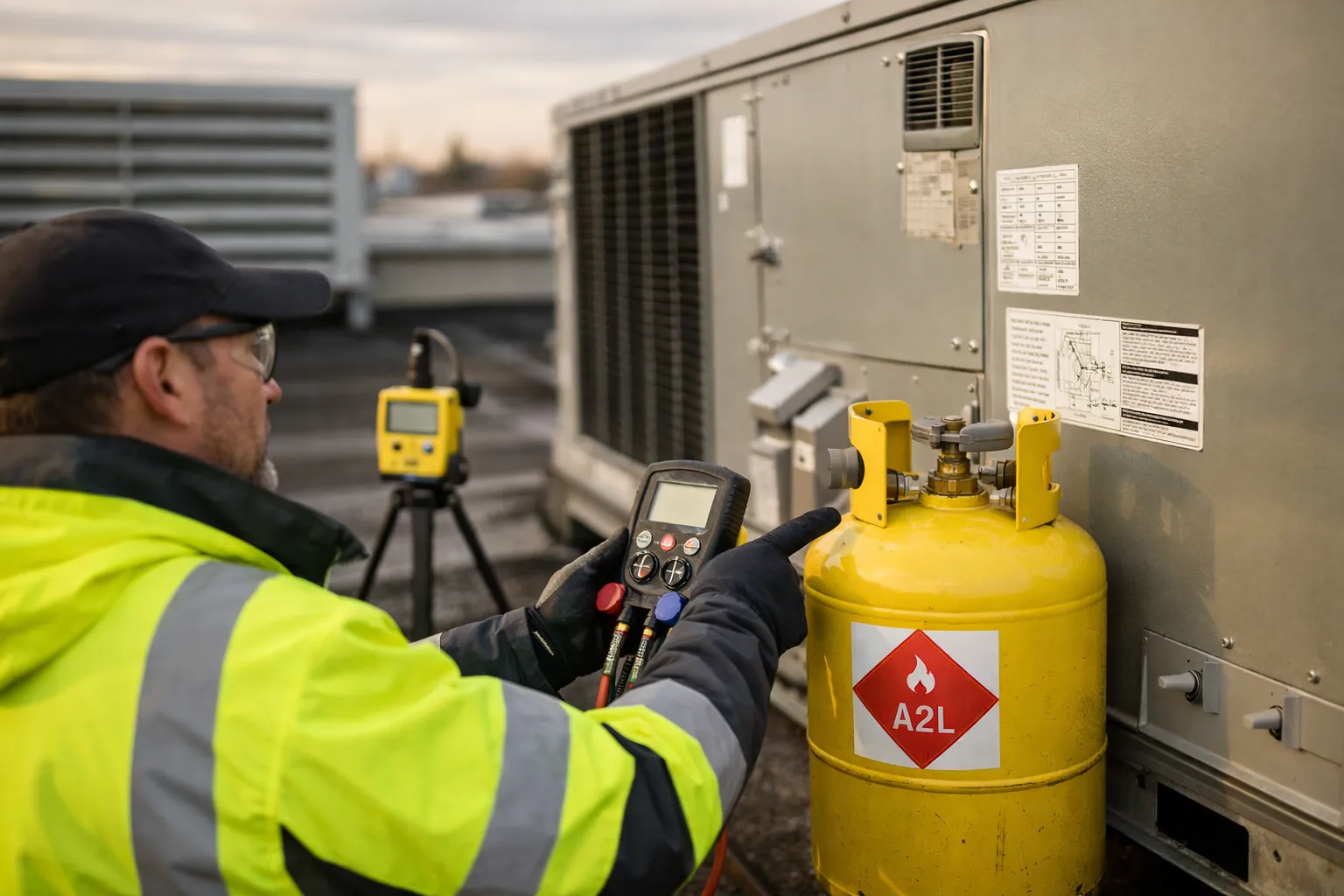
The International Code Council's 2026 model-code cycle introduced a set of revisions that significantly ease previous restrictions on mildly flammable (A2L) refrigerants in many commercial HVAC applications. For contractors, service techs and system designers, the practical implications are immediate: permitting language, ventilation and detection requirements, and installation practices now require coordinated updates across procurement, training and field work.
What changed in the 2026 I‑Code cycle
Across the 2026 code updates, code committees approved proposals that expand where A2L refrigerants can be used in rooftop packaged units, split systems, and certain indoor air‑handling units. The revisions do not universally authorize unlimited charge sizes; instead they replace older, conservative prohibitions with performance‑based limits and prescriptive mitigations—ventilation, leak detection, and equipment‑room safeguards—making it technically feasible for many commercial rooftop and small packaged units to be specified with low‑GWP A2L blends.
Importantly, the model codes now emphasize integration with other standards (mechanical, fuel‑gas and electrical codes) and require specific documentation in permit applications and inspection checklists. Because these are model‑code changes, local adoption will vary: some jurisdictions will incorporate the 2026 I‑Codes quickly, others will delay or modify the language.
Why this matters now
- Manufacturers have ramped A2L‑rated product lines; broader code acceptance clears a permitting path in many jurisdictions.
- Owners pushing for lower‑GWP refrigerants can move forward with fewer design exceptions, lowering retrofit and new‑build barriers.
- Installers must adapt job planning, safety procedures, and documentation to meet the new code expectations.
Immediate impacts for HVAC contractors and installers
The shift in model‑code language affects four practical areas on every A2L job: permitting and AHJ engagement, ventilation and leak‑detection design, field procedures and tools, and workforce qualification.
1. Permits and AHJ coordination
Under the new language, permit submittals need to include refrigerant type and charge calculations, engineered ventilation or dilution strategies where applicable, leak‑detection system specifications, and manufacturer data that demonstrate compliance with the applicable mechanical and fire codes.
Action steps:
- Engage the local AHJ at design stage. Bring manufacturer cut sheets and the equipment’s compliance statements to avoid last‑minute plan rejections.
- Prepare clear written narratives showing how the proposed mitigations (ventilation, isolation, FDD) achieve the model‑code performance goals.
2. Ventilation, detection and equipment‑room changes
Permitted A2L installations typically require either increased natural or mechanical ventilation rates, automatic leak detection hardwired to shutdown/control sequences, or placement changes (e.g., rooftop vs indoor machine room) to meet charge thresholds. Where mechanical ventilation is required, fans, louvers and ducting need to be sized and interlocked with equipment operation.
Action steps:
- Include ventilation calculations in bid packages. Don’t treat ventilation as an afterthought—under‑sized dilution can trigger code noncompliance.
- Specify certified gas detectors rated for lower LFLs associated with A2L blends and ensure integration with the unit control logic for safe shutdowns.
3. Field practices, tools and commissioning
Installers must update service procedures: brazing practices, recovery equipment, pressure testing, and evacuation sequences all differ for A2L refrigerants. Leak‑checking and commissioning now commonly include documented FDD tests and proof‑of‑operation for forced‑ventilation interlocks.
Action steps:
- Stock A2L‑compatible service tools—recovery machines, hoses, fittings and brazing materials that are approved for flammable refrigerants.
- Institute commissioning checklists that demonstrate detector calibration, ventilation activation thresholds and safe‑shutdown sequences.
4. Training, certification and safety programs
Because A2L refrigerants introduce flammability considerations, worker protection and procedural changes are mandatory. Employers should update lockout/tagout, hot‑work permits and respiratory protection plans where applicable.
Action steps:
- Provide formal A2L training for technicians before assigning A2L service or installations—cover leak response, brazing in occupied areas, and updated recovery rules.
- Coordinate with manufacturers on product‑specific training and get documentation of staff training for permit and insurance records.
How to plan for jurisdictional variation
Model code adoption is not uniform. Some states and municipalities will adopt the 2026 I‑Codes with little change; others will patch the language or issue local amendments that tighten charge limits or add additional ventilation and detection requirements.
Best practices:
- Before bidding, check the local mechanical and fire codes and ask the AHJ whether the jurisdiction has adopted the 2026 I‑Codes and any local amendments.
- When working across multiple jurisdictions, standardize your documentation: create a modular permit packet that can be customized for the local requirements.
- Track upcoming local amendments—some jurisdictions are issuing interim guidance or bulletins to accelerate A2L adoption for decarbonization goals.
Bottom line for HVAC professionals
The 2026 model‑code changes mark a practical turning point: A2L refrigerants are moving from niche applications into mainstream commercial rooftop and packaged systems where mitigation measures make them viable. For contractors this is an opportunity—more product choices and owner demand—but also a clear mandate to upgrade processes: engage AHJs early, update ventilation and leak‑detection engineering, invest in A2L‑compatible tools, and verify staff training.
Adapting quickly will reduce permitting friction, limit rework, and position firms to capture the next wave of low‑GWP retrofits and new installations. For many shops, that work begins with a single step: a documented A2L readiness checklist and an early‑engagement call to the local code official.