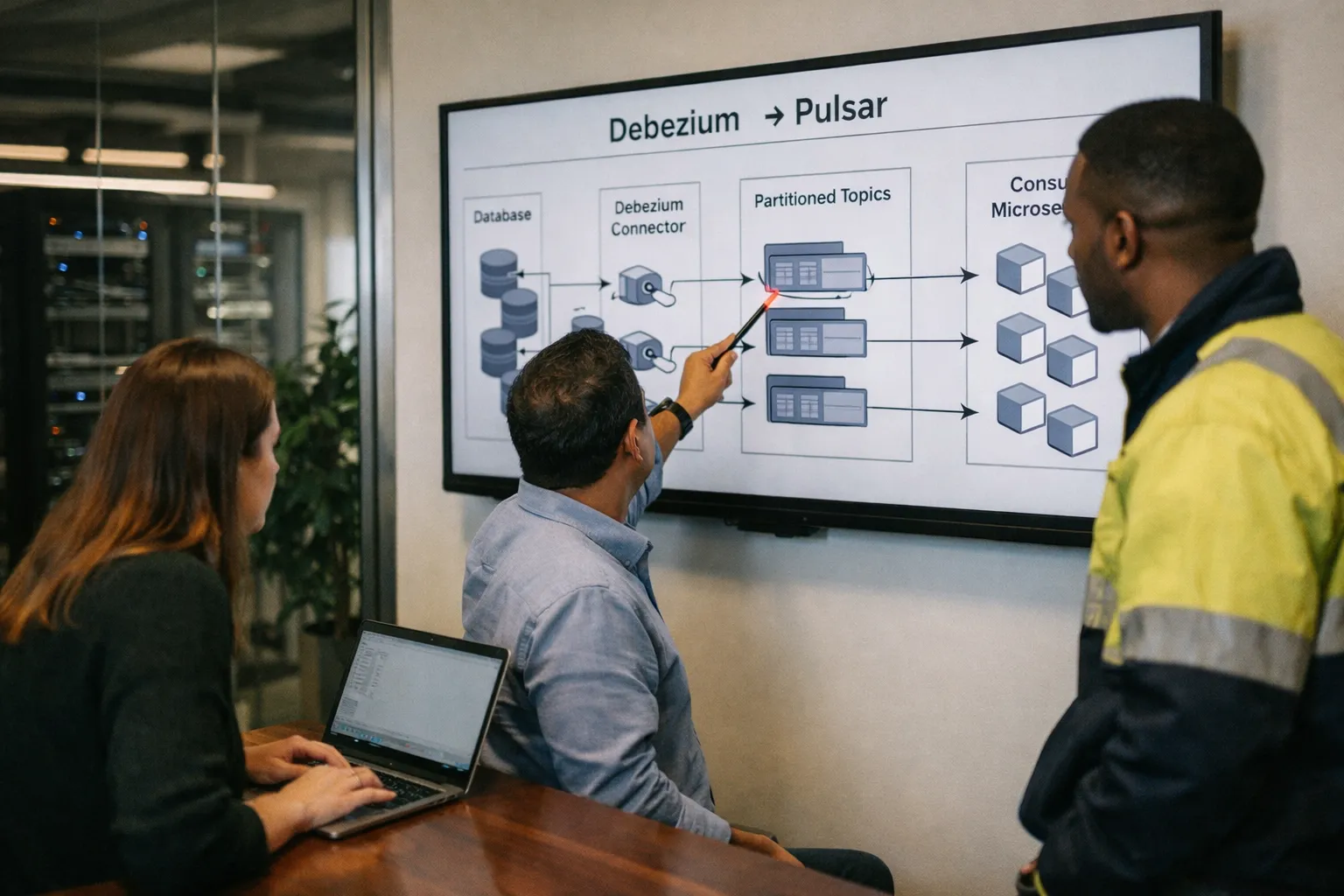
Change Data Capture (CDC) is the de facto pattern for near-real-time integration across enterprise systems. Paired with a cloud-native, multi-tenant messaging backbone, CDC lets organizations eliminate brittle ETL, reduce latency, and lower integration TCO. This guide shows a practical, end-to-end implementation of a CDC-driven integration layer using Debezium for source capture and Apache Pulsar for messaging and delivery.
Why Debezium + Pulsar for enterprise solutions?
This combination addresses five enterprise concerns:
- Scalability: Pulsar’s separation of compute (brokers) and storage (BookKeeper/managed tier) scales horizontally for high-throughput workloads.
- Integration flexibility: Debezium captures source changes from databases and publishes them in a change-log format that downstream consumers can consume without bespoke ETL.
- Durability & replay: Pulsar supports long-term retention and message replay for reprocessing or rebuilding materialized views.
- Operational model: Pulsar supports topic-level tenanting and fine-grained policies suitable for enterprise multi-team integration.
- ROI: Faster delivery of data to analytics, personalization, and fraud engines reduces time-to-insight and maintenance costs versus batch ETL.
Common enterprise use cases
- Inventory sync across microservices in retail (near-real-time stock levels)
- Fraud detection pipelines combining transactional events and identity signals
- Customer 360 assembly using materialized views and incremental updates
- Audit trails and regulatory reporting with immutable change logs
High-level architecture patterns
Three practical patterns you’ll see in the field:
- Direct Debezium → Pulsar (preferred when supported): Use Pulsar IO Debezium source to capture directly into Pulsar topics.
- Debezium → Kafka Connect → Pulsar via Kafka protocol handler: Useful when Debezium is already deployed into a Kafka Connect ecosystem and you want to migrate or integrate with Pulsar incrementally.
- Debezium → Kafka → Mirror to Pulsar / Bridge: For hybrid environments where Kafka and Pulsar coexist; use a mirror or connector to replicate topics into Pulsar namespaces.
Step-by-step implementation
1) Define integration contracts and SLAs
Start with a small bounded domain (e.g., orders & inventory). Define:
- Schema contract for change events (envelope format, key strategy)
- Latency SLA (99th percentile end-to-end)
- Retention policy per topic and access controls
- Backpressure and retry semantics
2) Inventory sources & plan connectors
List databases, versions, and replication settings. Debezium supports MySQL, PostgreSQL, SQL Server, Oracle (via LogMiner/XStream), MongoDB, and more. For each source capture:
- Replication user with minimal privileges
- Binary log or logical decoding enabled (e.g., WAL for Postgres)
- Primary keys identified (for upserts)
3) Choose your Debezium deployment model
Options:
- Kafka Connect-based Debezium cluster: Mature, with connector management and worker scaling.
- Debezium Server: Lightweight alternative that can publish to non-Kafka sinks; check availability of Pulsar sink in your Debezium Server distribution.
- Pulsar IO Debezium source: Deploy Debezium inside Pulsar IO if you want Debezium-managed connectors directly in Pulsar.
4) Topic modeling and partition strategy
Design topics by entity (e.g., orders, inventory, payments). Partition keys should map to your consumer parallelism needs (e.g., customer_id or SKU). Create partitioned topics in Pulsar:
pulsar-admin topics create-partitioned-topic persistent://tenant/namespace/orders -p 32Use more partitions for high throughput; size partition count to expected consumer concurrency and future growth.
5) Schema registry and evolution
Use a schema registry to validate and evolve event schemas. Pulsar has built-in schema support; you can also integrate Apicurio or Confluent Schema Registry. Enforce forward and backward compatibility rules and version your change event envelope.
6) Exactly-once, ordering, and idempotency
Debezium outputs logical change events (insert/update/delete). Consumers must implement idempotent upsert semantics keyed by primary key. Pulsar supports transactions and message ordering within partitions; test your end-to-end delivery guarantees and reconcile with database transactional boundaries.
7) Transformation, enrichment, and routing
Use lightweight stream processing for enrichment and routing. Options:
- Pulsar Functions for simple transforms
- Flink (or Pulsar + Flink) for complex, stateful processing
- Use serverless processors for per-tenant customization
8) Testing and validation
- Start with a pilot source; validate schema, ordering, and latency end-to-end.
- Run consumer replays and verify idempotency and materialized views are correct.
- Inject schema changes to validate compatibility rules.
- Simulate connector lag and broker failures to verify resilience.
9) Monitoring, observability, and alerting
Key signals:
- Connector lag (Debezium transaction apply time vs. source position)
- Pulsar broker metrics: throughput, latency, backlogs
- Topic-level retention and storage growth
- Consumer-end metrics: processing rates and retry rates
Expose Debezium and Pulsar metrics to Prometheus and build Grafana dashboards. Add distributed tracing for long-tail latencies (OpenTelemetry).
10) Security, governance, and access controls
Secure replication users and connections (TLS + mTLS). Use Pulsar’s tenant/namespace RBAC to restrict producers and consumers. Put data-sensitive topics behind additional access controls; integrate with enterprise IAM (OIDC or LDAP).
Costing and ROI
Estimate cost across three buckets: infrastructure, engineering (integration & maintenance), and operational (monitoring & incident response).
- Infrastructure: Pulsar brokers + storage (BookKeeper / tiered). Use retention policies to limit long-term storage costs.
- Engineering: initial implementation time (sprints) and connector maintenance. CDC reduces custom ETL code, lowering ongoing dev costs.
- Operational: monitoring and on-call. Better observability reduces incident MTTR.
ROI template (annual):
Annual Benefits = (Hours saved on ETL maintenance * avg engineer rate) + (Revenue impact from faster analytics)
Annual Cost = Infra + Licenses + Operational SRE cost + Depreciated implementation labor
ROI = (Annual Benefits - Annual Cost) / Annual Cost
Example: If CDC eliminates 1,200 engineering hours/year (~$150k) and generates $200k revenue uplift by improving personalization, against $100k/year infra + 50k ops, ROI = (350k - 150k)/150k ≈ 133%.
Operational considerations & pitfalls
- Schema drift: Uncontrolled schema changes at source lead to broken consumers. Enforce schema change process.
- Primary keyless tables: Debezium requires keys for meaningful upserts; consider synthetic keys or exclude such tables.
- Large transactions: Large, long-running DB transactions cause bursts or connector lag. Tune Debezium snapshot & event batching.
- Retention planning: Unlimited retention increases storage costs. Use tiered retention and compaction for changelog topics used for state stores.
- Consumer scaling: Under-partitioning limits consumer parallelism; over-partitioning increases metadata overhead.
Example configuration snippets
Debezium MySQL connector minimal config (Kafka Connect JSON):
{
  "name": "mysql-orders-connector",
  "config": {
    "connector.class": "io.debezium.connector.mysql.MySqlConnector",
    "database.hostname": "db1.prod.internal",
    "database.port": "3306",
    "database.user": "replicator",
    "database.password": "REDACTED",
    "database.server.id": "184054",
    "database.server.name": "prod.orders",
    "database.include.list": "ordersdb",
    "table.include.list": "ordersdb.orders,ordersdb.order_items",
    "include.schema.changes": "false"
  }
}
Create a 32-partition Pulsar topic:
pulsar-admin topics create-partitioned-topic persistent://enterprise/production/orders -p 32Pilot checklist (30–60 day)
- Choose 1–2 representative sources and 3 consumer applications
- Deploy Debezium (Kafka Connect or Pulsar IO) in a controlled environment
- Publish change events to partitioned Pulsar topics with schema enforcement
- Validate consumer upserts and replays
- Measure end-to-end 99th percentile latency and connector lag
- Run failure/resilience tests (broker outage, connector downtime)
- Estimate production infra cost and document ROI assumptions
When to choose alternatives
CDC + Pulsar is not always the right answer. Consider alternatives when:
- You need strict global ordering across many entity types (append-only Kafka topics per entity may be simpler).
- Source DB cannot support logical decoding and vendor constraints block CDC.
- Low volume, infrequent batch updates where scheduled ETL is cheaper.
Conclusion
Adopting a CDC-driven integration layer anchored by Debezium and Apache Pulsar lets enterprises build scalable, resilient, and replayable integration pipelines. The pattern reduces custom ETL, improves data freshness, and delivers measurable ROI when implemented with deliberate topology, schema governance, monitoring, and operational playbooks. Start small, validate SLAs, and iterate to expand integration coverage across the organization.
Next steps: run the pilot checklist above, capture metrics for cost and latency, and map ROI to one or two measurable business outcomes (e.g., reduced stockouts, faster fraud detection) to secure executive sponsorship.