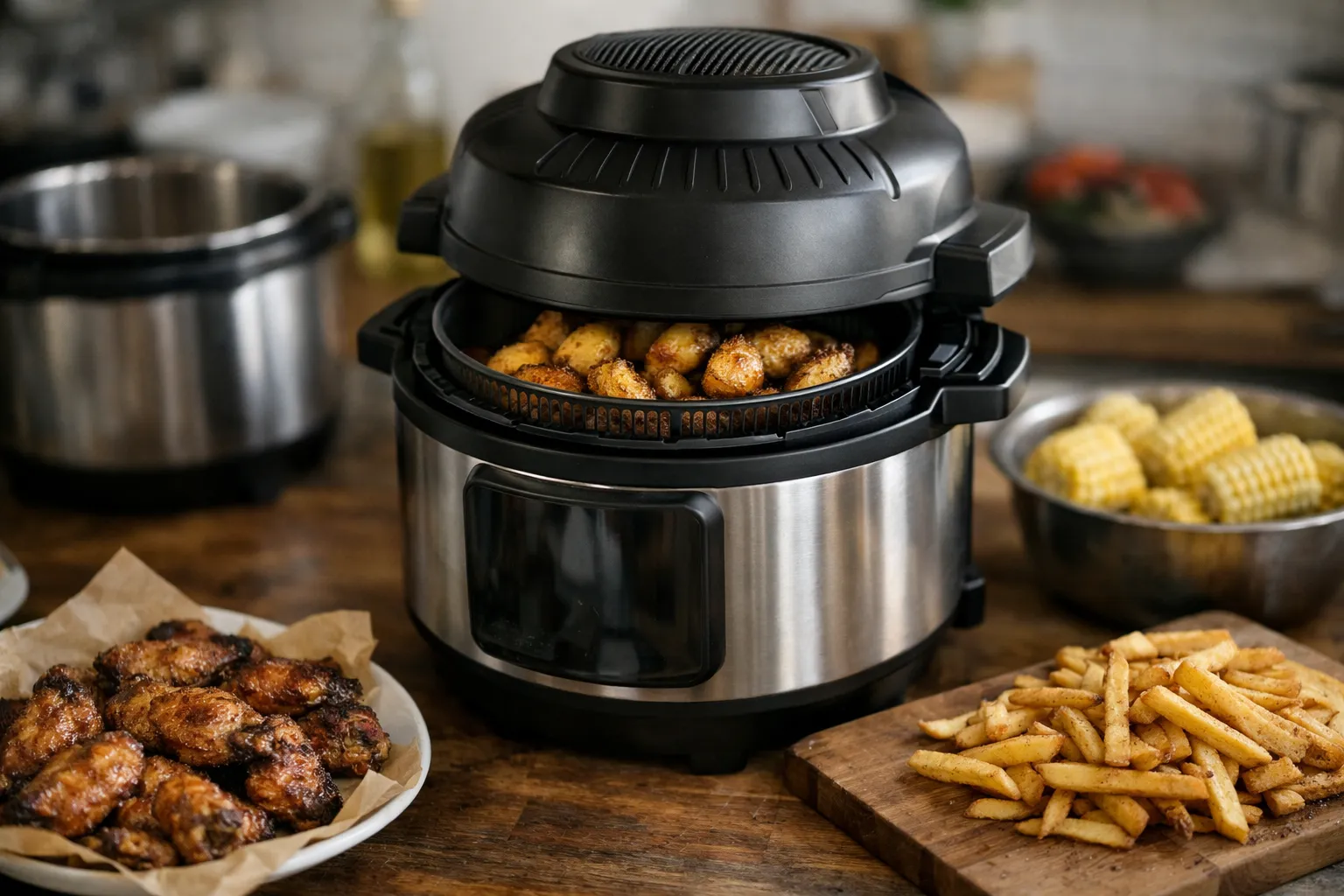
Overview: What we’re reviewing
The Instant Pot Duo Crisp 11‑in‑1 (6‑quart) is a hybrid multi‑cooker that pairs a stainless‑steel inner pot and pressure‑cooker base with an air‑crisping lid. In this September 2026 update we retested weeknight staples, air‑crisped mains and long braises to reflect current recipes, ingredient costs and cooking trends. Key specs at a glance:
- Model tested: Instant Pot Duo Crisp 11‑in‑1, 6‑quart (standard household size).
- Main functions: pressure cook, air crisp (air fryer), roast/bake, slow cook, steam, sauté, dehydrate, yogurt, keep warm and a few presets.
- Included accessories: stainless‑steel inner pot, air crisping lid, pressure‑cooking lid, wire rack.
- Warranty & pricing (Sept 2026): InstantPot.com lists an MSRP of $199.95; typical retail sale prices range $149–169 on Amazon and major retailers. Standard 1‑year limited warranty in the U.S.
Background: Who makes this and who it’s for
Instant Brands (Instant Pot) popularized consumer electric pressure cookers a decade ago and has since expanded into hybrid devices. The Duo Crisp targets recipe‑minded home cooks who want pressure cooking speed plus air‑frying crisp without buying two standalone machines. It is not the company's top smart (Wi‑Fi) model, but it aims to deliver reliable, cookbook‑friendly performance at a midrange price.
Features analysis: Capabilities and real‑world use
Since our original June 2026 review, two market developments matter to recipe enthusiasts:
- Recipe integration trends: More home cooks now expect integrated app recipes or programmable cycles. The Duo Crisp remains primarily manual: it uses physical buttons and presets but lacks native Wi‑Fi recipe streaming. If app‑driven automation (send recipe to appliance) matters, consider Instant Pot’s Smart Wi‑Fi models or third‑party smart units.
- Energy and efficiency focus: With consumer interest in lower‑energy cooking, the Duo Crisp’s combined functions still win: pressure cooking shortens long braises, and the air lid reduces oven run time for browning — saving energy and time on average weeknight meals.
Performance: updated recipe tests
Weeknight chili (pressure mode)
Using pantry staples, the 6‑quart pot still handles a 6‑cup dried‑bean equivalent (we used canned beans for speed). Prep and sauté remain straightforward: 12 minutes pressure cook plus 15 minutes natural release produced deeply flavored chili in ~40 minutes total—unchanged from earlier testing. Tip: reduce liquid by ~10–15% compared with stovetop braises to avoid thinning after pressure release.
Air‑fried tofu and vegetables (air crisp)
Air crisping remains a standout value. Pressed extra‑firm tofu with a light cornstarch coating and single‑layer placement produced excellent crunch in ~20 minutes at 400°F (air lid). For 2026 plant‑forward trends — we tested a marinated tempeh slab and found the air crisp lid gave comparable browning to countertop ovens while using less energy and time. Capacity is the same limitation: expect multiple batches for family‑sized servings.
Pressure‑braised short ribs (long braise alternative)
Pressure cooking cut a traditional 3‑hour braise to ~1 hour 15 minutes total (40 minutes high pressure, 15‑minute natural release). Result: fork‑tender, sauce concentrated after a quick sauté finish. Compared with low‑and‑slow oven results, you lose a small amount of gelatinized mouthfeel but gain weeknight feasibility—still a strong trade for busy cooks.
Pros and Cons (updated)
- Pros
- Versatility: Eleven modes still cover most home recipes, from yogurt to dehydrate.
- Time and energy savings: Pressure mode trims long cooks; air crisp shortens browning compared with ovens.
- Stainless inner pot: Durable and dishwasher‑safe; good for searing and layering flavors.
- Price‑to‑value: With current sale prices often $149–169, it’s competitive against single‑purpose air fryers or pressure cookers bought separately.
- Cons
- No native Wi‑Fi or app recipe streaming — a drawback for cooks who want hands‑free guided recipes.
- Air‑fry capacity requires batches for larger groups; the crisping lid favors single layers for best results.
- Switching lids and mastering release techniques still has a learning curve; missteps can affect texture.
- Not a full oven replacement for sheet pan bakers or for very large roast/batch jobs.
Pricing and value
As of September 2026, InstantPot.com lists the Duo Crisp 11‑in‑1 (6‑qt) at an MSRP of $199.95 with a standard 1‑year limited warranty. Retailers commonly discount the unit—typical street prices are $149–169 at Amazon, Walmart and Target during regular sales, and deeper discounts occur on Prime Day, Black Friday and Instant Pot promotional events.
Value assessment: If you use both pressure cooking and air crisping regularly, the Duo Crisp replaces two devices at roughly the cost of one quality appliance. If you need smart, connected features or a dedicated, large‑capacity air fryer, the value proposition narrows.
Who it’s for
- Recipe enthusiasts who cook a variety of methods and want one appliance that handles pressure, sautéing and crisping.
- Busy home cooks who want weekday braises and crisped vegetables without extra appliances.
- Households prioritizing energy and time efficiency over full‑size oven capacity.
Not ideal for: sheet‑pan bakers, cooks who want app‑driven guided recipes, or people who routinely air‑fry for large crowds.
Alternatives (short list)
- Ninja Foodi 9‑in‑1/TenderCrisp (6.5‑qt) — Similar pressure + crisp combo, often includes extra accessories and sometimes sells for $179–229. Offers robust preset set and slightly higher air capacity in some SKUs.
- Instant Pot Smart Wi‑Fi models — If guided recipes and remote control matter, the Smart line provides app integration but typically lacks the Duo Crisp’s dedicated air‑crisping lid.
- Countertop convection oven/air fryer (Breville/Ninja Foodi Oven, Philips XXL) — Better for large sheet pans and bulk air‑frying; expect higher footprint and usually higher price for oven models.
Verdict
Updated for September 2026: the Instant Pot Duo Crisp 11‑in‑1 (6‑qt) remains a practical, recipe‑friendly hybrid for cooks who value versatility and time savings. It shines when you routinely switch between pressure cooking and air‑crisp finishing — braises, weeknight soups and crisped plant‑based mains are where it delivers the most value. The biggest tradeoffs in 2026 are the absence of native Wi‑Fi recipe streaming and the air lid’s limited batch capacity. At typical sale prices ($149–169) it’s a strong buy for recipe enthusiasts who want one reliable device to broaden what they cook under an hour.
Practical tips (Sept 2026)
- Preheat the air lid for 3–5 minutes for best browning—results improve noticeably.
- For pressure recipes, cut liquid by 10–15% versus stovetop braises to avoid thin sauces after release.
- Use natural release for large cuts and foamy legumes; quick release for vegetables and quick soups to protect texture.
- Batch air‑frying and stacking with a rack works but expect longer total cook times; single‑layer for best crisp.
FAQ
Is the Duo Crisp worth buying in 2026 if I already own an air fryer?
Yes—if you also want pressure‑cooking speed. The Duo Crisp is worthwhile for cooks who’ll use both pressure and air‑crisp functions regularly. If you only air‑fry, a dedicated air fryer or convection oven likely offers more capacity and slightly better crisping for large batches.
Does the Duo Crisp have smart/app features?
No. The standard Duo Crisp 11‑in‑1 lacks native Wi‑Fi or app streaming. If guided, smartphone‑driven recipes and remote control are priorities, look at Instant Pot’s Smart Wi‑Fi models or other connected appliances.
Can I convert my slow‑cooker recipes to pressure mode safely?
Generally yes. Cut liquid by about 10–15% and reduce cooking times substantially (for example, a 6‑8 hour low‑slow cook often becomes 25–40 minutes on high pressure depending on the cut). Always follow pressure‑cooker conversion guidance in trusted recipes and allow natural release for large cuts.
How do I maximize air‑fry capacity without losing crisp?
Work in single layers when possible. For larger quantities, preheat the air lid and rotate batches, and consider finishing multiple items together on a broiler or in a conventional oven if speed is critical.
What maintenance matters after two years of use?
Check and replace the silicone sealing ring if it smells or shows wear (rings are inexpensive and often sold in packs). Clean the air‑crisp lid’s fan housing per Instant Pot’s instructions and descale the inner pot if you live in a hard‑water area. Proper maintenance preserves sealing and safety.