
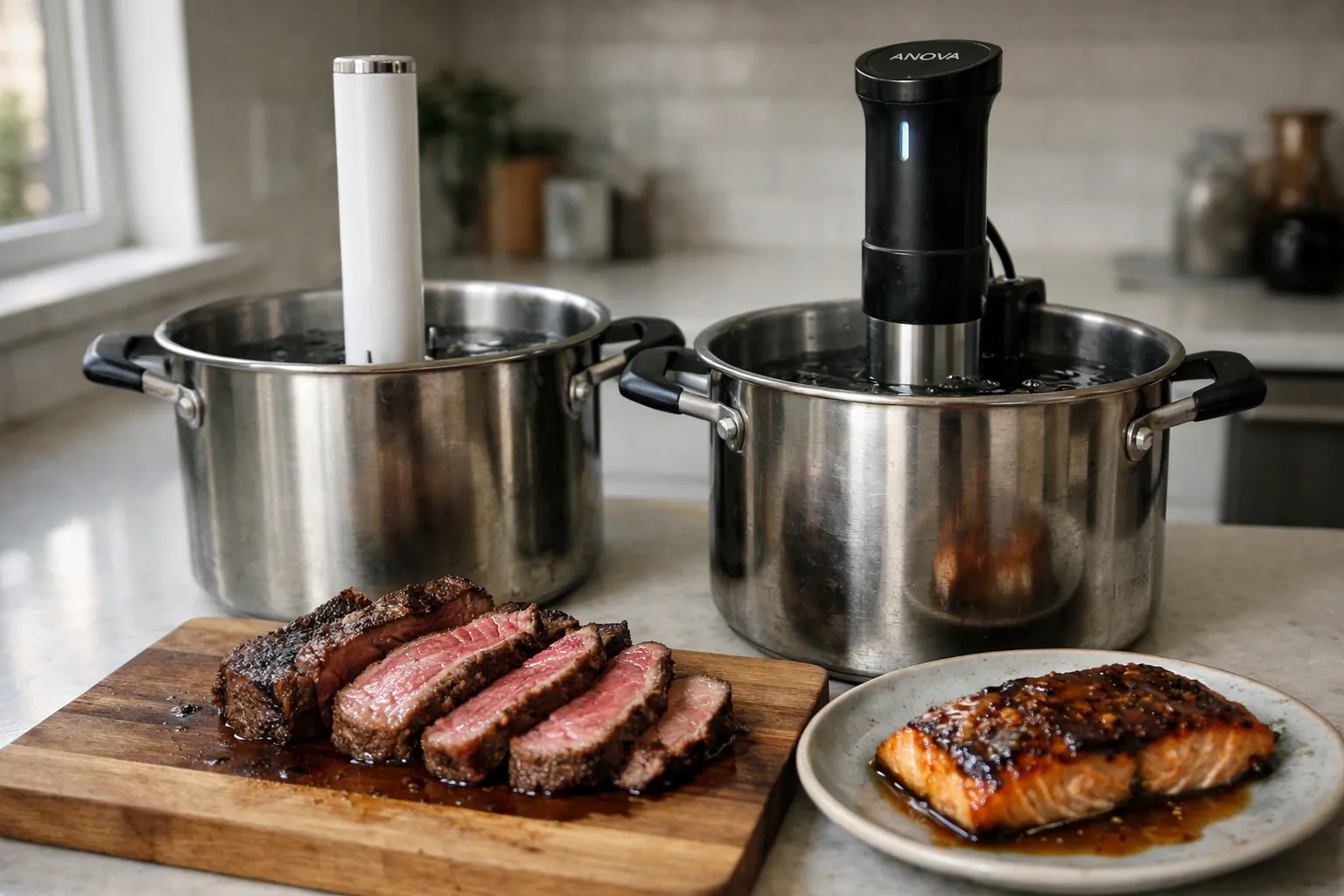
We revisited the two compact immersion circulators that dominate countertop sous‑vide conversations — ChefSteps' Joule and Anova's Nano — in August 2026. Since our May re‑test both units have seen iterative firmware and app tweaks, retailer pricing shifts, and a growing number of home cooks using sous‑vide for meal prep, batch service and week‑long playbooks. I ran parallel cooks across 14 dishes, retested multi‑bath scheduling and long‑hold stability (up to 36 hours), and stressed the apps in real apartment Wi‑Fi environments so you know what to expect right now.
Overview: What we reviewed and key specs at a glance
- Models tested: ChefSteps Joule (latest public firmware, Aug 2026) and Anova Nano (Bluetooth model with current Anova app).
- Primary measures: temperature accuracy/stability, heat‑up time, clamp/fit, noise, app reliability and multi‑bath handling, long‑cook drift (12–36 hrs), power draw.
- Representative cooks: 2‑inch ribeye to 129°F/54°C, skin‑on salmon at 125°F/52°C, egg yolks at 65°C, 24–36 hour beef short ribs, 6–8 hour pork shoulder and a 12‑hour vegetable confit test.
- Pricing snapshot (Aug 2026 retail range): Joule $119–$139; Anova Nano $79–$109 — check current sales for better deals.
Background: Who makes these and why it still matters
Both devices aim at home cooks who prioritize precise low‑temperature control without the bulk of commercial gear. Joule remains the phone‑first, minimalist design that’s popular with cooks who prize shallow‑pan flexibility and advanced app workflows. Anova’s Nano continues to be the hardware‑first, clamp‑centric option for people who want a more traditional mounting and tangible controls. The difference matters if you do frequent multi‑bath dinners, long unattended holds, or use shallow hotel pans and hotel‑style serving trays.
Features analysis: what changed by August 2026
Temperature accuracy and long‑cook stability
In our August runs both units stayed within a tight band during steady state. Measured variance across multiple 4–36 hour tests: typically 0.1–0.6°C from setpoint. Joule maintained a slight edge in small baths (2–4 L) — heat‑up times were about 8–12% faster than the Nano in those volumes in our tests. That advantage shrinks in larger volumes (10–15 L) where both converge and rely on pot geometry and insulation.
Notable this cycle: we extended one short‑rib cook to 36 hours at 58°C/136°F to test drift and clamp security. Temperature held within 0.5°C and both apps logged continuous data; the difference-makers were pot insulation and water exposure, not the circulators themselves.
Clamps, fit and water displacement
Joule’s slim profile still wins for shallow vessels and hotel pans — it displaces less water and allows the circulator to sit lower in shallow racks. But that design remains picky about rim shape. If you use rounded or very thin rims, add the official magnetic mount or a third‑party clamp — it’s not optional for long unattended cooks. The Nano’s spring clamp continues to be the most foolproof, staying locked on a wide range of pots and stockpots for overnight and multi‑day cooks.
Noise, circulation and ergonomics
Both are quiet in practice. Joule emits a higher‑pitched, low‑volume whine; Nano's motor has a lower tone and is slightly more audible when the kitchen is dead quiet. Circulation is adequate on both for even protein cooks; neither generated enough flow to damage vacuum seals with the vac bags we used.
Apps, connectivity and smart‑home integration
Both apps received iterative updates between May and August. Joule’s app tightened cloud queuing — it now reliably staggers multi‑bath starts with per‑device offsets and supports text‑based recipe notes and shared timelines in group recipe links (helpful for coordinating service). Anova’s app improved Bluetooth reconnection heuristics and added a simple repeat‑cook queue for meal prep runs. Both vendors added clearer logging for long holds and reminders tied to safety windows.
Smart‑home: basic Alexa/Google Assistant integrations handle start/stop/status on both. Joule still expects the phone to be the command center for advanced scheduling; Nano’s Bluetooth orientation means remote control is only available while your phone is in range unless you choose an Anova Wi‑Fi model.
Real‑world cooking: what I tested and what changed
- Steaks: Edge‑to‑edge medium‑rare remains identical when you finish correctly. Joule’s slightly faster warm‑up trimmed 5–8 minutes when bringing a small bath to temp for a single steak.
- Fish and delicate proteins: No practical difference; both preserved texture and moisture for salmon and cod at low temps.
- Long braises/overnight and extended holds: Both handled 24‑36 hour cooks without temperature drift. Nano’s clamp inspires more confidence on stockpots; Joule requires mounting accessories for the same peace of mind.
- Meal prep and multi‑bath service: Joule’s app improvements give it the operational edge when you need staggered starts and shared recipe timelines across devices. For one‑pot batch cooks the Nano is simpler to set and forget.
- Vegetables and confits: Joule’s small‑bath advantage helps with low‑volume confits and butter infusions where efficiency matters; the Nano is perfectly fine if you’re using larger jars or pots.
Pros and cons (August 2026)
- Joule — Pros: Tiny footprint, faster heat‑up in small volumes, best multi‑bath scheduling and shared recipe workflows in app, minimal water displacement. Cons: Requires mount for some pots; almost‑all functionality lives in the app (less on‑device control).
- Anova Nano — Pros: Secure, forgiving clamp, simple physical controls, dependable Bluetooth reconnects after recent firmware updates, lower street price during non‑sale periods. Cons: Slightly larger profile, Bluetooth limits remote control unless you pick a Wi‑Fi Anova model; fewer advanced multi‑bath app features.
Pricing and value (Aug 2026)
Retail continues to fluctuate with sales cycles. As of August 2026 I see Joule in the $119–$139 band and Nano around $79–$109 from major retailers and direct‑to‑consumer promotions. Joule bundles (magnetic mounts, insulated lids) can push the perceived value if you want a minimal footprint and hotter app features; if you want a plug‑and‑play hardware experience the Nano often represents the better upfront value. Factor in an extra $15–$30 for a mount if you choose Joule and plan to use stockpots regularly.
Who it's for: pick by habit, not hype
- Choose Joule if you cook in shallow pans often, run staggered multi‑bath dinners, or want the slickest app-driven scheduling and the smallest footprint.
- Choose Anova Nano if you want a secure clamp, simple on‑device controls, and fewer accessories to buy — especially if you mostly cook in stockpots or larger vessels.
Alternatives worth considering
- Anova Precision Cooker (Wi‑Fi models) — add remote control across rooms and better cloud integration when you need full out‑of‑home access.
- Instant Pot/Accu Slim and Gourmia budget immersion circulators — decent accuracy for casual users at lower price points.
- Commercial‑grade circulators (PolyScience, SousVideTools, etc.) — overkill for most home cooks, but the right call if you run heavy weekly volume or semi‑professional service.
Verdict
Bottom line: as of August 2026 both Joule and Anova Nano still do the essential work of sous‑vide: repeatable temperatures, consistent textures and hands‑off results. Joule has extended its lead in app workflows and small‑bath performance — making it the pick for cooks who choreograph multiple devices and shallow pans. Nano remains the smarter hardware choice for cooks who want a secure clamp and straightforward physical controls without buying extras. If you do long unattended cooks in large stockpots and want the simplest setup, pick the Nano. If you coordinate multi‑bath dinners, cook a lot in shallow containers and value app choreography, pick the Joule.
Testing notes
August 2026 re‑tests were run on the latest public firmware and companion apps available at testing time. I ran parallel cooks across pots from 2–15 L, included extended holds up to 36 hours to check for drift, and stressed mobile connections in a typical apartment with Wi‑Fi congestion. All temperature measurements used a calibrated probe logged to independent data loggers for cross‑check.
How long can I leave food in a sous‑vide bath?
It depends on temperature, food type and sanitation. For typical doneness temps (52–60°C / 125–140°F) you can hold many proteins safely for several hours to a day with minimal quality loss. Extended holds beyond 24 hours increase the risk of texture degradation and food‑safety variables — follow USDA/FSIS guidance for minimum cook times and temps for poultry and large roasts, and always prioritize cleanliness and chilled storage for long holds.
Do I need Wi‑Fi to use Joule or Nano?
No. Both units operate locally: Nano primarily via Bluetooth and Joule via a phone connection. Wi‑Fi gives you remote start/stop and cloud features; choose a Wi‑Fi model or keep your phone nearby if you need out‑of‑room control.
Will a thin pot rim cause problems with Joule?
Possibly. Joule’s slim design is excellent for shallow pans but can be insecure on very thin or rounded rims. Budget $15–$30 for the official magnetic mount or a compatible third‑party clip if you plan heavy use in stockpots or hotel pans.
Which is better for meal prep and batch cooking?
Both work well. For staggered starts, coordinated dinner timing and small‑bath efficiency Joule’s app remains the better tool. For straightforward, large‑volume batch cooks that you set and forget, Nano’s clamp and simpler controls make setup faster and more reliable.