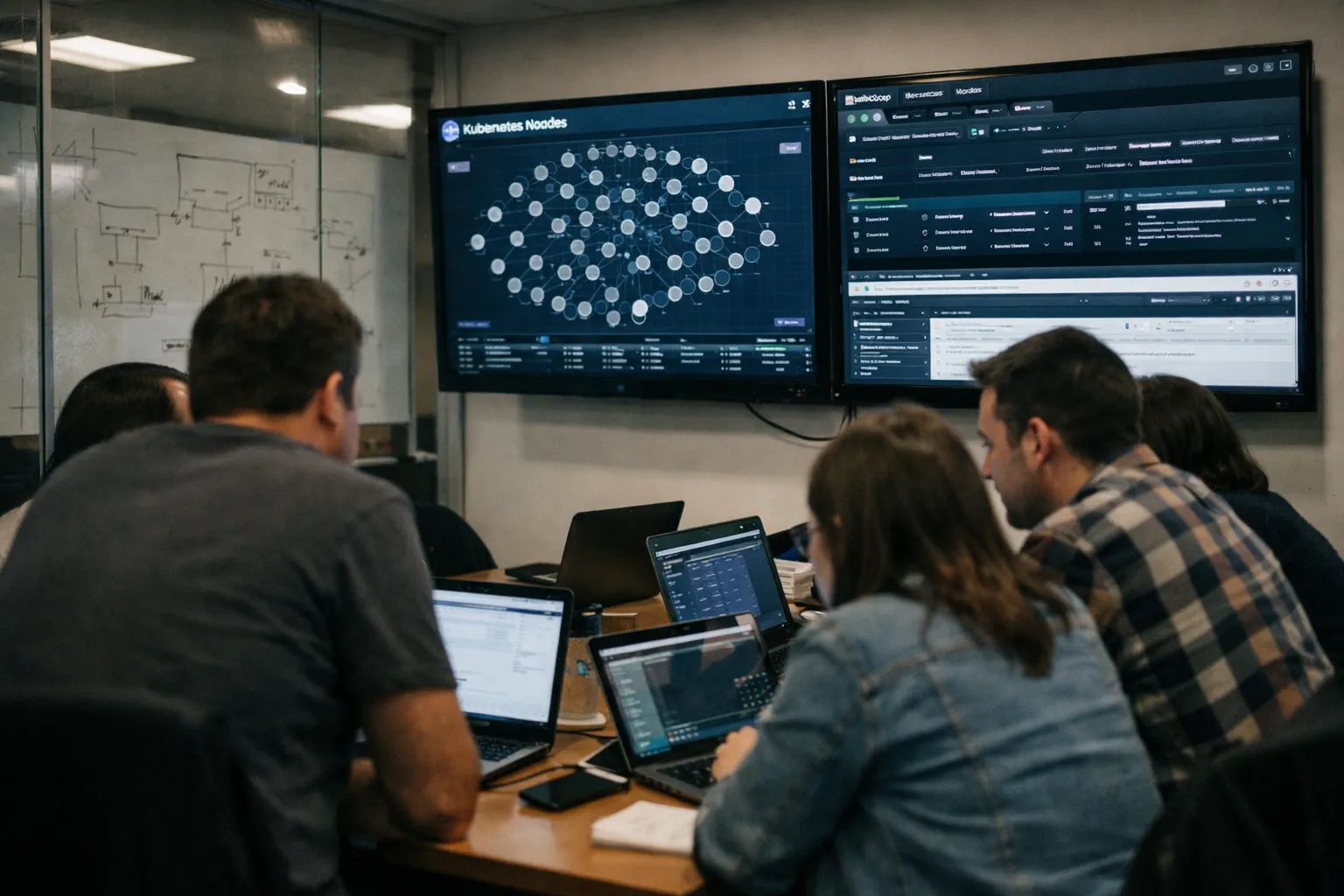
Enterprise teams choosing a container orchestration platform in June 2026 face an environment that has evolved beyond raw scale: new workload classes (GenAI inference, WebAssembly), heightened cost scrutiny after three years of cloud budget tightening, and stronger regulatory demands for supply‑chain and runtime provenance. This updated comparison of Kubernetes, HashiCorp Nomad and AWS ECS keeps the original framework (scalability, integration, implementation, ROI) but adds 2026‑specific realities and practical examples so platform owners can make a timely decision.
Why this comparison matters in 2026
Orchestrators now power not just web services but latency‑sensitive ML inference, ephemeral edge workloads, and mixed compute types (containers, VMs, Wasm runtimes). The choice affects operational cost, developer velocity, regulatory compliance (SBOMs, runtime attestation), and the ability to use specialized hardware (GPUs, DPUs). Kubernetes remains the broad ecosystem leader; Nomad has sharpened its case for mixed workloads and simpler ops; and AWS ECS continues to appeal to AWS‑first enterprises seeking operational simplicity. The right pick is situational—grounded in workload mix, talent, and vendor strategy.
Comparison criteria — what matters now
We apply consistent, enterprise‑focused criteria updated for 2026 realities:
- Scalability & specialized hardware: horizontal/vertical scale, multi‑cluster and multi‑region, GPU/TPU/DPUs and low‑latency inference support.
- Integration & ecosystem: CI/CD, observability, service meshes, service‑to‑service policy, supply chain tooling (SBOM, attestation), and Wasm/VM runtime support.
- Implementation effort & skills: time to production, platform engineering needs, learning curve, and migration complexity.
- Operational cost & ROI: infrastructure spend (including spot/spot‑like), staffing, tooling, and developer productivity gains.
- Security, governance & compliance: policy‑as‑code, secrets management, runtime protection and auditability for regulated industries.
- Fit‑for‑purpose: which platform best serves GenAI inference, batch/ETL, edge/Wasm, or strictly cloud‑native services.
Short overview
- Kubernetes — largest ecosystem, mature operators for stateful apps and ML stacks (Kubeflow, KServe variants); best when multi‑vendor portability and rich integrations matter. Requires significant platform engineering to extract value.
- HashiCorp Nomad — lightweight scheduler for mixed workloads: containers, VMs, batch, and in many shops, Wasm via community runtimes. Favored where simplicity, predictable scheduling latency and HashiCorp integration matter.
- AWS ECS — AWS‑native container orchestration with Fargate serverless compute. Fastest to market inside AWS accounts; tight integration with IAM, CloudWatch and other AWS controls but limited portability outside AWS.
Scalability & specialized workloads
Kubernetes: Continues to demonstrate hyperscale capability; major cloud providers and on‑prem distributions support multi‑cluster control‑plane patterns. In 2026 the ecosystem added more mature operator patterns for GPU scheduling and node‑pool specialization, and the CNCF community stabilized several autoscaling extensions. Large enterprise clusters still require experienced SREs to tune control‑plane resilience and scheduling for thousands of nodes.
Nomad: Retains a simpler control plane and predictable scheduler behavior for mixed workloads. Enterprises deploying high‑throughput batch jobs, periodic ETL, and stateful services report consistent scheduling latency and easier horizontal scaling. Nomad adoption for GPU‑backed ML inference has increased where teams prefer a single scheduler for mixed workloads rather than Kubernetes' heavier ML ecosystem.
AWS ECS: Scales effectively within AWS and leverages Fargate and EC2 Auto Scaling for capacity. For GPU inference, ECS integrates with EC2 GPU instances; however, multi‑region/global fleet orchestration and hybrid on‑prem requirements remain more complex than Kubernetes multi‑cluster toolchains.
Integration & ecosystem (2026 specifics)
Kubernetes: The ecosystem remains the deepest: operators for databases, K8s-native ML stacks (Kubeflow forks, KServe variants), service meshes, OpenTelemetry pipelines and a mature CSI landscape. Kubernetes also remains the locus for Wasm runtimes (WasmEdge, Wasmtime integrations) and multi‑runtime orchestration via KubeVirt and Kata containers.
Nomad: Strong, predictable integrations with HashiCorp Vault, Consul and Terraform remain a differentiator. Nomad's ecosystem for observability and policy is smaller but focused; teams pairing Nomad with OpenTelemetry and Prometheus exporters achieve parity for metrics and traces with fewer moving parts.
AWS ECS: Deep, first‑class integration with AWS services simplifies identity, networking, logging and cost allocation. ECS now fits smoothly into modern AWS observability and security control planes, reducing bespoke integration work for AWS‑heavy enterprises.
Implementation effort & platform engineering
Kubernetes: Expect weeks to months to reach production‑grade clusters. Platform engineering teams in 2026 commonly supply curated platform APIs (GitOps via ArgoCD/Flux, policy via Open Policy Agent) to shield developers. The investment is substantial but pays off where many internal teams consume shared services.
Nomad: Shorter time to production for mixed workloads. Nomad’s job spec and smaller control surface reduce onboarding friction; many teams reported platform readiness in days to weeks for core services. Organizations using HashiCorp Cloud Platform or SaaS offerings further reduced time to value.
AWS ECS: Fastest path for AWS shops, particularly with Fargate. For greenfield microservices, teams move from code to production in days. The tradeoff is less control over node‑level tuning and portability outside AWS.
Operational cost & ROI (what to model in 2026)
Key levers to quantify in 2026:
- Compute mix: Spot/interruptible instances, Fargate serverless, and reserved capacity for GPUs materially change cost profiles. Model GPU utilization and spot eviction handling for inference workloads.
- Engineering labor: Kubernetes typically needs more SRE/platform engineers; Nomad reduces platform surface area; ECS shifts effort into AWS account and policy management.
- Tooling and compliance: Supply‑chain verification (SBOMs), attestation and runtime policy tooling add recurring costs. Kubernetes investments in policy and operator management can be significant.
Practical example: enterprises running high‑volume, latency‑sensitive inference often cut unit compute costs by mixing spot GPU instances and specialized scheduling; that mix is easier to control in Kubernetes or Nomad than in pure Fargate models. Conversely, organizations prioritizing predictable operational spend and rapid onboarding still find ECS + Fargate delivers the fastest payback.
Security, governance & compliance
In 2026 the regulatory and risk landscape emphasized SBOMs, runtime attestation and policy‑as‑code. All three platforms can meet enterprise compliance, but operational approaches differ:
- Kubernetes: Offers mature RBAC, network policies, OPA/Gatekeeper for policy enforcement, and ecosystem tooling for SBOM and attestation. Implementing and auditing end‑to‑end supply‑chain controls requires platform engineering and CI/CD integration.
- Nomad: When paired with Vault and Consul, Nomad delivers a compact, auditable stack with simpler attack surface. Enterprises appreciated Nomad’s smaller footprint for reducing blast radius and easing compliance proof points.
- AWS ECS: Uses AWS IAM, service control policies and account boundaries to centralize governance. For AWS‑regulated workloads, ECS simplifies audit trails but increases reliance on AWS primitives.
Side‑by‑side summary
- Best scalability for heterogeneous, multi‑vendor environments: Kubernetes
- Best simplicity for mixed workloads and faster ops: Nomad
- Best fastest path inside AWS with minimal ops: AWS ECS + Fargate
- Best for GPU/ML inference when portability matters: Kubernetes or Nomad (depending on existing stack)
- Best for predictable, managed spend in AWS: ECS/Fargate
Choose this if… (2026 scenarios)
- Choose Kubernetes if you need the largest ecosystem, vendor portability, and plan to run many stateful, data‑heavy services or curated ML platforms across clouds or on‑prem.
- Choose Nomad if you run mixed workloads (batch, services, VMs), want faster platform delivery with fewer SREs, and already use HashiCorp tooling (Vault/Consul/Terraform).
- Choose AWS ECS if your estate is AWS‑centric, you want a low‑ops path to production (especially via Fargate), and vendor lock‑in is an acceptable tradeoff for reduced operational overhead.
Updated migration & pilot checklist (2026)
Before committing, run a four‑week pilot that includes these 2026‑specific items:
- Catalog workloads by runtime needs: containers, VMs, Wasm modules, GPU/TPU usage and inference latency constraints.
- Map supply‑chain controls: SBOM generation, signature verification, and CI/CD attestation flows.
- Test cost scenarios: simulate spot eviction for GPUs, Fargate pricing, and reserved instance commitments over 12–36 months.
- Measure developer workflow impact: time to deploy (CI→prod), rollbacks, and mean time to recovery for injected failures.
- Include sustainability and cost metrics: power usage, carbon reporting (if relevant), and unit cost per inference or request.
Recommendations — pragmatic next steps
- Define the one or two business outcomes that matter most (e.g., lower ops cost, reduce time‑to‑market for inference, multi‑cloud portability).
- Run a representative pilot for 4–12 weeks with a cross‑functional team (devs, SREs, security). Collect metrics: cost per service, deployment lead time, incidents, and developer satisfaction.
- Decorrelate cost vs. platform decisions: some savings come from commit strategies (reserved/spot), not just the orchestrator choice.
- Standardize platform APIs (GitOps, policy-as-code) to reduce future migration friction regardless of the orchestrator you pick now.
FAQ — common enterprise questions in mid‑2026
Is Kubernetes overkill for most enterprise workloads in 2026?
Not necessarily, but often yes for small teams or narrow workload sets. Kubernetes provides unmatched ecosystem depth; however, if your organization runs mostly homogeneous services or mixed batch/VM workloads and wants lower ops cost, Nomad or ECS can be more efficient. Run a short pilot to measure platform engineering overhead relative to business benefit.
Can Nomad handle GenAI/ML inference workloads effectively?
Yes—many teams now run inference on Nomad, especially when they want a single scheduler for batch, service and VM‑based ML toolchains. Nomad's simpler scheduling and integration with Vault/Consul are attractive. For teams needing advanced K8s operators or ecosystem ML tooling (Kubeflow variants, serving frameworks), Kubernetes may still be preferable.
How serious is the vendor‑lock‑in risk with ECS in 2026?
ECS provides operational speed inside AWS, but it increases reliance on AWS primitives (IAM, ALBs, CloudWatch). If multi‑cloud portability is a strategic requirement, factor in migration costs and integration duplication. If your enterprise is committed to AWS for the medium term, ECS often reduces total cost and time to market.
What new concerns should platform owners add to their checklist in 2026?
Include supply‑chain attestation (SBOMs), Wasm runtime support for edge cases, GPU spot/eviction strategies for inference, and carbon or sustainability reporting where relevant. These items increasingly affect procurement and compliance decisions.
Final verdict — still situational
There is no universal winner. Through June 2026 the best choice depends on workload mix, existing tooling, and the business outcomes you need to deliver quickly. Kubernetes remains the right answer when ecosystem breadth and portability matter. Nomad is compelling where simplicity, mixed workloads and HashiCorp alignment reduce operational burden. AWS ECS is the right pragmatic choice when your estate is AWS‑centric and you want to minimize platform engineering. Use a short, measurable pilot to validate the selection against real cost and productivity metrics.