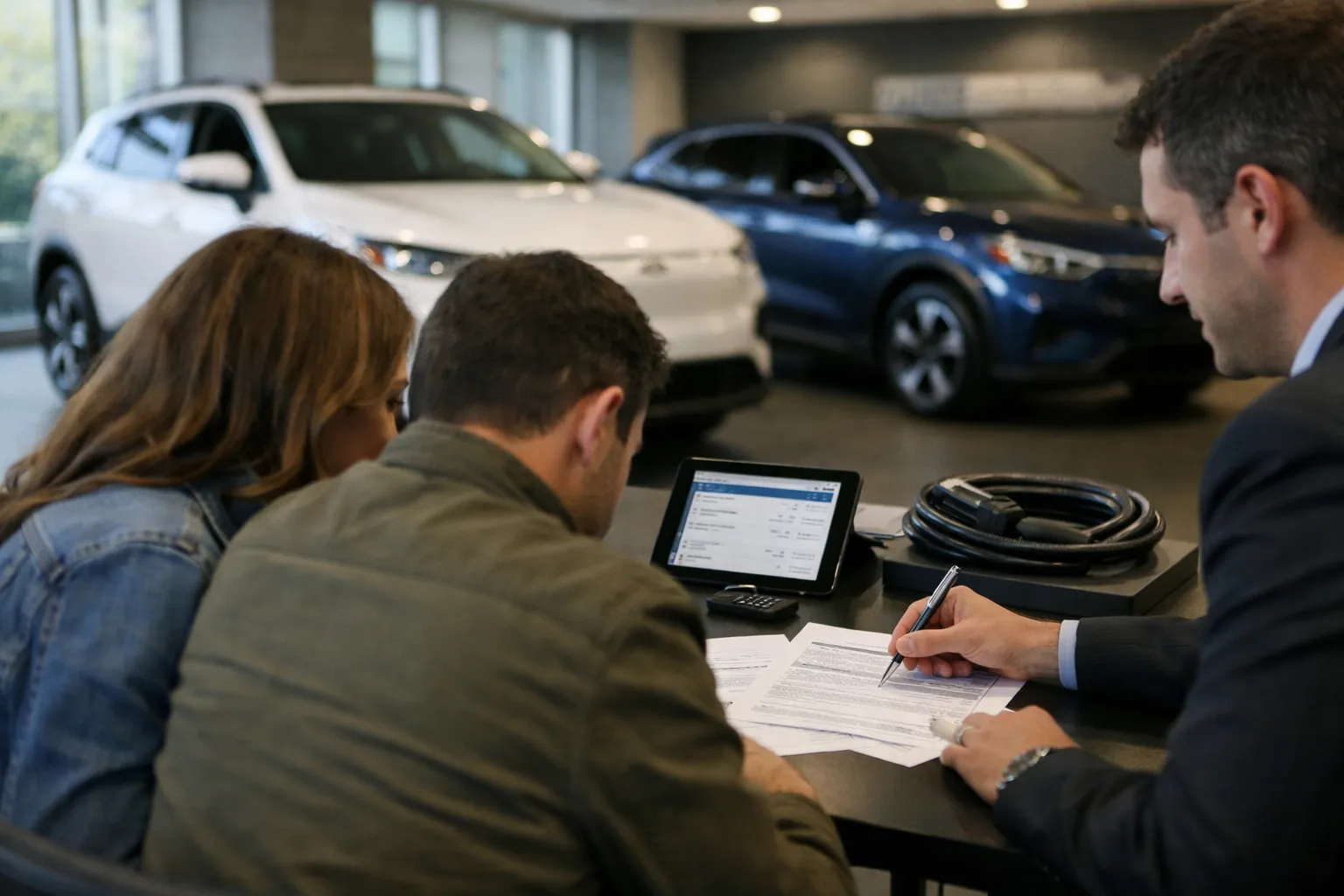
Electric-vehicle ownership decisions in late 2026 are no longer just about range and charging networks. They now hinge on how the market values EVs over time, how manufacturers structure battery warranties and software access, and how lenders and lessors price residual risk. For buyers who follow incentives and payments closely, leasing still looks attractive in specific circumstances — but buying has regained ground for others. This analysis examines the mechanics behind that choice and lays out a practical framework to decide which route suits a given buyer.
What makes EV leasing vs buying different in 2026?
At a high level, lease and loan math is the same as it was for combustion vehicles: leases focus on the vehicle's expected depreciation (residual) plus fees and interest; buying spreads the full purchase price across the loan term plus interest. For EVs, three features change the calculus:
- Battery risk and warranty structures. Most major automakers continue to offer long battery warranties (commonly around eight years or 100,000 miles on many 2020s models). That warranty reduces downside for lessees and buyers, but the length, transferability and scope vary by manufacturer and model.
- Residual volatility. EV residuals have been more volatile than ICE cars since rapid model turnover, changes in used-EV demand, and the rise of software-based feature monetization. Lessors price that uncertainty into lease payments.
- Software and subscription features. Features tied to software updates or subscription unlocks can influence resale value and therefore lease residuals. Buyers who intend a long hold can benefit if they plan to keep access; those concerned about losing functionality at resale may prefer leasing to avoid long-term exposure.
How lessors price EV leases
Leases are constructed around three key numbers: the capitalized cost (what the vehicle is "worth" at lease start), the residual (expected value at lease end), and the money factor (interest-equivalent cost). For EVs:
- Residuals can swing more. Lessors either lower residuals to protect themselves (raising monthly payments) or require larger down payments or higher rents. That makes GMVs (guaranteed residuals) and lease-end purchase options important to check.
- Mileage limits bite earlier. Since EV buyers can be high-mileage commuters who benefit from lower fuel costs, standard 10–12k miles per year leases may be too tight; extra miles are costly.
- Incentives and subsidized leases. OEM captive lenders sometimes offer lease specials that incorporate manufacturer incentives, which can drastically reduce monthly payments relative to financing a purchase.
How buying changes the picture
Buying gives owners full upside at resale but also exposes them to depreciation and battery-repair risk. Key considerations:
- Longer-term ownership tends to favor buying. If you keep a vehicle beyond the period when typical lease terms end (e.g., 3–4 years), a financed purchase often produces lower average monthly cost once the loan is paid off and resale value is captured.
- Financing rates matter more than they used to. Lenders price EV loans with similar risk models as ICE loans, but residual uncertainty has in some cases pushed used-EV loan rates slightly higher — a factor for buyers who finance.
- Battery health and repair exposure. A buyer who plans to keep a car past warranty needs to weigh potential battery repairs; transferability of OEM battery warranties and the existence of third-party battery testing and refurbishment markets mitigate that risk.
Illustrative comparison: a 36‑month lease vs a 60‑month loan (hypothetical)
Below is a simple, hypothetical example to make the trade-offs concrete. These are example numbers to show methodology — get live quotes before deciding.
- MSRP / cash price: $46,000
- Typical lease term: 36 months with 10k miles/year
- Typical loan term: 60 months, 20% down vs 36-month lease with equivalent down
Assume the lessor sets a residual of 50% (=$23,000) at 36 months. Lease payments cover the $23,000 depreciation plus fees and interest — split into 36 monthly payments. A financed purchase spreads $36,800 (price minus 20% down) across 60 months plus interest.
Under those assumptions, the lease may produce a lower monthly payment because the lessee is only paying for the vehicle’s expected loss in value during the term. But if the buyer keeps the car beyond 36 months, monthly cost over a 5–7 year horizon can be lower for the buyer, because the purchaser realizes the vehicle’s residual value when they sell it later.
Two important caveats: (1) If the actual residual is lower than predicted, a lessee could face higher lease payments in future or steep end-of-lease charges; (2) if the purchaser finances at a materially higher interest rate than the lease money factor equivalent, the buyers' monthly payments can be higher on a loan.
Which buyer profiles favor leasing vs buying?
- Lease likely better if:
- You want the lowest monthly payment for a fixed term and like to upgrade frequently (every 2–3 years).
- You drive moderate miles within the lease cap or can negotiate higher mileage in the lease at a reasonable cost.
- You prioritize transfer of battery warranty risk and new‑car technology access without long-term ownership exposure.
- Buy likely better if:
- You plan to keep the vehicle 5+ years, especially past warranty expiration, and you value resale proceeds.
- You drive high annual miles (above 12–15k) where excess-mile leases get expensive.
- You intend to modify the vehicle or live in a market where used EV demand is strong, preserving high resale.
Practical checks before you sign
Whether leasing or buying, run these checks before signing:
- Inspect the battery warranty. How long does it last? Is it transferable? What are the terms for capacity loss and covered repairs?
- Ask about software features. Confirm which features are included in the purchase price, which may require future subscriptions, and whether such limitations affect resale value.
- Get the lease residual and buyout terms in writing. Understand the end‑of‑lease purchase price and potential market risk if you plan to buy out at term.
- Compare true out‑the‑door costs. For leases, include acquisition fees, disposition fees and excess-mileage charges; for purchases, include finance charges and potential higher insurance costs for EVs in some markets.
- Check third‑party battery testing and diagnostics. A used‑car SOH (state of health) report can be decisive when buying used EVs or evaluating a lease return.
Negotiation levers specific to EVs
- Negotiate a higher residual if the lessor used a conservative forecast — ask for a residual that tracks recent used-EV auction prices in your region.
- Push for including a transferable battery warranty or a battery protection plan in the deal.
- If buying, consider conditional offers that let you refinance later if interest rates fall or EV loan spreads compress.
Bottom line
There’s no single right answer for everyone in 2026. Leasing still offers the simplest hedge against rapid technological change and uncertain residuals, delivering predictable monthly payments and limited exposure to long-term battery risk. Buying is generally better for those who plan to keep the car beyond typical lease durations, who rack up miles, or who can accept the resale risk in exchange for eventual ownership value.
Make the decision with three concrete inputs: a current market quote for lease residuals, a firm battery‑warranty summary from the manufacturer, and a total‑cost projection across your expected ownership horizon (including insurance, charging costs and likely resale value). When those pieces are on the table, you can compare apples to apples — and choose the option that minimizes your risk and maximizes value for how you drive.