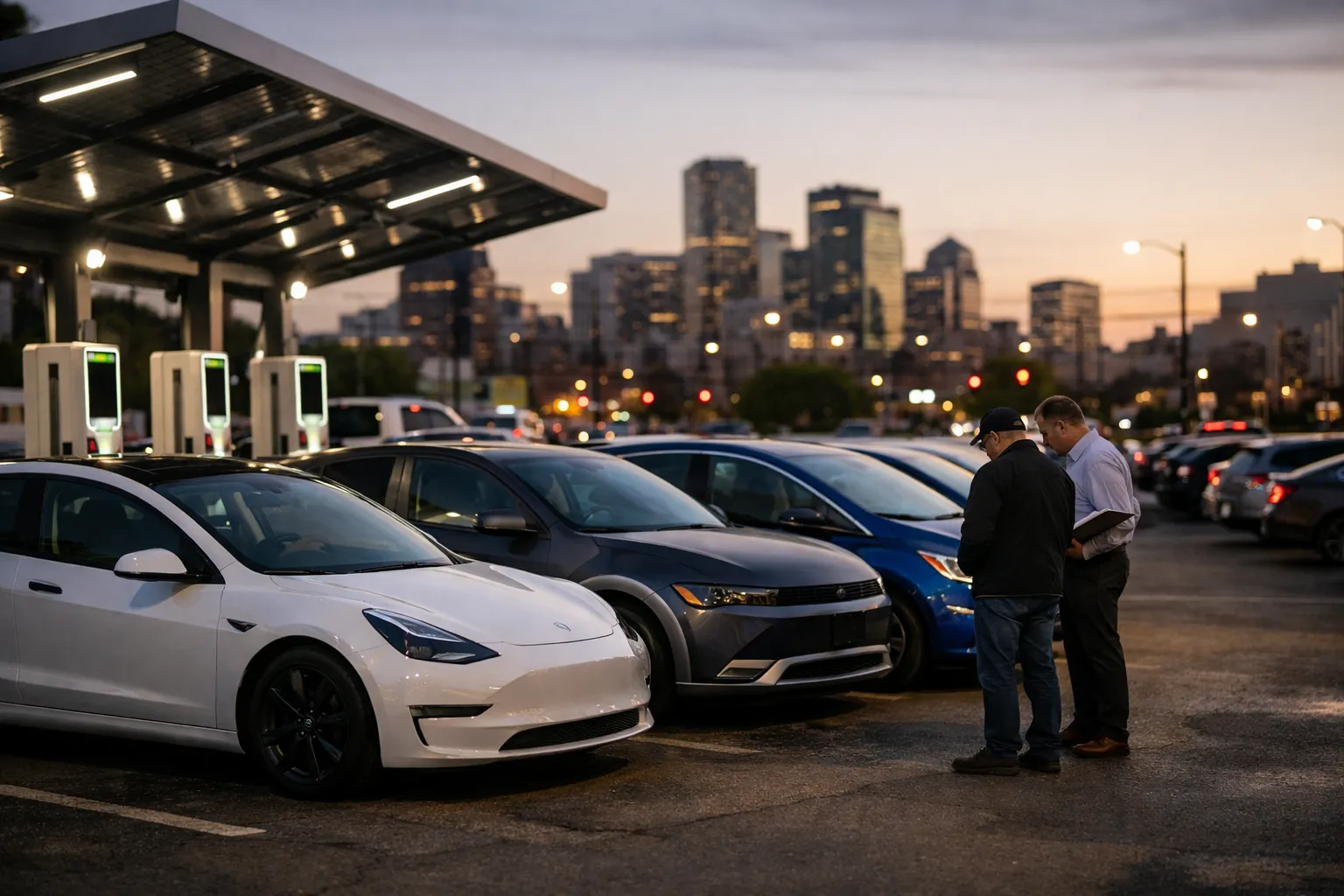
By mid‑2026 the used‑electric vehicle market is no longer a single national marketplace; it is a patchwork of regional micro‑markets shaped by public charging density, lease returns, local EV adoption and utility incentives. For car‑buying enthusiasts looking to time purchases or shop across metro lines, understanding how charging access alters demand — and therefore price — is essential.
Why charging access matters for used‑EV values
EV owners and prospective buyers weigh charging convenience differently than drivers of internal‑combustion vehicles. When public charging is plentiful and reliable, urban buyers are willing to pay a premium for used EVs because day‑to‑day hassles are reduced. Conversely, where chargers are sparse, buyers demand a discount to compensate for longer public‑charging trips, queuing, and range‑management stress.
Three market mechanisms link charger supply to prices:
- Demand elasticity: In high‑charger metros a broader buyer pool (including those without home charging) increases competition for used EVs; in low‑charger areas the buyer pool shrinks.
- Perceived utility: A used EV’s practical value—especially for short‑range models—declines where fast chargers are distant or unreliable.
- Transaction friction and risk: Buyers expect higher transaction costs (time, planning) in low‑charger metros and price that risk into offers.
What 2024–2026 supply dynamics amplified regional differences
Three supply‑side trends over the past two years have increased the flow of used EVs into the market while also making regional effects stronger:
- Lease maturities and fleet returns: A large cohort of 2019–2021 EV leases matured starting in 2023. Off‑lease vehicles add to wholesale pools unevenly; metros with high initial EV penetration see more off‑lease stock and therefore deeper price sensitivity.
- New‑model launches and price competition: The wave of lower‑priced, longer‑range BEVs since 2022 pushed down residuals for earlier, shorter‑range models (e.g., early Chevy Bolt, Nissan Leaf), disproportionately affecting markets with fewer chargers where range anxiety is a larger deterrent.
- Charger rollout and policy timing: Federal NEVI funding and state programs accelerated public‑charger buildouts, but deployment sequencing has been uneven. Some metros saw fast gains in 2024–2025; others lagged into 2026. That mismatch changed buyer confidence at different speeds across regions.
How the gaps show up: case examples
The effect is clearest when comparing city pairs with similar incomes and population sizes but different charging footprints. Three practical patterns we observed in markets and dealer behavior in 2026:
- High charger density, premium pricing: In dense West Coast metros with integrated public chargers and high apartment‑dweller EV adoption, dealers and private sellers frequently list late‑model used EVs at a visible premium relative to comparable ICE vehicles and to the same EVs listed in low‑charger metros. Buyers without home charging will still consider these vehicles because the public network reduces daily friction.
- Low charger density, discounts and parity: In several Sun Belt and Midwestern metros where public fast chargers remain sparse per capita, asking prices for short‑range used EVs are often at parity with or below equivalent ICE models once federal and state tax credits on new vehicles are factored out. Buyers in these areas negotiate discounts citing charging limitations.
- Model‑specific divergence: Long‑range EVs (e.g., newer Tesla Model 3/Y variants, larger‑range Hyundai/Kia models) retain value more uniformly across metros; short‑range legacy EVs lose value faster where chargers are scarce. That produces a market where the same brand/model can trade at materially different price points depending on metro charging context.
What this means for buyers who shop locally — and cross‑shop
Car‑buying enthusiasts can exploit regional differences but must do the math carefully.
Local buyers
- If your metro has a dense, reliable charger network and you rely on public charging, you can accept a narrower premium for convenience. Factor in annualized time costs for charging trips when assessing value.
- In low‑charger metros prioritize long‑range versions, vehicles with robust warranty coverage, or options that simplify charging (e.g., included adapter bundles). Avoid short‑range models unless you have guaranteed home charging.
Cross‑shopping across metros
Cross‑metro buying still yields opportunities but adds transaction complexity. Consider:
- Net landed cost: Add travel, registration, inspection, any out‑of‑state taxes or fees, and potential battery‑health tests. A nominal price gap can evaporate once these are included.
- Battery warranty transferability: Confirm whether a remaining battery warranty transfers and whether it has location‑based service limitations.
- Charger compatibility and region‑specific hardware: Some used vehicles come with equipment tailored to their original market (plug types, onboard chargers). Ensure compatibility with your local infrastructure.
How to assess the charging landscape quickly
Before placing an offer, use these practical checks:
- Scan federal and commercial charger maps (U.S. Dept. of Energy AFDC, PlugShare, ChargePoint) to calculate public chargers per 100,000 residents in the vehicle’s metro. Look specifically at the availability of DC fast chargers within a 10–20 minute drive from likely home locations.
- Check local reliability reports and recent user reviews for commonly used chargers in the area. A cluster of chargers that are frequently out of service reduces effective supply.
- Ask sellers for recent charging history if available — number of fast‑charge sessions and typical state‑of‑charge on long trips can indicate real‑world usage patterns.
Negotiation levers in uneven markets
Buyers can use the charging environment as a negotiation tool.
- In low‑charger metros point to real additional costs: time spent charging, planned detours, and potential price differences for home charger installation if you lack it—sellers often underprice these future costs in their asking price.
- In high‑charger metros sellers may expect less discounting; buyers should instead press on battery health, warranty, and accessory completeness.
- Independent battery‑health diagnostics (voltage under load, state‑of‑health estimates, pack imbalance checks) are particularly effective in both environments; a marginally larger discount on a used EV can be obtained with a confirmed below‑nominal battery health reading.
What to watch next — market and policy signals through late 2026
Buyers and sellers should track three developments that will drive regional price convergence or divergence:
- Charger uptime and maintenance data: As more public networks publish reliability metrics, perceived effective charger supply will change faster than raw station counts.
- Utility and municipal incentive changes: Local programs that subsidize home chargers or fast‑charging hubs can quickly expand a metro’s effective charging access and support used‑EV prices.
- Wholesale flows of off‑lease EVs: Continued influxes from lease maturities could depress prices in saturated metros while providing buying opportunities elsewhere.
Bottom line for enthusiasts
In 2026 the used‑EV market is locally nuanced. Charging infrastructure isn’t just a convenience variable — it’s a price determinant. Serious buyers should treat every used EV purchase as both a vehicle and a location play: evaluate the local charging ecosystem, match model range to available infrastructure, and compute total landed cost when cross‑shopping. Those who do will find opportunities to buy EVs at fair discounts — or to pay a justified premium for trouble‑free, charger‑rich life.
Methodology note: This analysis synthesizes industry reporting, public charger inventories (U.S. Department of Energy AFDC), and market observations from dealer listings and online marketplaces in mid‑2026. For individual deals, always verify charger maps, warranty transferability and obtain an independent battery health inspection before purchase.