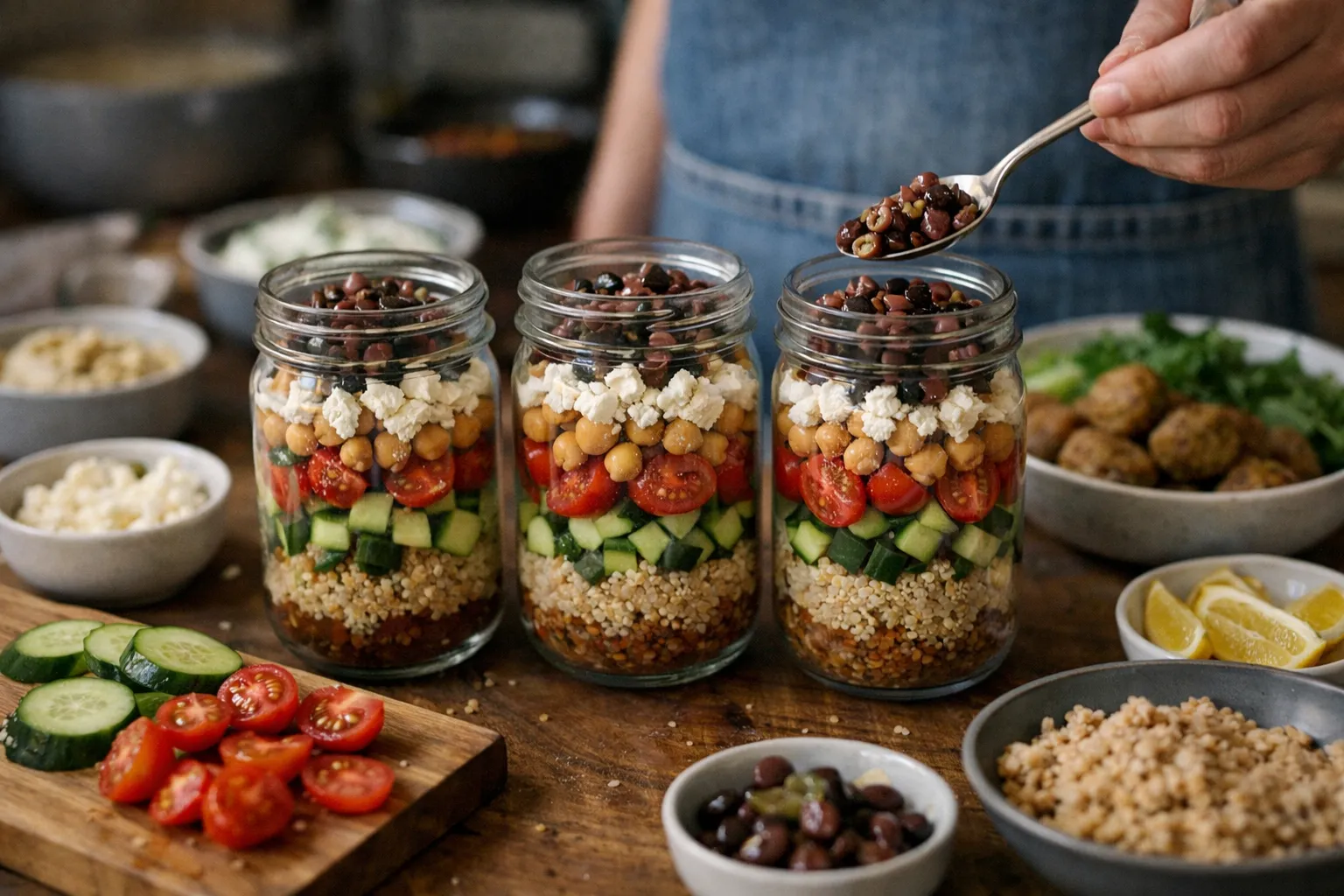
There’s nothing more satisfying than a bright, nourishing bowl ready to grab on a busy morning. This guide walks recipe fans through building make-ahead Mediterranean mason-jar grain bowls that stay crisp, taste fresh and scale easily. You’ll get a full ingredients framework, realistic prep time, tested cooking method tips, exact serving size guidance and straightforward dietary modifications so everyone at the table is happy.
Why mason-jar grain bowls?
Mason jars are ideal for layered meal-prep: the tight seal keeps dressings separate, the transparent sides show off colorful ingredients, and jars are portable. When you assemble in the correct order, flavors stay bright and textures avoid the dreaded sog.
What you’ll need
- Ball or Mason jars with tight lids (16 oz jars are the most versatile)
- Basic tools: medium pot, sheet pan, skillet, chef’s knife, cutting board, measuring cups/spoons
- Optional: silicone jar funnel and condensed dressing bottle for ease
Standard ingredient groups
Organize your shopping list into five groups to make decisions fast:
- Base grain or substitute (e.g., farro, quinoa, brown rice, or cauliflower rice)
- Starchy element (roasted potatoes, sweet potato cubes, or pita croutons)
- Roasted or marinated vegetables (eggplant, zucchini, cherry tomatoes, peppers)
- Fresh crunchy veg and leafy greens (cucumber, red onion, arugula)
- Protein & finishing (chickpeas, grilled chicken, feta, olives, toasted seeds)
Prep time & serving size
Expect the following timeline when prepping for a week of lunches (4 jars):
- Active prep time: 45–60 minutes (chopping, roasting, dressing)
- Hands-off cooking: 25–40 minutes (grains simmering, veggies roasting)
- Total elapsed time: ~90 minutes including cooling down
- Serving size: one 16-oz jar per person as a main; 8–12 oz jars make a hearty side
These estimates assume modest batch roasting and a single-pot grain cooking method. If you’re multi-tasking (oven and stovetop simultaneously), shrink the total time closer to 75 minutes.
Best cooking method for consistent results
Combine stovetop and oven methods for efficiency and flavor:
- Grains: simmer on the stovetop (1:2 ratio for brown rice, 1:1.5 for quinoa) with a 5–10 minute resting time off heat for fluffing.
- Roasted veg: high-heat oven roast (425°F / 220°C) on a sheet pan for caramelization—20–30 minutes depending on the vegetable.
- Proteins: grill or sear chicken and halloumi; roast chickpeas in the oven (400°F / 200°C for 20–25 minutes) for crunchy texture.
Layering order — the no-sog method
The secret to a jar that stays fresh is thoughtful layering. Follow this order from bottom to top:
- Dressing (place at the very bottom to keep upright)
- Dense, moisture-resistant items (roasted veg, cooked starches)
- Proteins (grilled chicken, roasted chickpeas, halloumi)
- Grains
- Fresh crunchy veg (cucumber, bell pepper)
- Leafy greens (arugula, spinach) — these must sit on top
- Finishers (nuts, seeds, olives, crumbled feta) — sprinkle on top right before sealing
Tip: Put items that would get soggy (tomatoes, dressed cucumbers) in a small separate container if you plan to store for more than two days.
Sample build: One Mediterranean 16‑oz jar (serving size)
- 2 tbsp hummus or dressing (bottom)
- 1/3 cup roasted cherry tomatoes and zucchini
- 1/4 cup roasted chickpeas (crisp)
- 1/2 cup cooked quinoa (or farro)
- 1/4 cup diced cucumber + 1 tbsp red onion
- 1 cup arugula or baby spinach (packed)
- 1 tbsp toasted pine nuts or pumpkin seeds + 2 tbsp crumbled feta
This single-jar formula scales cleanly to 4–8 jars: multiply quantities by jar count, and use sheet pans to roast larger batches at once.
Batch schedule (make-ahead plan)
Day -1 (evening): Roast vegetables and chickpeas, cook grains, prepare dressing.
Day 0 (morning): Cool hot items to room temperature, assemble jars following layering order, seal, chill. Jars last 3–4 days refrigerated at peak quality—greens may wilt after day 4.
Dietary modifications
Every bowl can be adapted quickly. Here are tested swaps.
- Vegan: Skip feta; use extra roasted chickpeas or marinated tofu. Use tahini-lemon dressing instead of yogurt-based dressings.
- Gluten-free: Use quinoa, millet, or certified gluten-free oats instead of farro or barley.
- Low-FODMAP: Replace onion and garlic with chives and garlic-infused oil; use firm tofu or chicken breast and focus on low-FODMAP veg (cucumber, carrots, bell peppers).
- Keto / Low-Carb: Swap grains for cauliflower rice or a bed of roasted cauliflower florets; keep higher-fat proteins like halloumi or olives.
- Nut-free: Replace pine nuts with toasted pumpkin or sunflower seeds.
Note on dressings and stability
Emulsified dressings (olive oil + lemon + mustard) are ideal for jars. Creamy dressings with yogurt or tahini can work if placed at the bottom and kept chilled. If you want the dressing separate for freshness, use tiny screw-top containers or a silicone cup nested in the jar’s mouth.
Transport, storage and reheating
- Transport: Keep jars upright in a tote. Use a small ice pack if you’ll be out for over two hours.
- Storage: Refrigerate jars upright. For longer-term storage of cooked components (grains, roasted veg), freeze in portioned containers up to 2 months; thaw overnight in the fridge before assembly.
- Reheating: If you prefer warm grains, empty jar into a microwave-safe bowl, reheat, then reassemble with fresh greens and finishers.
Flavor combo ideas (mix-and-match)
Try these plug-and-play combos that use the same assembly logic:
- Mediterranean: quinoa, roasted eggplant & peppers, chickpeas, cucumber, arugula, lemon-oregano vinaigrette, feta, kalamata olives.
- Herb & Citrus Chicken: farro, roasted sweet potato, grilled lemon-herbed chicken, shredded kale, parsley, tzatziki, toasted almonds.
- Smoky Halloumi: brown rice, charred cherry tomatoes, grilled halloumi, cucumber, harissa-yogurt dressing (bottom), seeds.
- Black Bean & Avocado (vegan): cilantro-lime quinoa, roasted corn & pepper, black beans, avocado tucked in a small pouch (add on eating), lime-tahini dressing.
Troubleshooting common problems
- Soggy greens: Make sure greens are completely dry before adding; place them at the very top of the jar and keep dressing at the bottom.
- Hot steam softening crisp items: Cool grains and roasted veg completely to room temperature before sealing jars—this prevents condensation.
- Mold or off-flavor: Use clean jars and refrigerate promptly. Most jars keep 3–4 days at peak freshness.
- Leaky lids: Test lids before packing; replace rings that have lost elasticity. Tighten lids by hand firmly—but not with excessive force.
Cost and scaling tips
To scale without stress: cook grains in a large pot once (enough for 8–10 jars), roast multiple sheet pans simultaneously (rotate racks mid-roast), and use a single quart of dressing to season several jars. Bulk buys of chickpeas, grains and seasonal vegetables lower per-jar cost dramatically.
Final tips — make it yours
- Label jars with assembly date and the main protein (helps with next-to-last-day decisions).
- Keep a “mix-and-match” bin of quick add-ons: lemon wedges, pita chips, mini containers of avocado.
- Rotate dressings weekly to avoid flavor fatigue—try lemon-mustard, red-wine vinaigrette, or a cilantro-tahini for variety.
With a clear ingredients blueprint, sensible prep time, a consistent cooking method and thoughtful layering, mason-jar Mediterranean grain bowls are one of the most rewarding make-ahead projects you can do. They save time, reduce lunchtime decision fatigue and are endlessly adaptable with dietary modifications. Start with one jar tonight—chances are you’ll be hooked by the first bite.