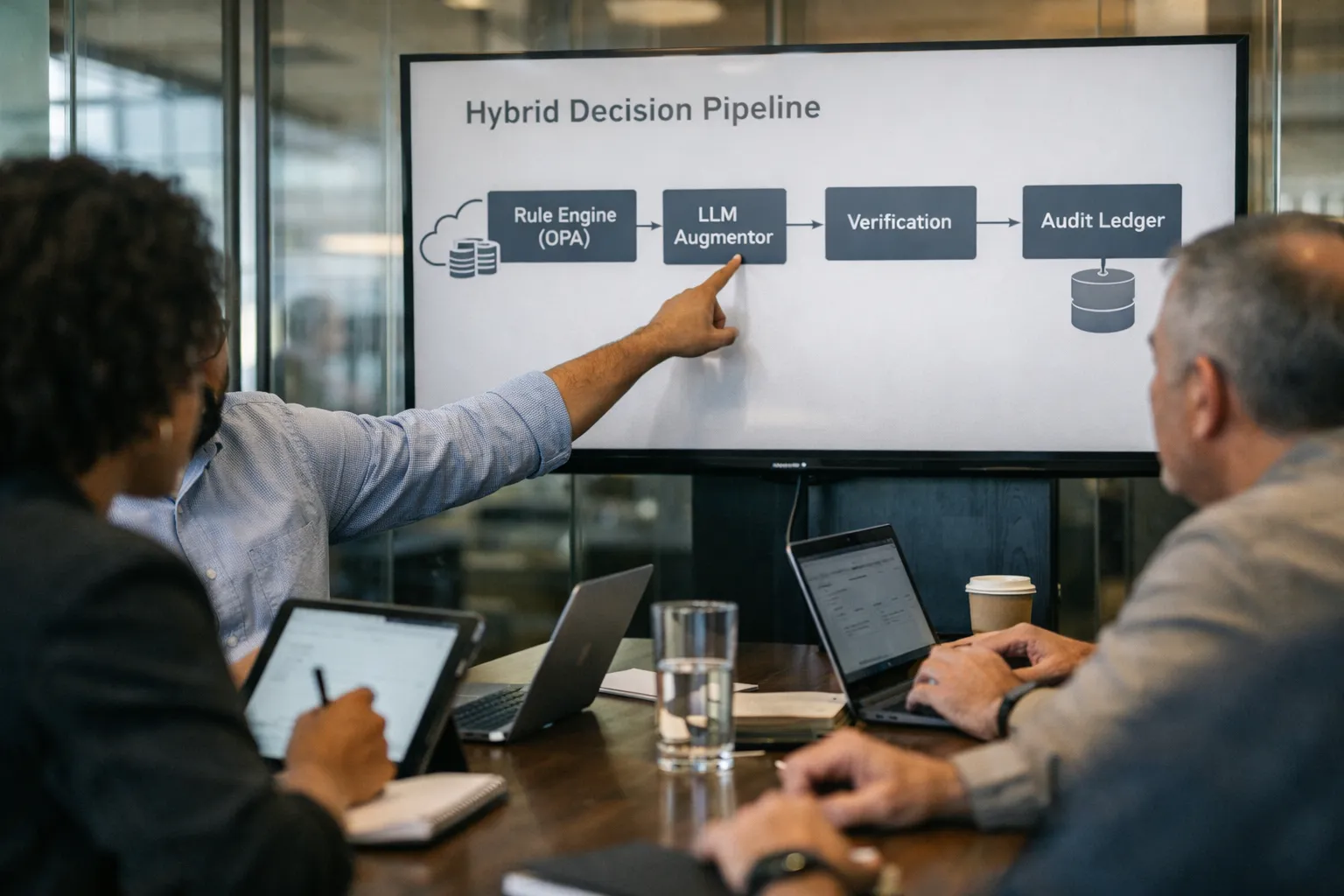
Enterprises still running decades-old rule platforms (Drools, BRMS, homegrown decision trees) face the same tradeoff: rules are auditable and deterministic but brittle; large language models (LLMs) are flexible and productive but probabilistic. In mid-2026 the practical path for regulated organizations remains a hybrid: keep deterministic controls in a rule layer, use LLMs for interpretive and unstructured tasks, and place an independent verification & provenance layer between them. This updated guide adds 2026 trends, tooling notes, and tested patterns so AI-for-business teams can execute a safe, auditable migration in 6–12 weeks for a moderate decision domain.
Who should use this guide
- Product, architecture and compliance leads planning decisioning modernization
- Engineering teams integrating LLMs into regulated workflows (credit, insurance, healthcare, telecom)
- AI governance, risk, and compliance officers needing an operational migration playbook
What you’ll learn
This guide gives a concrete migration process: rule inventory, decision contract/schema design, hybrid architecture (rule-first / LLM-augment / verify), implementation steps, verification techniques, testing strategies, and phased rollout. It incorporates 2026 operational practices — structured outputs as default, signed model provenance, RAG controls, and drift governance — and shows how to apply them with real examples.
Prerequisites / Context
- Existing rule engine or BRMS with versioned rules (Drools, BRMS, or homegrown)
- Access to at least one production-grade LLM that supports schema-constrained responses or function-calling
- Policy engine capability (Open Policy Agent or equivalent) for deterministic checks
- Audit/event store (immutable or append-only) and a governance forum (legal/compliance + product + engineering)
Why a hybrid, verifiable approach in 2026?
- Deterministic controls remain required for regulatory thresholds, eligibility blocks and safety constraints—these must be encoded in a rule engine or policy layer.
- LLMs now excel at multi-document synthesis, entity extraction from messy documents, and producing structured proposals when constrained by schemas and retrieval augmentation (RAG).
- Verification and provenance are more practical — by 2026 major providers surface model identifiers, signed response metadata, and function-calling, enabling stronger audit trails and tamper detection.
High-level architecture (updated pattern)
Use a “rule-first, LLM-augment, verify” pipeline with updated components:
- Decision Orchestrator — routes requests, enforces timeouts and fallback policies.
- Rule Engine — executes hard constraints and high-confidence rules (OPA, Drools, or BRMS). If decisive, short-circuit and return with audit metadata.
- LLM Augmentor — called for interpretive tasks. Use function-calling or schema APIs so the model returns validated JSON. Prefer RAG with vetted document stores and provenance markers.
- Verification Layer — independent OPA/Rego or deterministic validators re-check every LLM proposal against constraints, cross-field invariants, and evidence citation rules.
- Audit & Provenance Store — append-only records with input snapshot, rule bundle hash, model ID & signed response metadata, prompt template hash, and chained hashes for tamper evidence.
- Monitoring & Drift Detection — monitor input distributions, decision parity vs baseline, and business KPIs; set automated alerts for divergence.
Step-by-step migration plan
1. Rule inventory and classification (1–2 weeks)
Catalog active rules, decision paths and owners. For each rule capture:
- Business owner and purpose
- Determinism requirement (must be deterministic, preferred deterministic, flexible)
- Input data types: structured fields, uploaded documents, API calls
- Compliance impact (auditable, legally binding, reversible)
- Failure mode examples and exception rate
Classify rules into:
- Hard constraints — regulatory thresholds, fraud blocks (keep in rule engine).
- Soft rules — business preferences that may be augmented by LLMs (e.g., “prefer lower risk products”).
- Interpretive tasks — document interpretation, summarization, free-text classification suitable for LLMs.
2. Define the decision contract and schemas (1 week)
Create explicit JSON schemas for inputs, outputs, decision codes and evidence references. Include:
- Canonical field names, types and enumerations
- Decision and reason codes (with documented semantics)
- Evidence references (document IDs, byte offsets, quote spans)
- Confidence / provenance fields (model_id, model_version, signed_response_hash)
Why: Schema-first design forces structured outputs, which are auditable and verifiable. In 2026, prefer provider function-calling or schema-enforcement APIs rather than free-text parsing.
3. Build the hybrid pipeline prototype (2–4 weeks)
- Implement the orchestrator and keep rule engine intact for hard constraints. Short-circuit when rules give decisive outcomes.
- For interpretive buckets, call the LLM with a strict template. Use RAG pointing at a vetted document index; include citation constraints in prompts and require evidence_refs in the returned JSON.
- Immediately validate the LLM output against the decision schema. Reject or escalate on nonconformance.
Example pseudocode (illustrative):
// simplified flow
res = ruleEngine.evaluate(request)
if res.decisive:
  saveAudit(res, provenance)
  return res

proposal = llm.call(prompt(request), schema=decisionSchema, rag_docs=docIDs)
if not validateSchema(proposal):
  escalateHuman(request, reason="schema_fail")
else:
  verify = opa.evaluate(proposal)
  if verify.ok:
    final = applyBusinessRules(proposal)
    saveAudit(final, provenance)
    return final
  else:
    escalateHuman(request, reason="policy_violation")
4. Verification & policy enforcement (independent layer)
The verification layer must be deterministic and independent from the LLM. Use OPA or an equivalent policy bundle to check:
- Field-level types and enumerations
- Cross-field invariants (e.g., if employment_type == 'contractor' then income_docs.required == true)
- Evidence provenance: citations must map to stored documents and spans
- Risk gating: certain risk scores trigger human review
In 2026, add automated checks for signed_response_hashes from providers (where supported). If the provider supplies signed metadata, verify the signature to ensure the record ties to the model run.
5. Immutable audit trail and verifiable logs
Record a complete decision bundle for each request:
- Input snapshot, sanitized where necessary for PII
- Rule bundle ID and policy hash
- Model identifier, model_version, prompt_template_hash and function call trace
- LLM raw response, parsed output, verification result, final decision
- Digital signer (service account) and chained hash linking to previous record
Implementation notes: use append-only object storage (S3 with object versioning), or an event stream (Kafka + immutable sink). For high-assurance use a timestamping or ledger service. Ensure retention policies meet legal requirements.
6. Testing: unit, integration, compliance
Test at three levels:
- Unit: rule logic, schema validators, OPA policies.
- Integration: replay historical requests through the hybrid pipeline and measure decision parity versus the legacy baseline.
- Adversarial/red-team: prompt injection, hallucination probes, malformed inputs, and malicious metadata.
Keep a golden dataset with representative edge cases and compliance-critical scenarios. Automate nightly replays and produce diff reports for governance review.
7. Evaluation metrics and governance
Track both technical and business metrics:
- Decision parity vs legacy (agreement rate and delta analysis)
- Reason-code accuracy and evidence coverage
- Runtime latency and service-level error rates
- Human escalation rate and average handle time
- Business outcomes: approvals, revenue, false-positive/negative rates
Governance cadence: biweekly engineering reviews during rollout; monthly cross-functional governance with legal/compliance to review high-severity incidents and drift reports.
8. Phased rollout strategy (recommended)
- Shadow: LLM runs in parallel and logs proposals. Decisions remain rule-driven.
- Advisory: LLM proposals shown to human operators but not applied automatically.
- Partial automation: LLM can auto-decide low-risk buckets when verification passes; medium-risk cases require human sign-off.
- Full automation with fallbacks: LLM decisions accepted automatically if verification & provenance checks pass and confidence thresholds are met; always leave hard constraints in rules.
Use canary segments (small customer cohorts), A/B tests, and staged traffic ramp-up to measure real-world effects and detect regressions early.
Updated tooling recommendations (2026)
- Policy engine: Open Policy Agent (Rego) remains standard for constraint evaluation and policy bundles.
- Rule management: Keep Drools/BRMS for legacy deterministic sets; consider migrating policies to OPA for simpler policy-as-code workflows.
- LLM orchestration: Use provider SDKs that support function-calling, schema enforcement and signed response metadata; prefer vendors who expose model_id and signed_response_hash.
- RAG/document store: Vector DBs with provenance linking (document IDs + text spans); ensure the retrieval layer is access-controlled and auditable.
- Audit storage: Append-only object storage (S3 with versioning), or immutable ledger for high-assurance use cases.
- Monitoring: Observability stacks (Prometheus/Grafana) for runtime metrics; model/data drift tools that accept LLM outputs and evidence coverage metrics.
- Secrets & signing: Cloud KMS or HashiCorp Vault for signing keys used in provenance and response signing.
Common pitfalls and how to avoid them
- Rewriting everything at once: Don’t. Preserve hard constraints in the rule engine and migrate incrementally.
- No schema enforcement: Require structured outputs. Free text decisions are hard to audit and verify.
- Missing provenance: Capture model IDs, prompt hashes and policy bundle versions with each decision.
- Ignoring drift: Set automated thresholds tied to governance playbooks for retraining, prompt updates or rollbacks.
- Overtrusting confidence scores: Require ensemble checks, evidence citation, and human review for critical cases; confidence is not a legal shield.
- Weak PII handling: Redact or pseudonymize inputs stored in audit logs; follow privacy retention rules.
Pro tips (operational)
- Hash and store prompt templates; require that any prompt change increments a template version and triggers regression tests.
- Use "rationale logging" — store the model's step-by-step chain-of-thought or extraction trace (where provider policy allows) as evidence for decisions.
- Build automatic reconciliation checks that compare LLM-extracted values to canonical fields (e.g., extracted income vs declared income) and quantify delta.
- Instrument a "what-if" sandbox to test policy changes against historical data before pushing to production policy bundles.
- Adopt a single source of truth for enumerations and decision codes (a catalog service) to avoid drift between rule, LLM, and downstream systems.
Updated example: insurance claims triage (2026)
Scenario: A mid-sized insurer wants better handling of ambiguous bodily injury descriptions in claims to reduce unnecessary human case reviews.
- Inventory: Policy coverage rules (e.g., "hospitalized within 48 hours" = auto-refer) are hard constraints and remain in the rule engine. Injury-description classification is interpretive and suited to LLMs.
- Schema: Decision output includes decision_code, severity_score (0–100), evidence_refs (document ID + span), and model_provenance (model_id, signed_response_hash).
- Pipeline: If a hard policy triggers → follow rule. Otherwise: LLM reads physician notes and claimant message, extracts injury entities and timelines, returns structured severity_score with spans. OPA verifies that evidence_refs map to stored documents and that any required cross-field invariants hold. If delta > threshold or provenance missing → escalate.
- Audit: Store claim snapshot, LLM raw response, verification result and final action. Retain golden cases for nightly regression.
- Rollout: 6 weeks shadow → 4 weeks advisory to triage team → 8 weeks partial automation for low-severity claims.
Checklist before production
- Complete rule inventory and classification
- Decision schemas defined and enforced via provider schema APIs
- OPA/Drools bundles versioned and auditable
- LLM outputs constrained to JSON schemas and validated
- Independent verification layer implemented and tested
- Append-only audit logs with chained hashes and prompt/version metadata
- Golden dataset and automated regression tests in place
- Phased rollout plan, rollback SLAs and canary controls established
- Governance committee scheduled for regular reviews and incident response
Regulatory and compliance notes (practical)
In 2026 regulators and standards bodies continue to emphasize traceability, human oversight and explainability for high-risk AI decisions. Practical steps: explicitly document where LLMs have discretion; keep deterministic policy bundles for critical constraints; record provenance and human review outcomes, and maintain retention and redaction practices for PII. Treat model provenance and signed responses as part of your auditable control set.
Conclusion
Migrating legacy rule systems to a verifiable LLM policy engine is an operational program, not a one-off project. Inventory rules, adopt schema-first design, retain rule-first safety, constrain LLM outputs, implement independent verification and immutable provenance, and roll out in phases. With the 2026 advances in schema enforcement, provider metadata, and RAG controls, enterprises can safely gain interpretive capability from LLMs while preserving auditability and compliance.
Common questions
How do I decide which rules to move to the LLM vs keep in the rule engine?
Use a simple classification: keep hard constraints (regulatory thresholds, non-negotiable blocks) in the rule engine; move interpretive, document-based, or language-heavy tasks to the LLM. For soft rules, consider a hybrid: LLM proposals that are then verified by deterministic policy checks before application.
What level of provenance is sufficient for audits?
At minimum capture: input snapshot, rule bundle/version, model identifier and version, prompt template hash, raw LLM response, parsed output, verification outcome, and signer metadata. Where providers support signed_response_hash or model-signed metadata, verify and store that for higher assurance.
Can I rely on the model’s confidence score to avoid human review?
No. Confidence scores are model-internal and not legally sufficient for critical decisions. Combine confidence with evidence coverage (does the model cite documents/spans), ensemble checks, verification rules, and business thresholds before reducing human oversight.
How do I handle PII and privacy in audit logs?
Minimize storing raw PII: redact or pseudonymize inputs where possible, store hashes for verification, and apply strict access controls and retention schedules. If audits require original inputs, keep them in a highly controlled, access-logged vault and document access for compliance.