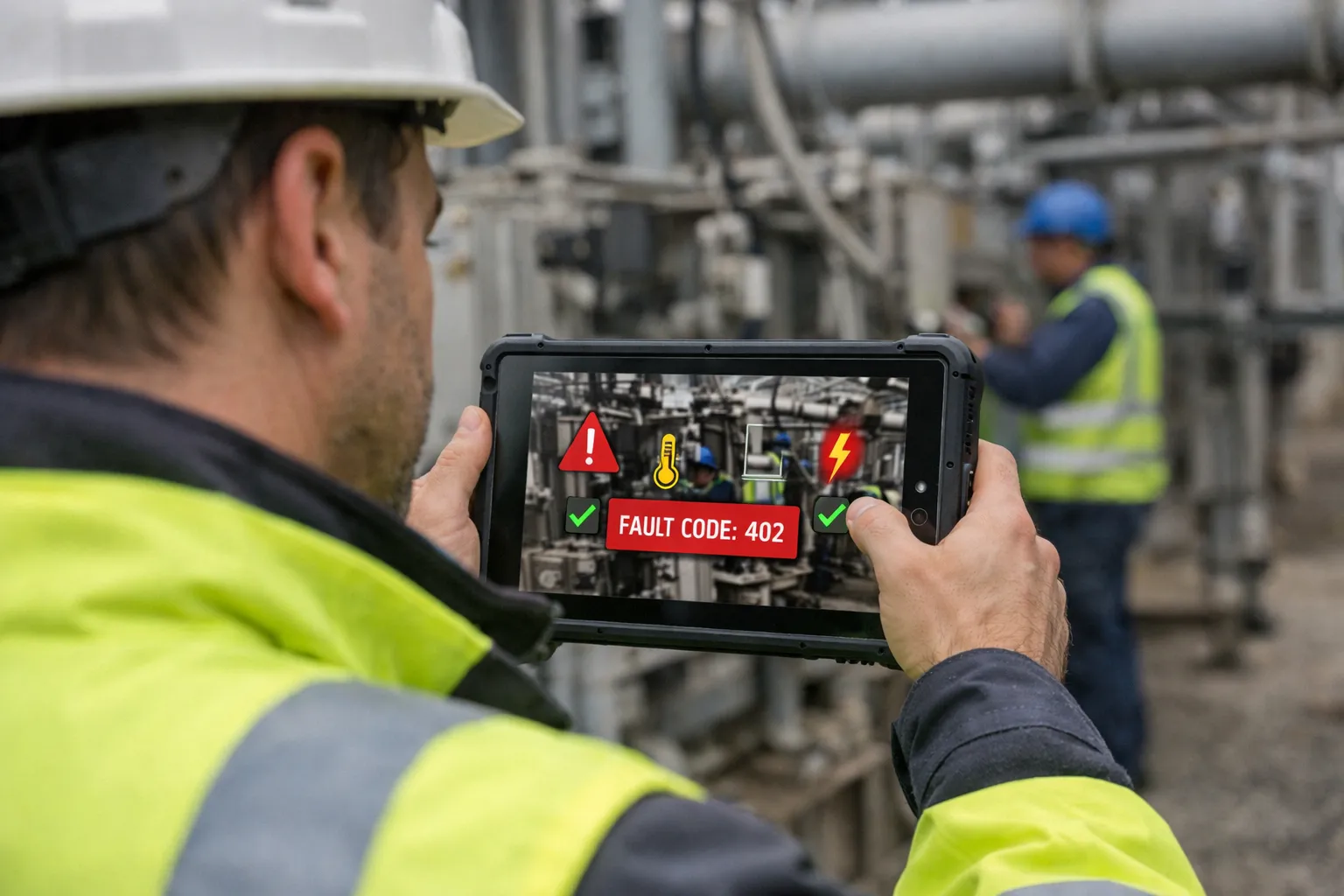
Field service organizations—from utilities and telecoms to heavy equipment OEMs—are moving from script‑based mobile apps to AI assistants that combine vision, natural language and telemetry. These multimodal assistants accelerate troubleshooting, improve first‑time‑fix rates and reduce safety incidents. But the engineering and governance required to deploy them reliably at scale are nontrivial.
What this guide covers
This article gives a practical, vendor‑neutral, step‑by‑step guide to design, pilot and scale multimodal AI assistants for field service in 2026. It walks through use‑case selection, architecture options (edge, cloud, hybrid), data pipelines, model choices, integration with CMMS/ERP, compliance and monitoring, and an operational checklist for pilots and production rollouts.
Why multimodal assistants now (2026 context)
- Model maturity: Compact vision + language models and efficient quantized encoders make on‑device inference feasible for many tasks.
- Edge hardware: Widely available embedded accelerators (NVIDIA Jetson Orin family, Apple/Google on‑device NPUs, Qualcomm AI stacks) lower latency and allow offline modes.
- Connectivity: 5G and private LTE reduce cloud round‑trip delays where available, making hybrid designs practical.
- Regulation and governance: The EU AI Act and updated NIST guidance (AI RMF iterations to 2025) require explicit risk and mitigation plans; planning now avoids costly retrofits.
Step 1 — Pick a narrowly defined pilot use case
Start with a single, high‑value, well‑scoped task. Examples that work well for pilots:
- Guided diagnostics for a single equipment class (e.g., industrial HVAC compressor fault trees).
- Visual inspection and defect classification for specific components (e.g., photovoltaic panel microcracks).
- Procedural guidance with safety checks for a defined maintenance routine.
Success metrics (define these before you build):
- First‑time‑fix rate improvement (%)
- Average job completion time reduction (minutes)
- Escalation rate to senior technicians
- Compliance adherence (checklist pass rate)
- Safety incidents avoided
Step 2 — Map data sources and ownership
Catalog the inputs the assistant will use and where they live:
- Image/video: rugged tablet photos, AR overlays, drone imagery.
- Sensor/telemetry: SCADA, PLCs via OPC UA, MQTT streams from edge gateways.
- Documentation: OEM manuals, parts catalogs, service histories in CMMS (SAP EAM, IBM Maximo, Oracle).
- User input: voice transcripts, technician notes, checklists.
For each source capture:
- Location (on‑device, private network, cloud)
- Retention and access policy (who can see raw images and logs)
- PII and IP risks (technician faces, proprietary circuit diagrams)
Step 3 — Choose an architecture: edge, cloud, or hybrid
Tradeoffs to consider:
- Latency and offline needs — choose edge inference when 200 ms response or offline operation is required.
- Model complexity — heavy reasoning and large knowledge retrieval can stay in the cloud; vision encoders and immediate inference can run on the edge.
- Data residency and compliance — on‑prem or private cloud for sensitive industrial IP; cloud for scale retrieval and analytics.
Three practical architectures:
1. Edge‑first (preferred for remote/offline work)
- Run a compact vision encoder and small language model on the device or local gateway.
- Use a local vector index for frequently accessed knowledge (quantized embeddings).
- Sync logs and batched telemetry to cloud when connectivity permits.
2. Hybrid (most common)
- Do fast vision preprocessing and anonymization on the device.
- Send embeddings or compressed observations to a cloud RAG service for deeper reasoning and document retrieval.
- Keep a thin local policy engine for safety checks and mandatory human‑in‑the‑loop approvals.
3. Cloud‑first (for follow‑the‑sun support teams)
- Devices capture and stream encrypted data to cloud inference.
- Cloud multimodal models return recommendations and create full audit trails.
- Not suitable where connectivity is intermittent or data residency is restrictive.
Step 4 — Technical building blocks and recommended tooling
Key components to assemble:
- Edge device + OS: rugged Android/iOS tablets or Linux gateways with hardware acceleration (NVIDIA Jetson, Apple silicon, Edge TPUs).
- Vision encoder: lightweight CNN/transformer pretrained on industrial imagery; use quantized models for on‑device use.
- Language model: small fine‑tuned LLM (parameter counts in the hundreds of millions to low billions) for on‑device reasoning; larger cloud models for complex reasoning.
- Vector database and RAG layer: options include Weaviate, Milvus, Pinecone; for sensitive data consider sovereign/cloud‑private deployments.
- Message bus / telemetry: MQTT or AMQP for device telemetry; OPC UA for PLC integration.
- CMMS/ERP integration: API adapters to read asset history and log work orders (consider tokenized access and least privilege).
- Security: device attestation (TPM), mutual TLS, end‑to‑end encryption, secrets management and hardware key storage.
- Audit & logging: immutable event logs capturing inputs, model versions, outputs, and human overrides for compliance.
Step 5 — Data strategy and model governance
Data labeling and synthetic data: Begin with a curated labeled set for your target equipment. Augment with synthetic variations (lighting, occlusion). Keep an authoritative dataset for regression testing.
Model lifecycle controls:
- Version model artifacts and record training data provenance.
- Create a test suite: accuracy on labeled data, safety checks, hallucination tests with adversarial examples.
- Define rollback criteria and automated canary deployment thresholds.
Step 6 — Human‑in‑the‑loop and safety controls
Multimodal assistants should not replace skilled technicians for critical decisions. Implement these controls:
- Confidence thresholds: require technician confirmation or supervisor approval for actions below the threshold.
- Intervention workflows: easily override suggestions and capture the rationale (this data improves models later).
- Fail‑safe behavior: if model is uncertain, present a conservative checklist or escalate to a remote expert—don’t auto‑execute hazardous steps.
Step 7 — Compliance, privacy and regulatory checklist
Key items (2026):
- EU AI Act: for high‑risk systems, document risk assessments, conform to transparency and post‑market monitoring obligations.
- Data residency: ensure telemetry and images comply with contract and jurisdictional rules; consider on‑prem vector stores for sensitive IP.
- Worker privacy: redact faces and PII before cloud upload; log access to raw media.
- Safety standards: align procedural guidance with OSHA (or local equivalents) and industry safety certifications.
Step 8 — Pilot design and measurement
Pilot scope example (6–12 weeks): 20 technicians, single equipment family, two regions. Pilot deliverables:
- Working assistant on rugged tablets with hybrid inference
- Integration with CMMS to auto‑generate/update work orders
- Observability dashboard tracking recommended vs accepted actions, average time per job, and incidents
Measure baseline for each metric before pilot; run A/B tests where feasible.
Step 9 — Scaling to production
When pilot meets targets, plan scale with these considerations:
- Operationalize model deployment: CI/CD for model artifacts and infrastructure as code for edge images.
- Cost allocation: separate edge/compute costs per region and model inference tags for chargeback.
- Support and training: structured training modules for technicians; embedded in‑app micro‑training based on observed errors.
- Governance: quarterly model audits, incident reviews, and continuous risk assessment updates.
Monitoring and continuous improvement
Essential telemetry to collect:
- Input distribution drift: image characteristics, telemetry patterns
- Model performance: top‑k accuracy, false positives/negatives by class
- Operational metrics: latency, offline fallbacks triggered, sync success rates
- Human override reasons and their recurrence
Use this data for periodic retraining and to refine confidence thresholds and knowledge bases.
Estimate costs & ROI (practical rules of thumb)
Cost drivers include edge hardware procurement, per‑inference cloud costs, integration engineering and change management. Approximate early costs for a 20‑tech pilot:
- Hardware (rugged tablets + gateways): $25k–$50k
- Integration & development: $200k–$600k depending on complexity
- Cloud services & model inference: variable; many pilots cost $3k–$10k/month for modest usage
Typical early ROI sources: fewer truck rolls, higher first‑time fix rates, reduced mean time to repair and decreased escalation to field experts.
Common pitfalls and how to avoid them
- Overfitting the pilot: avoid using pilot‑only data for production model without broadening dataset.
- Ignoring offline use cases: design offline fallback behavior from day one.
- Insufficient audit trails: build logging that meets regulatory and internal QA needs before rollout.
- Poor change management: train technicians and create clear escalation pathways; a user interface is not a substitute for process change.
Quick rollout checklist
- Define pilot use case, KPIs and success criteria.
- Catalog data sources and consent/residency rules.
- Choose edge/hybrid/cloud architecture and hardware.
- Assemble baseline dataset; label and augment for variability.
- Build a minimum viable assistant with human‑in‑the‑loop safeguards.
- Run a controlled pilot and measure against KPIs.
- Iterate models, add monitoring, and prepare governance artifacts for audits.
- Plan scale with CI/CD, cost allocation and training programs.
Final advice
Multimodal AI assistants can deliver big productivity and safety gains for field service teams, but their value depends on disciplined scoping, rigorous data governance, and strong human‑centred design. Start small, instrument everything, and build a repeatable model and data pipeline so pilots become predictable production outcomes.
If you’re planning a pilot, begin with a one‑page project charter: scope, KPIs, data inventory, compliance owners and a 12‑week delivery plan. That simple artifact is the single best predictor of success.