Who: European regulators, global packaging suppliers and major grocery and foodservice retailers.
What: The regulatory push to restrict intentionally added PFAS in food‑contact materials is moving from rulemaking into enforcement and commercial rollout; suppliers and retailers have scaled PFAS‑free options and updated timelines.
When: Update: August 2026 (reflects developments since the article’s July 2026 publish date).
Where: European Union (primary regulatory driver), with knock‑on effects across North America and other export markets.
Why this matters: PFAS have been used for grease resistance and nonstick properties in paper, cardboard and coatings. Limiting their intentional use changes packaging availability, costs and performance for prepared foods, takeaway and home baking.
Context: from regulatory proposal to market movement
The regulatory debate over PFAS in food contact materials has been active for several years. European policy developments in 2025–2026 signaled clear intent to restrict intentionally added PFAS in paper‑ and board‑based packaging used for food contact. That regulatory pressure — combined with state‑level U.S. measures (for example, Maine and Washington restrictions that preceded EU action) and heightened consumer attention — pushed many manufacturers to accelerate substitutions.
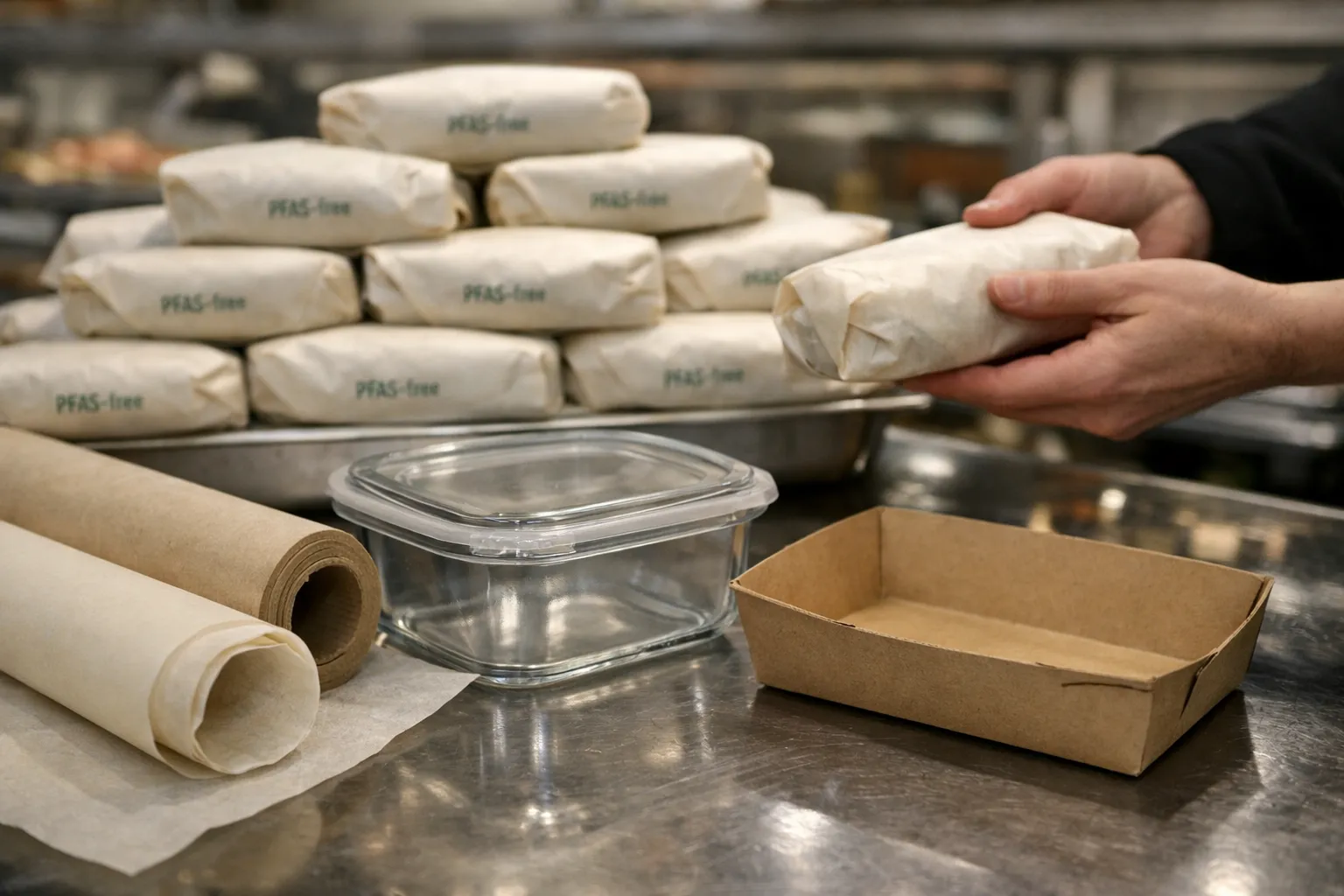
Since July 2026, the story has shifted from pilots to scale-up. Suppliers, converters and several large retail groups are moving from testing non‑fluorinated solutions toward broader commercial availability. That shift is visible in supermarket deli counters, quick‑service restaurant packaging programs, and in trade‑channel product lines marketed as “PFAS‑free” or “fluorine‑free.”
What’s actually changed since July 2026
- Commercial rollouts broadened. Several major European retailers and a growing number of North American chains have published phased timelines for removing intentionally added PFAS from deli wraps, burger and fry papers, and some microwaveable trays. In many cases those timelines target completion by the end of 2026 or during 2027 for items sold under private‑label or high‑volume SKUs.
- Suppliers report scaled capacity. Global converters and packaging mills have expanded production of non‑fluorinated grease‑resistant papers and laminated solutions. Industry groups report that the pool of certified PFAS‑free grades and laminated barrier constructions has grown materially in the first half of 2026, reducing lead times for major customers.
- New certification and testing tools. Independent testing laboratories and a few new third‑party certification programs focused on low or non‑detectable fluorine in finished food contact papers have entered the market in 2026, making “PFAS‑free” claims easier to verify for retailers and brands.
- Costs and availability diverge by product type. For short‑term, low‑fat applications (sandwich wraps, deli sheets), PFAS‑free alternatives are widely available at price parity or modest premiums. For frozen, high‑fat or long‑shelf‑life products that require robust grease and moisture barriers, brands may still face higher costs or additional requalification steps during 2026–2027.
Examples and real‑world impact
What you’re beginning to see in stores and cafés in August 2026:
- Deli counters in urban supermarkets replacing thin, fluorinated deli papers with thicker grease‑resistant papers or laminated trays and adding “PFAS‑free” signage at point of sale.
- Independent bakeries reporting longer lead times for specific greaseproof grades as converters prioritize supermarket and QSR contracts during their capacity expansion.
- Meal‑kit and ready‑meal suppliers switching to polymer‑laminated board or silicon‑coated paper for microwaveable applications; those conversions often require lab re‑testing for grease migration and shelf life.
New science and verification trends
Testing capacity has increased in 2026: more food‑contact manufacturers are running targeted fluorine screening (total oxidizable precursor methods and targeted LC‑MS/MS where available) before making PFAS‑free claims. That expanded testing has revealed two practical realities:
- Trace, unintended fluorine residues can persist in recycled fibers and some additive packages; robust supplier declarations and analytical verification are becoming a standard procurement requirement.
- Performance tradeoffs remain for some demanding applications: moisture and oxygen transmission rates and grease resistance profiles of non‑fluorinated alternatives are not universally identical to fluorinated treatments, so brands must re‑qualify packaging for product‑specific shelf life.
What this means for home cooks and food lovers
For most home cooks the change is incremental but tangible in these ways:
- Expect more “PFAS‑free” labels at deli counters and on prepared foods; look for supplier or certification names when you want verification.
- For baking and reheating, uncoated parchment, silicone mats and glass or stainless containers remain the lowest‑risk options.
- When reheating high‑fat foods, prefer nonpaper containers (glass, ceramic) or explicitly labeled microwave‑safe laminated trays; avoid relying on thin, unlabelled paper for long reheats.
Updated practical recommendations (August 2026)
- Favor reusable storage (glass, stainless, silicone) when possible; these eliminate packaging as a potential PFAS route.
- When buying prepared foods, look for clear on‑pack or in‑store “PFAS‑free” claims backed by named testing bodies or certifications.
- If you run a small food business, contact multiple converters early — expect requalification windows of 2–6 months for many products and plan inventory accordingly.
Who feels the impact — and when to expect more change
Large grocery chains and national restaurant groups will continue to be first movers because they can aggregate demand. Small producers, food trucks and independent bakeries will convert more slowly, largely because of supplier prioritization and narrower margins. Expect the next 12 months (through mid‑2027) to be a period of continued substitution and performance testing; by late 2027 the majority of low‑barrier applications (sandwich wraps, deli sheets) are likely to be widely PFAS‑free in European retail assortments and increasingly so in North America.
Stakeholder reactions
“We’ve moved from testing to supply‑chain deployment this summer,” said a packaging‑industry procurement executive involved in multiple retailer transitions. “The last mile is validation — making sure the alternative keeps food quality and safety intact.”
Public health advocates continue to press for strict enforcement and transparent testing; packaging trade associations emphasize the technical challenges and call for coordinated timelines that allow requalification without disrupting food supply.
FAQs
Are PFAS still being used in food packaging in 2026?
Yes, some fluorinated treatments remain in use for high‑barrier applications, but regulatory pressure and commercial rollouts in 2026 have materially reduced intentional uses in many common items (deli papers, sandwich wraps, some microwaveable trays). Availability now varies by product type and market.
How can I tell if packaging is PFAS‑free?
Look for explicit “PFAS‑free” or “fluorine‑free” labels backed by a named third‑party test or certification. Retailers increasingly post supplier details at deli counters or on product pages. If in doubt, choose glass, stainless steel, silicone, or uncoated parchment for reheating and storage.
Will my favorite bakery be able to switch without changing recipes or prices?
Smaller bakeries may face higher costs or lead times while converters prioritize larger contracts. Many alternatives perform well for short‑term holding and reheating, but some high‑fat or long‑shelf‑life products may require new materials or packaging designs that can change costs. Planning and open conversations with suppliers help smooth the transition.
What should I watch for next?
Monitor retailer announcements, third‑party certification programs, and supplier product bulletins through late 2026 and 2027. Those will show where performance parity has been achieved and which product categories still require caution.
For food enthusiasts, the practical takeaway in August 2026 is simple: PFAS‑free options are becoming common for many everyday prepared foods, testing and certification are improving, and sensible reuse and container choices remain the most reliable way to avoid potential exposure.