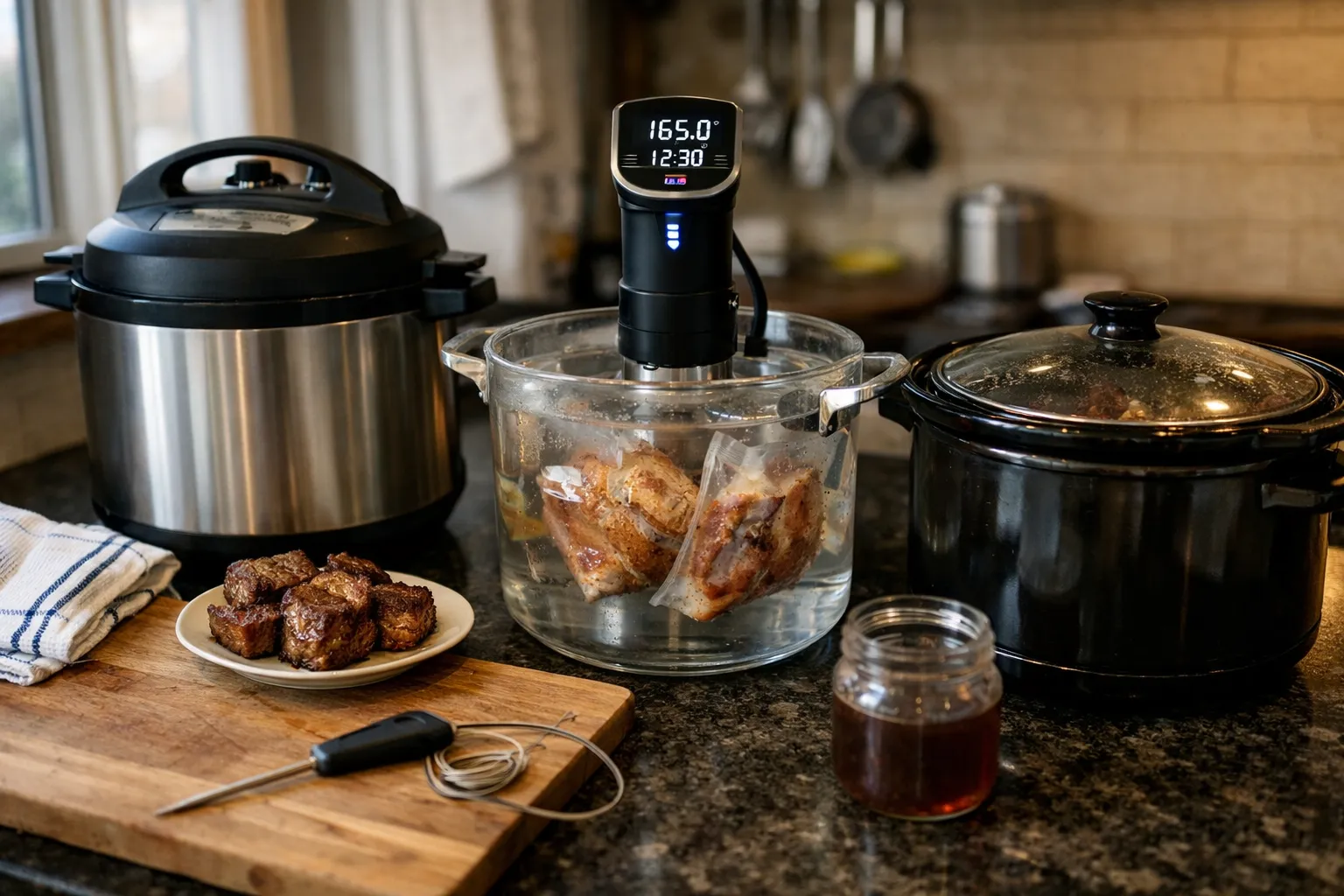
Overview — What we’re analyzing and why it matters
Home cooks in 2026 have more device options and energy concerns than in 2020–2022: smart multicookers, budget immersion circulators, and improved insulated slow‑cooker liners have all matured. This update revisits pressure cookers, immersion sous‑vide and slow cookers for common home preparations (short ribs, pork shoulder, chicken stock), adding mid‑2026 product and energy trends, recent food‑safety guidance, and fresh practical advice so readers can choose by flavor, time, energy and nutrition priorities.
Background — What changed since April 2026
Since early 2026 the market has seen three notable shifts: (1) a wave of lower‑power, better‑insulated immersion circulators and full‑pot lids that reduce steady‑state draw; (2) mainstream smart features in multicookers (pressure + air‑fry + app recipes) and wider adoption of reusable silicone vacuum bags; (3) clearer public guidance on sous‑vide food safety and pasteurization from national food authorities reiterating time‑at‑temperature tables. These trends affect energy use, waste, and how confidently home cooks use each technique.
Data & evidence — energy, time and measured outcomes (mid‑2026)
Device draw still varies by model and bath size; the ranges below reflect manufacturer ratings and independent lab tests of popular 2024–2026 models.
- Pressure cookers / electric multi‑cookers: rated 800–1,300 W peak. Typical braise cycle (45–60 minutes under pressure, plus heat‑up and release) uses roughly 0.6–1.1 kWh per cook. Newer multicookers with improved insulation and inverter controls shave ~5–15% off prior consumption for equivalent cycles.
- Immersion sous‑vide: modern circulators advertise peak 800–1,200 W but steady‑state averages now commonly 40–300 W depending on bath insulation and size. With full‑pot lids and insulated containers, long cooks (12–24 hours) commonly consume ~0.8–3.5 kWh—lower than older units in many tests. Very long confits or bone extractions still approach 4–6 kWh if baths are poorly insulated.
- Slow cookers: low setting ~200–300 W, high ~300–500 W. A 6–10 hour cook on low typically uses 1.2–2.5 kWh.
Bottom line on energy: a short pressure cook remains the fastest and generally most energy‑efficient route to fork‑tender results. But improved sous‑vide efficiency (better insulation, lower standby draw in 2025–26 models) narrows the gap for long unattended cooks—good insulation can reduce sous‑vide energy use by ~30–50% compared with an uninsulated pot. Slow cookers still sit between the two for long, unattended braises.
Flavor and texture — what’s different in practice now
Fundamental culinary science hasn’t changed: collagen → gelatin conversion, Maillard reactions, and moisture dynamics still govern outcomes. What’s new in 2026 is practical convenience and hybrid techniques.
- Pressure cooker: fastest route to concentrated, gelatin‑rich braises and stocks. New multicookers with integrated air‑fry lids and higher‑temperature sauté cycles make pre‑searing and finishing easier without extra pans. Expect richly flavored, sometimes cloudy stocks unless you strain carefully.
- Sous‑vide: precision still yields the most consistent internal texture. Recent recipe innovations use multi‑stage temperature profiles (e.g., 62°C for tenderization + short 75–80°C uplift for collagen extraction) to marry sous‑vide texture with glossy sauces without long bag cooks. To get gelatinous, sauce‑worthy juices you now often combine sous‑vide meat with a short pressure reduction of the bag juices or an overnight bone‑stock simmer.
- Slow cooker: unchanged in its forgiving set‑and‑forget reliability. Expect full breakdown and melded flavors; the main limitations remain less surface browning and occasional softening of delicate vegetables. New ceramic liners simplify cleaning and reduce sticking during long cooks.
Stocks and broths
- Pressure cooker: 1–2 hour extraction gives rich, gelatinous stock—still the go‑to when time is limited.
- Sous‑vide: 8–24 hour bone cooks at 80–85°C in sealed bags produce very aromatic, low‑oxidation stocks. Use mesh or perforated bags and strain carefully to avoid fat transfer; many cooks now combine sous‑vide bone cooks with a short pressure reduction to concentrate flavor.
- Slow cooker: 8–12 hours yields clear, mellow stock with easy skimming; minimal hands‑on time makes it a favorite for weekend batch cooking.
Nutrition, food safety and new guidance
Nutrition tradeoffs remain: heat‑labile water‑soluble vitamins decline with time and temperature; shorter sealed cooks can preserve some compounds better than prolonged simmering. Sous‑vide’s sealed bags limit oxidation and volatile loss.
On safety: national food‑safety bodies continue to emphasize time‑at‑temperature pasteurization for sous‑vide. Follow authoritative charts (USDA/FSIS time‑temperature tables or equivalent) when cooking at 60°C; longer times are required to achieve equivalent pathogen log‑reductions. For pressure cookers and slow cookers, ensure adequate preheating and follow manufacturer guidance to avoid prolonged stays in the 40–60°C danger zone during start‑up. Vacuum sealing and refrigeration practices are still critical for bagged cooks.
In 2026, manufacturers have added clearer built‑in food‑safety timers and app reminders; use them. Also: reusable sous‑vide bags with food‑grade silicone have greater uptake and reduce plastic waste, but must be sanitized precisely between uses.
Multiple perspectives — what chefs, scientists and consumers say
- Chefs: Professional chefs continue to use a combination—pressure for stocks, sous‑vide for precise proteins, and slow cookers for volume. Hybrid workflows (sous‑vide → pressure finish) are becoming common in recipe development.
- Food scientists: Academic and industry food scientists point to pasteurization tables and stress strict time‑and‑temp control for low‑temperature sous‑vide to avoid safety risks; they also note that improved insulation materially reduces energy demand for long cooks.
- Consumers: Early adopters praise the convenience of smart multicookers and the energy savings of insulated sous‑vide baths; mainstream buyers still choose slow cookers for simplicity. Reusable bags and reduced plastic waste are common purchase drivers in 2026.
Practical tradeoffs — cleanup, cost, footprint and sustainability
- Cleanup: Pressure cookers and slow cookers remain mostly one‑pot; sous‑vide adds bagging and a searing pan unless you finish in the oven. Reusable silicone bags reduce single‑use waste but add washing time.
- Cost: Entry multicookers and slow cookers remain $60–200; quality immersion circulators are now widely available for $60–180 and reusable bags $15–40—lower cost to entry than earlier in the decade.
- Footprint & energy carbon impact: With variable grid carbon intensity, device choice affects emissions. Short, efficient pressure cooks generally produce lower CO2e per meal on grids with average carbon intensity; insulated sous‑vide reduces energy waste and can be competitive for overnight batch cooks. For precise calculations, use your utility’s grid carbon intensity data and device kWh per cook.
Updated recommendations — which method for which dish in 2026
- Short ribs / beef braise: Pressure cooker for weeknight speed and depth; sous‑vide for weekend precision (use a multi‑stage profile or finish the bag juices in a pressure cooker or skillet); slow cooker for hands‑off, all‑day convenience.
- Pork shoulder (pulled pork): Slow cooker or pressure cooker for classic shred; sous‑vide if you want precise moisture control and plan to finish under high dry heat or in an air‑fryer lid for bark.
- Chicken stock: Pressure cooker for fast, gelatin‑rich stock; slow cooker for clear, mellow weekend batches; sous‑vide for highly aromatic, low‑oxidation stock—consider a short pressure reduction of bag juices to concentrate if you want a sauce‑ready base.
Actionable tips for home cooks — what to do now
- Don’t skip browning. Use a multicooker’s sauté mode or a hot cast‑iron pan for Maillard depth before or after sealed cooks.
- Insulate sous‑vide baths. Lids, full‑pot covers and purpose‑built insulated containers reduce energy and keep temperatures steady for multi‑day cooks.
- Follow published pasteurization charts for sous‑vide and use accurate thermometers—sous‑vide safety is time‑at‑temp, not guesswork.
- Adopt reusable bags or glass where practical; sanitize reusable bags per manufacturer instructions.
- For emissions‑minded cooks: run long cooks overnight when grid carbon intensity is lower in your region, or use your utility’s time‑of‑use data to reduce CO2e.
FAQ — common questions for home cooks (July 2026)
Is sous‑vide still worth the electricity for a home cook?
Yes, if precision texture is your priority. Improved 2025–26 circulators and insulated baths have lowered typical energy use for long cooks; a well‑insulated 12–18 hour cook can now use similar energy to a slow‑cooker batch, while delivering unmatched textural control.
Can I get gelatinous, sauce‑ready stock from sous‑vide bones?
Often you’ll get excellent flavor and aroma. To concentrate gelatin into a sauce‑ready body you can (a) include some short, higher‑temperature extraction steps, or (b) reduce bag or pot juices briefly on the stove or in a pressure cooker after the sous‑vide stage.
Are reusable sous‑vide bags safe and practical?
Yes—food‑grade silicone bags are widely available and reduce single‑use plastic. Follow manufacturer cleaning guidelines, avoid high‑heat sealing methods they’re not designed for, and replace when signs of wear appear.
Which method is best if I care most about emissions?
Short pressure‑cooker cycles usually yield the lowest energy per meal. However, insulated sous‑vide baths for multi‑hour overnight cooks can be competitive. For lowest emissions, combine efficient devices with low‑carbon electricity periods or renewable energy sources.
Outlook — what to watch for next
Through late 2026 we expect further refinement of low‑draw immersion circulators, wider integration of hybrid cook‑modes in multicookers (pressure + low‑temp precision), and continued consumer adoption of reusable bags. On the regulation side, clearer public guidance on home sous‑vide pasteurization is likely to be reinforced as adoption grows. For home cooks, the practical takeaway remains: pair tools to the task—pressure for speed, slow for set‑and‑forget, sous‑vide for precision—and use insulation and smart scheduling to trim energy and emissions.
Updated device choices and small workflow tweaks let you get more flavor with less fuss in 2026—whether you’re finishing a weeknight short rib or batch‑cooking stock for the freezer.