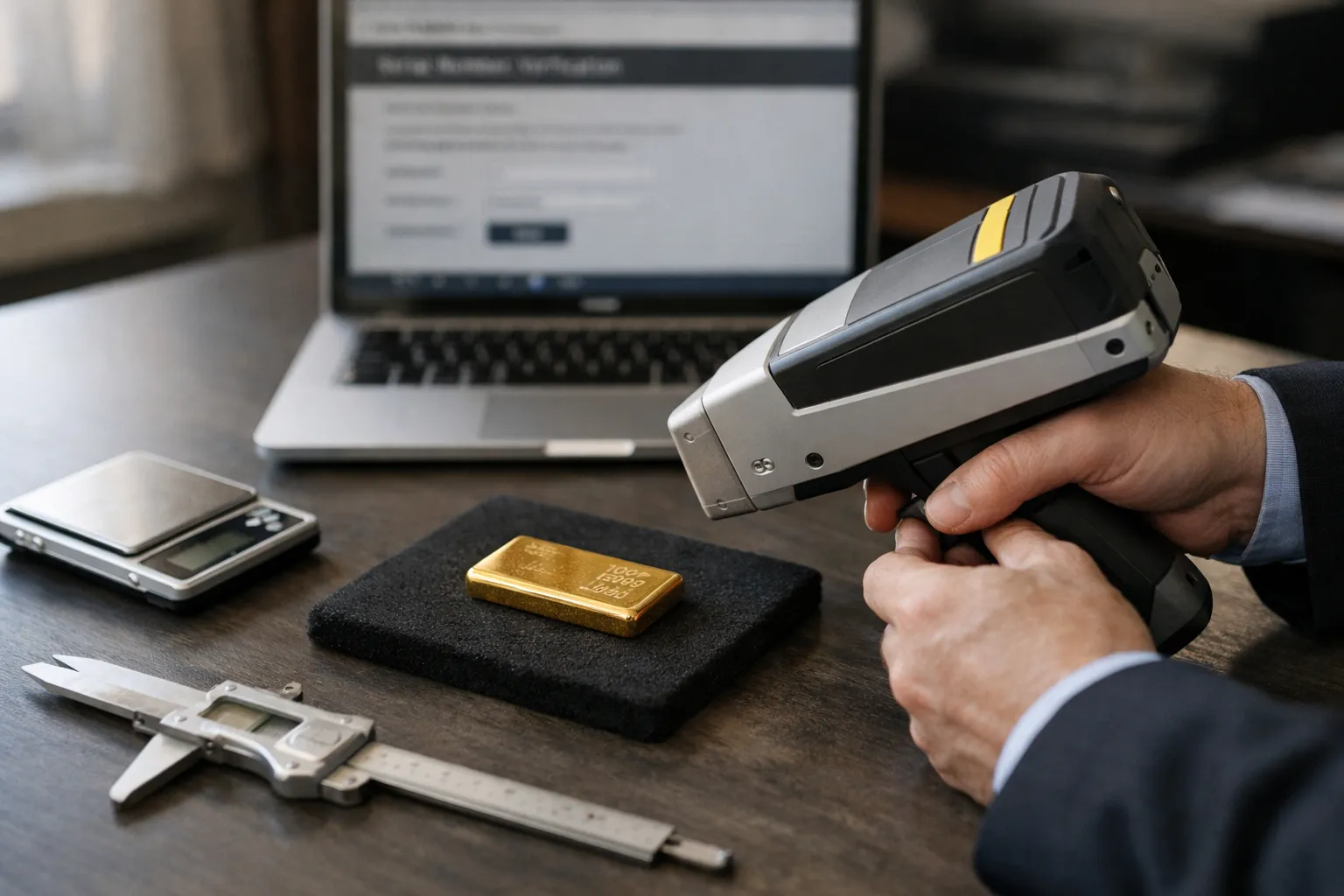
What you will learn: How to authenticate pre‑owned gold bars and coins in July 2026, using current tools, tests and settlement best practices so you minimize fraud risk and preserve resale value. This guide is written for individual and small institutional investors who buy secondary‑market bullion from dealers, online marketplaces or private sellers.
Prerequisites and context
Secondary‑market bullion remains an attractive place to buy physical gold because premiums are typically lower and selection broader than new-mint pieces. Since 2024 the counterfeiting threat has evolved: higher-quality plated and composite fakes, improved cosmetic replication and deliberate reuse of authentic packaging make visual inspection alone insufficient.
At the same time, tooling and services available to buyers have improved. Portable X‑ray fluorescence (XRF) devices are more accurate, independent assayers offer high-resolution CT scanning as a non‑destructive option, and several refiners and marketplaces now offer digital provenance tools and verified serial‑number lookup services. The recommended approach in 2026 is a layered one: visual + physics + instrument tests + provenance verification + secured settlement.
Quick checklist (what to confirm before you buy)
- Refiner or mint: known marks from LBMA-recognized refiners and major national mints (PAMP, Valcambi, Argor‑Heraeus, Heraeus, Credit Suisse, Royal Canadian Mint, Perth Mint, US Mint).
- Physical match: weight (1 troy oz = 31.1035 g), dimensions, edge treatment and relief against manufacturer specs.
- Security features: serial number, assay card, micro‑engraving, latent images — verify against official examples.
- Non‑destructive testing: portable XRF, density/Archimedes, ultrasound/CT and conductivity checks where available.
- Documentation: original assay certificate (if any), chain‑of‑custody records, seller ID and written buyback or return terms.
- Settlement plan: escrow, in‑person inspection, or insured courier with signature and tracked handover.
Step 1 — Research the item and seller before inspection
- Verify images and serials: Use high‑resolution official product images from the refiner or mint to compare hallmarks, font, and hallmark placement. If a serial number is present, ask the refiner or mint whether they provide verification on request and retain any written confirmation.
- Seller due diligence: Check dealer history, trade memberships, storefront longevity, verified reviews and whether they offer in‑person inspection or escrow. For private sellers, insist on photographed ID, dated photos and a short video of the item being handled.
- Market price sanity check: Compare the asking price against live spot + typical secondary‑market premiums offered by reputable dealers. An out‑of‑market low price is a high‑risk signal.
Step 2 — Field inspection: the non‑destructive checks
If possible, inspect in person. If buying remotely, require a time‑stamped recorded video and independent testing before final payment.
1) Visual and tactile checks
- Use a calibrated scale and calipers; confirm weight and dimensions match manufacturer specs (e.g., 1 oz = 31.1035 g; 100 oz bar dimensions vary by refiner).
- Compare edge reeding, micro‑text and relief detail to authenticated images. Micro‑engraving and latent images used by several mints are hard to reproduce convincingly.
- Examine packaging critically. Factory seals and tamper-evident cards are helpful but not definitive — counterfeiters can replicate packaging.
2) Simple physics tests
- Magnet: gold is not magnetic; any magnetic response is a red flag (but absence of magnetism does not prove purity).
- Archimedes/density: measure displaced water volume to calculate density. This is inexpensive and catches obvious core swaps (e.g., tungsten cores).
- Tap test: experienced inspectors can sometimes detect anomalies by sound, but use this only as a quick heuristic, not proof.
3) Portable XRF analysis — what to ask for in 2026
Portable XRF remains the workhorse for non‑destructive compositional checks. In mid‑2026 expect these norms:
- Ask for the printed report plus the raw spectrum file (many instruments now export CSV/Bruker‑style spectrum files). Retain device model and calibration standard in writing.
- Remember surface bias: XRF reads near‑surface composition. It reliably confirms karat close to mark level for many genuine items but can be fooled by plated surfaces over base cores unless combined with density/ultrasound.
- Multi‑energy and high‑resolution XRF units reduce uncertainty; dealers and labs increasingly use multi‑energy handhelds that improve depth discrimination.
4) Ultrasound, CT and conductivity testing
Ultrasound (including phased‑array methods) detects internal voids and heterogeneous cores. In 2025–26 several independent labs began offering non‑destructive CT scanning for high‑value items — CT provides a volumetric map that can reveal a plated layer over dense core without cutting the bar. CT and ultrasound are more expensive but are practical for 100 oz bars or high‑value lots.
Conductivity/eddy‑current testers are effective for flagging alloys inconsistent with pure gold and are a useful supplement to XRF and density checks.
Step 3 — Serial numbers, assay cards and refiner verification
- Contact the refiner or mint: Many major refiners will verify serials or confirm whether a given assay card number format is valid. Save email or chat transcripts; a logged phone reference with date and agent name is also useful.
- Match certificate data: Confirm weight, fineness, serial number and issue date on the certificate align with the physical item. Photocopies should be treated suspiciously unless traceable to the refiner.
- Digital provenance: Some refiners and marketplaces now offer digital provenance records (tokenized ownership records or blockchain anchors). These are useful when present but still require physical verification—digital provenance reduces, but does not eliminate, fraud risk.
Step 4 — When you need a conclusive assay
Non‑destructive methods usually suffice. If doubts persist, commission a formal assay. Options and considerations in 2026:
- Independent XRF/CT report: Non‑destructive lab reports (XRF plus CT) typically cost less than full destructive assays and are accepted by many dealers for secondary‑market trades.
- Fire assay (destructive): The gold standard for conclusively determining purity. Destructive testing is recommended only for items where the value justifies taking a loss on part of the bar (or when buyer and seller agree to share cost/risk).
- Cost and turnaround: Expect non‑destructive lab checks to range from modest fees to a few hundred dollars depending on test complexity; destructive assays and insured shipping for high‑value items will be higher. Ask labs for a written cost and turnaround estimate before shipping.
- Chain‑of‑custody: Use insured, tracked shipping and retain documentation of who handled the item at each step. Reputable labs will provide chain‑of‑custody forms.
Step 5 — Settlement, payment and documentation
- Prefer regulated escrow or exchange custody: Use escrow services provided by regulated platforms or well‑known bullion exchanges for remote trades. Verify the escrow provider’s regulatory status and insurance coverage.
- In‑person settlement: Where practical, inspect and test before payment at a dealer’s premises or neutral location. Bring your own small portable tools (scale, calipers) and request vendor XRF results.
- Shipping terms: If shipping, require fully insured courier service with signature on delivery and no‑value declarations. Specify return and dispute procedures in writing.
- Documentation to retain: Invoice, bill of sale, ID/KYC for private sales, XRF/raw spectra, lab reports (CT or fire assay), photos, and any written buyback or return commitments.
Common mistakes that lead to losses
- Relying on packaging alone. Tamper‑evident packaging can be replicated.
- Accepting a verbal serial‑number verification without written confirmation from the refiner.
- Skipping density or ultrasound checks because the XRF "looked right."
- Paying before independent verification or without escrow when buying remotely.
- Under‑insuring shipments or using untraceable payment methods for high‑value lots.
Pro tips — practical actions experienced buyers use
- Request the XRF raw spectrum (not just a summary) so an independent expert can re‑interpret readings if a dispute arises.
- Record a short video of the XRF test showing the device readout, device model, calibration sticker and serial number. Hash and time‑stamp the file if possible.
- For bulk lots, test a representative sample rather than every piece—combine random sampling with targeted checks on high‑value items.
- Maintain a digital provenance folder for each purchase: photos, test reports, correspondence and invoices. This materially improves liquidity at resale.
- Use reputable, insured local storage or vaulting for large holdings; many vault operators also perform routine re‑verification on request.
Real‑world examples (how to apply the steps)
Example 1 — 1 oz Gold Maple Leaf from a private seller
Ask for a live, time‑stamped video showing obverse and reverse, edge and micro‑engraving. Insist on a portable XRF read in‑person or by an independent local dealer. If the seller refuses recorded proof and insists on rush payment, walk away.
Example 2 — 100 oz secondary‑market bar with assay card
Verify the serial and assay number with the refiner in writing. Request independent XRF plus density. For material doubt, send the bar to an accredited lab offering CT scanning before finalizing payment; use escrow for funds until reports are returned.
Example 3 — Estate bulk lot of assorted bars and coins
Sample at least 10–20% of items across types for XRF and density checks, prioritizing pieces with serials or high unit value. Price the lot to include potential assay/processing costs and the possibility of re‑melting if pieces fail later verification.
Where to get help: labs, lists and resources
- Independent assayers and testing firms that operate precious‑metals labs (industry mainstays: Bureau Veritas, SGS, Intertek) — they offer both XRF and destructive assays.
- Major refiners and national mints (customer service channels often verify serials or provide authentication guidance).
- Local reputable bullion dealers and regulated vaults — they can perform independent checks and offer escrow or trade‑in options.
- Industry reference lists (LBMA Good Delivery and major mint directories) — use these to identify trusted refiners.
Final rules of thumb
- Use multiple test methods: visual + XRF + density/ultrasound + provenance checks.
- Insist on written verification from refiners where serials or assay cards are claimed.
- Document everything at the time of purchase — photos, videos, reports and receipts materially help resolve disputes and preserve resale value.
- When in doubt, pay for independent lab verification or walk away — the cost of a definitive test is usually small compared with the risk of a counterfeit.
FAQ
How reliable is portable XRF for detecting plated fakes?
Portable XRF is very useful for confirming near‑surface alloy and typical fineness values, but it reads only the surface layer. Well‑executed plated fakes can show correct surface gold values while hiding a different core. To detect plated cores, combine XRF with density checks, ultrasound or CT scanning; these methods expose internal heterogeneity that XRF alone can miss.
Can I rely on serial‑number verification from the seller?
No — always seek independent confirmation from the refiner or mint. Serial numbers and certificates can be forged or copied. If a refiner provides authenticated verification, retain that confirmation in writing (email with agent name and date) before completing the transaction.
When should I pay for a destructive fire assay?
Only when non‑destructive testing leaves unresolved doubt and the item's value justifies the cost and partial destruction. Fire assays are definitive but destructive; they are appropriate for high‑value, ambiguous items where resale or institutional use demands absolute certainty.
What are safe settlement methods for remote purchases?
Use a regulated escrow service tied to a recognized bullion exchange or a reputable, insured vaulting provider. Alternatively, have the piece shipped to an independent lab or local dealer for testing before funds are released. Avoid untraceable payment methods for high‑value buys.
Are digital provenance or blockchain tokens a guarantee of authenticity?
Digital provenance helps by recording an ownership chain and issuing verified serials, but it is not a substitute for physical verification. Tokens can prove an item was recorded at a point in time, but they do not prevent the creation of look‑alike fakes or fraudulent token issuance. Always combine digital records with physical testing.
Secondary‑market gold buying in July 2026 favors disciplined, evidence‑based verification. The best outcomes come from layering quick, low‑cost checks with targeted advanced testing, insisting on written refiner verification when available, and using secure settlement channels. Those practices materially reduce counterparty and counterfeit risk and preserve both purity and liquidity of your holdings.