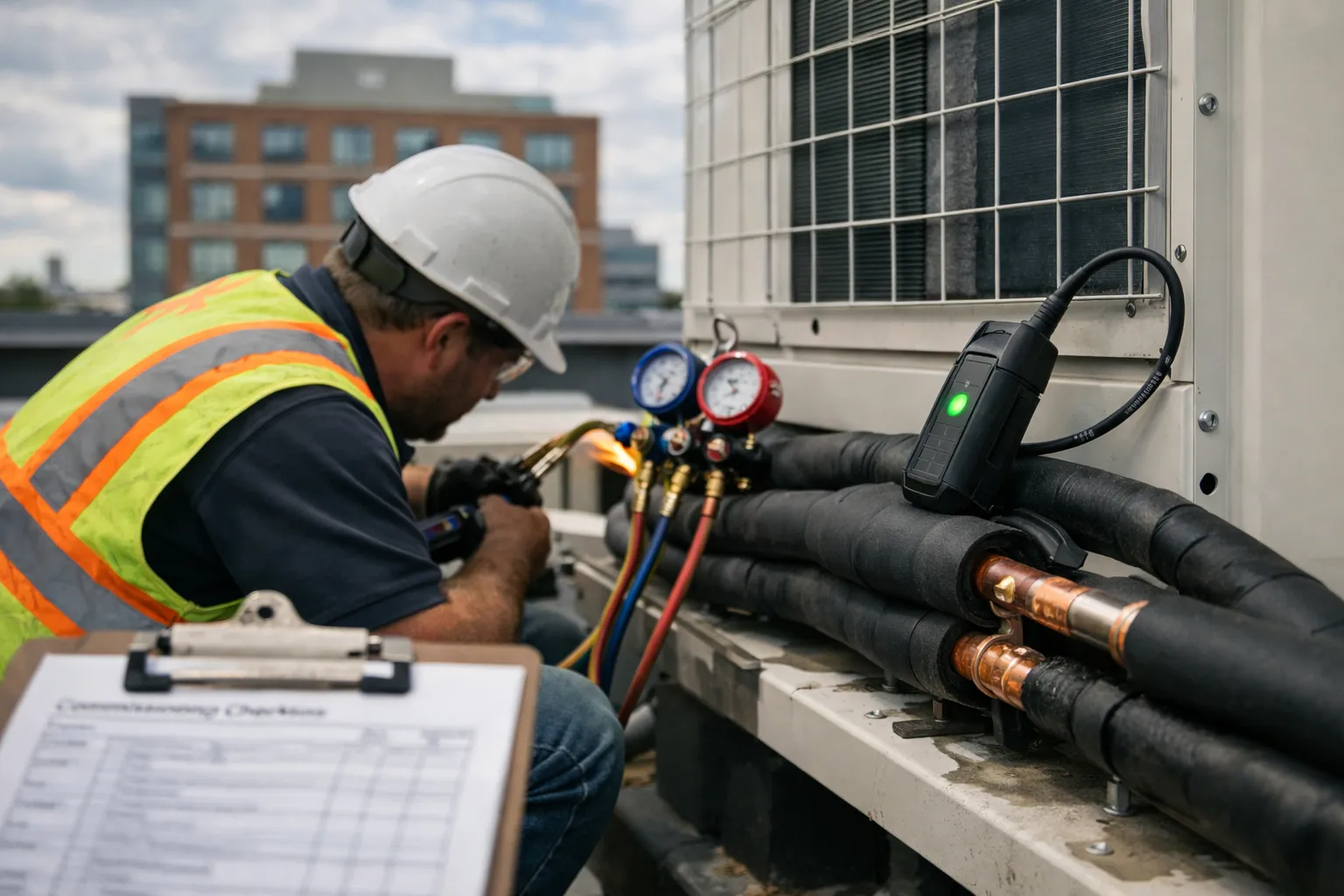
As variable‑refrigerant‑flow (VRF) systems move from niche to mainstream in North American retrofits, owners and contractors face tradeoffs that go beyond initial efficiency claims: refrigerant stewardship, long‑term maintenance costs, and the real-world energy gains when retrofitting existing building envelopes and ductwork. HVAC System Guide analyzed an anonymized dataset of 120 commercial and multi‑family VRF retrofit projects completed between 2022 and mid‑2026 to quantify outcomes and identify durable procurement and operations strategies.
Dataset and methodology
The dataset spans small office, retail, and multi‑family buildings (10,000–120,000 ft²) across 18 U.S. states and 4 Canadian provinces. Data sources include contractor service logs, utility billing (pre/post), refrigerant purchase and reclamation records, and site commissioning reports. We normalized energy results to heating‑degree and cooling‑degree days and excluded projects with major concurrent envelope or lighting retrofits to isolate HVAC impacts.
Key findings — headline numbers
- Median annual refrigerant loss: 6% of installed charge (range: 0.5%–28%).
- Median measured whole‑building HVAC energy savings vs. baseline packaged rooftop or split systems: 22% first year (range: −5% to 45%).
- Median first‑year service cost increase for owners: 12% above previous packaged‑R/M costs, primarily due to leak detection, refrigerant reclaiming and additional diagnostics.
- Typical payback on incremental installed cost (vs. like‑for‑like high‑efficiency RTU): 4–9 years depending on incentives and operational hours.
Interpreting refrigerant loss
Refrigerant loss clustered by installation quality and system topology. Projects with long, retrofit‑routed refrigerant lines and multiple brazed service joints reported the highest losses (median ~12%). Turnkey duct‑replacement installs where outdoor units were modestly relocated and factory‑prefabricated line‑sets were used had the lowest losses (median ~1.8%).
High leak rates were not evenly distributed: roughly 18% of projects accounted for 60% of total reported annual refrigerant loss. These projects shared common traits—multiple field braze joints, limited access to outdoor condensing units, and commissioning that prioritized airflow and controls over pressure decay testing.
Energy performance realities
Measured energy savings generally met manufacturer lab performance when systems were installed and commissioned per factory guidance—especially on cooling‑dominant sites where zoning gains and inverter compressor modulation reduced cycling losses. However, heating outcomes varied: in cold climates the majority of heat‑pump based VRF retrofits required supplemental electric resistance or fossil backup during extreme cold, reducing measured seasonal heating savings.
- Cooling‑dominant sites (southern U.S.): median HVAC energy reduction 28%.
- Mixed‑climate sites: median reduction 20% but with wider variance.
- Cold‑climate retrofits: 8–18% median reduction depending on backup strategy and charge optimization.
Two recurring causes of underperformance were: (1) improper refrigerant charge after long line runs resulting in reduced heat‑transfer and (2) outdated controls integration that limited capacity modulation and coordinated setback features.
Maintenance and service‑cost impacts
Owners saw a modest bump in annual service spend driven by:
- Mandatory leak detection sensor installation for high‑charge systems (labor and sensor subscription costs).
- More frequent refrigerant handling—recovery, reclaim, and refill—on systems with higher leak rates.
- Controls and commissioning warranty claims requiring vendor‑specific diagnostics and firmware updates.
Notably, projects that bundled a multi‑year service contract with refrigerant‑loss guarantees reduced owner exposure; vendors absorbed up to 100% of refrigerant replacement costs for the first 2–3 years in exchange for premium monthly fees. Where such contracts existed, owners reported greater uptime and fewer deferred maintenance issues.
Market drivers shaping outcomes
Three market forces influenced the dataset outcomes:
- Regulatory and supply shocks: AIM Act‑driven HFC phase‑down and post‑2023 supply volatility kept refrigerant prices elevated in 2024–2026. Higher refill costs increased owner sensitivity to leak rates.
- Installer experience: Early adopters of VRF in North America often relied on trained, manufacturer‑certified crews. Projects using generic HVAC contractors without VRF‑specific training had 2–3× higher leak incidence.
- Controls integration complexity: Retrofits with full BMS integration and remote fault reporting achieved better real‑world savings and lower season‑to‑season performance decay.
Practical recommendations
Based on the analysis, owners and contractors should adopt a three‑pronged approach: design for low leak risk, contract for long‑term stewardship, and instrument for verification.
1. Design and installation
- Prioritize prefabricated line‑sets and minimize field brazing whenever site constraints allow.
- Specify mechanical rooms or rooftop access that permit regular leak surveys and equipment replacement without costly rigging.
- Include pressure‑decay testing and nitrogen purge procedures in the commissioning scope; require documented hold times before system handover.
2. Contracting strategies
- Require manufacturer‑certified installation crews or verified contractor training as a prequalification in bid documents.
- Negotiate refrigerant‑loss or leak‑rate guarantees for the first 2–3 years; where vendors charge premiums, compare against forecasted refill costs under AIM Act trajectories.
- Consider performance‑based maintenance contracts that tie payments to verified energy performance and specified leak thresholds.
3. Commissioning and monitoring
- Install fixed leak detectors at typical leak‑path locations (mechanical closets, rooftop curbs) and integrate alarms into the BMS or service portal.
- Require baseline energy and refrigerant‑mass metrics in the post‑commissioning report and schedule seasonal re‑commissioning checks at 6 and 18 months.
- Use remote analytics to flag abnormal suction/discharge pressures that suggest charge loss before gross performance decline occurs.
Policy and procurement implications
Procurement language matters. Public owners and large portfolios should update bid templates to explicitly address refrigerant stewardship: mandatory commissioning pressure tests, documented training, leak guarantees, and inclusion of refrigerant management reporting in post‑installation analytics. Incentive programs should weight low leak‑risk installation practices in scoring, not just quoted SEER/HSPF numbers.
Conclusion
VRF retrofits deliver substantial measured energy reductions in many contexts, but their long‑term value depends on managing refrigerant risk and ensuring high‑quality installation and controls integration. Our 120‑project analysis shows that a minority of poorly executed projects account for most refrigerant loss and that well‑specified procurement and monitoring practices can materially lower owner lifecycle costs. For owners considering VRF now, the highest‑leverage actions are prequalifying trained installers, demanding robust commissioning, and contracting for refrigerant stewardship.
HVAC System Guide will publish a companion procurement checklist and sample contract language in a follow‑up briefing to help owners operationalize these recommendations.