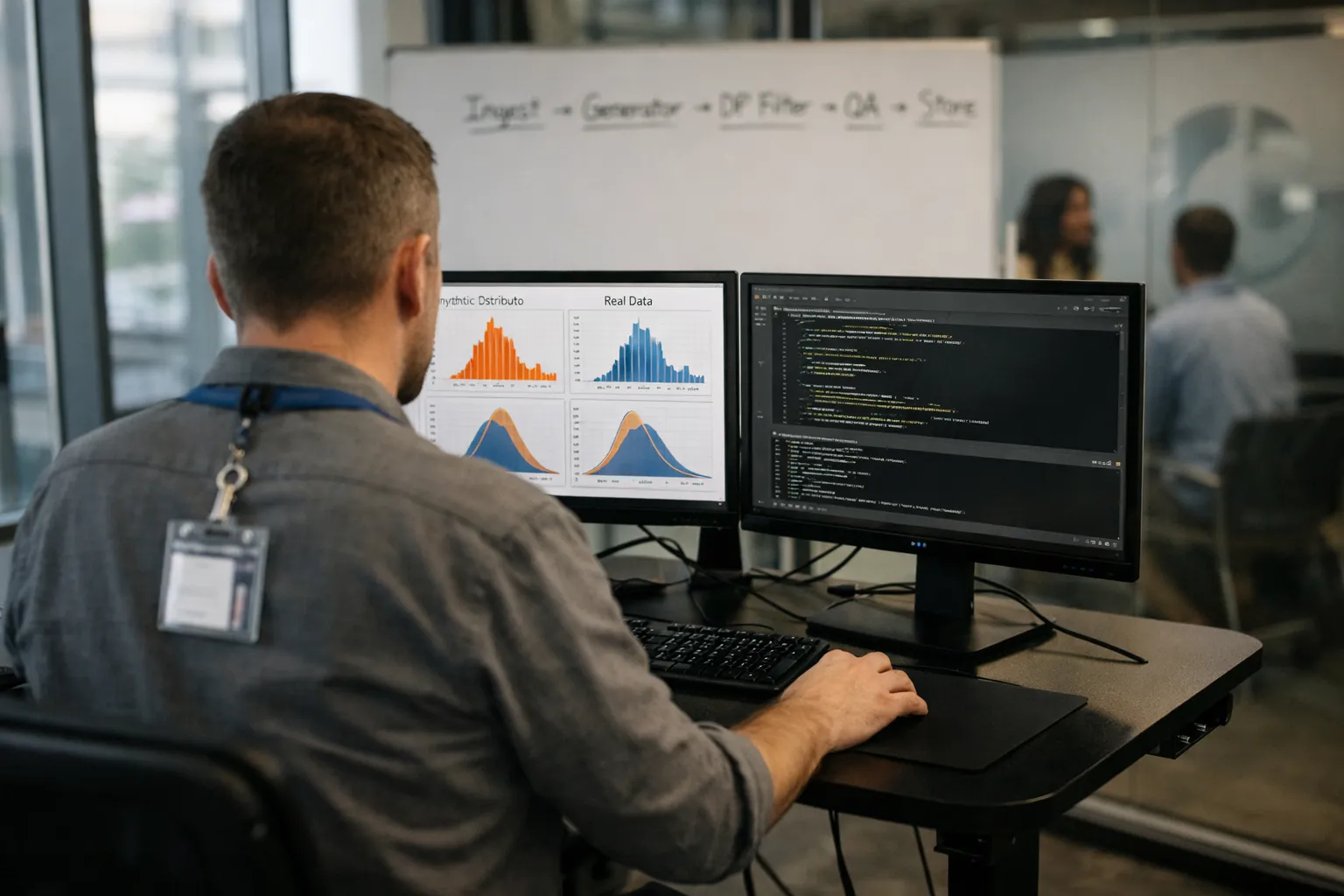
Enterprises increasingly use synthetic data to accelerate model development, reduce privacy risk, and share datasets across teams. By 2026, synthetic generation tools—ranging from tabular GANs and diffusion models to LLM-based augmenters—are mature enough to be part of production ML stacks. But operationalizing synthetic data safely and effectively requires an engineering-plus-governance approach: clear use-case scoping, privacy controls, evaluation metrics, reproducible pipelines, and continuous monitoring.
Who this guide is for
This guide targets AI-for-business practitioners (data engineers, ML engineers, product managers, and compliance leads) who need a step-by-step playbook to design, build and govern enterprise-grade synthetic data pipelines for model training, testing, and safe sharing in 2026.
When to use synthetic data — practical decision rules
- Use it when you need: rapid data-sharing across teams, de-risked model training where real PII cannot be exposed, augmentation for under-represented classes, or generation of labeled data for expensive manual labeling (e.g., simulated customer dialogs).
- Don't use it when: the target is modeling extremely rare tail events with no realistic generative prior, your production model depends on exact transaction traces, or regulatory rules explicitly require only original data (rare but possible).
- Hybrid approach—often best: augment limited real data with synthetic samples for class balancing or privacy-preserving test sets, while retaining a small real-data validation holdout.
High-level pipeline: seven practical steps
- Scope & objectives
- Define explicit goals (e.g., train a fraud model with 30% synthetic augmentation; share a synthetic customer dataset with partner teams).
- Identify acceptance criteria: minimum model performance drop (or improvement), maximum acceptable re‑identification risk, audit requirements, and regulatory constraints (GDPR, HIPAA, EU AI Act obligations for "high-risk" AI where applicable).
- Inventory and data profiling
- Catalog all source tables, fields, and metadata (sensitivity tags, PHI/PII flags). Use a data catalog (Collibra, Alation, or open-source alternatives) and tag columns by sensitivity class.
- Profile distributions, cardinality, missingness, and natural keys. Record upstream lineage and retention policies.
- Risk assessment & governance policy
- Perform a Data Protection Impact Assessment (DPIA) for the synthetic use. Define allowable downstream uses and reviewer approvals.
- Set privacy thresholds: target differential privacy epsilon, acceptable uniqueness percentage, and re-identification risk limits. Decide whether to allow "record-level fidelity" for debug sets or only statistical fidelity for production training.
- Choose generation methods
- Match method to data modality:
- Tabular numerical/categorical: CTGAN/TVAE (SDV), conditional tabular diffusion, or probabilistic graphical models.
- Time-series: TimeGAN variants or diffusion models with temporal conditioning.
- Text and dialogs: LLM-conditioned generation (careful with memorization), retrieval-augmented generation for domain consistency.
- Images / video: domain-specific synthetic renderers (Datagen-style) or diffusion-based generators, especially for labeled supervisory signals (bounding boxes, segmentation).
- Consider hybrid pipelines: a rules-based sanitizer for PII fields, then a generative model for residual distributional structure.
- Match method to data modality:
- Build the pipeline
- Architectural components:
- Ingestion & profiling: Airflow/Prefect/step functions plus catalog metadata.
- Preprocessing: deterministic scrubbing (tokenization, date bucketing) and schema transformations.
- Generator layer: containerized generator jobs (GPU-enabled for heavy models) with parameterized seeds for reproducibility.
- Privacy enforcement: DP mechanisms, k-anonymization tools (ARX) or output filtering.
- Quality checks: automated statistical tests and ML utility evaluations.
- Storage & access: separate synthetic data stores and access control policies; maintain cryptographic hashes for auditability.
- Make the pipeline reproducible: store generator model versions, random seeds, configuration, and container images in a model registry (MLflow or similar).
- Architectural components:
- Validate utility and disclosure risk
- Utility tests:
- ML efficacy: train same model architecture on synthetic training data and evaluate on a small, restricted real-data holdout. Track delta AUC/accuracy, calibration drift, and fairness metrics.
- Statistical similarity: distributional tests (KS test, chi-square), feature correlation matrices, marginal and joint distributions, and coverage metrics (e.g., support overlap).
- Privacy tests:
- Re-identification risk: nearest-neighbor similarity checks, record uniqueness, and attacker simulations.
- Membership inference / memorization checks: run membership inference attacks and sample-based memorization tests, especially for LLM-generated text.
- Formal DP evaluation: compute or bound epsilon when using DP mechanisms; if using ad-hoc techniques, provide empirical risk assessments.
- Gate criteria: only promote synthetic sets that meet both utility and privacy thresholds defined in step 1.
- Utility tests:
- Deploy, monitor, and audit
- Productionize as data product versions: tag synthetic datasets with version, generator model ID, privacy guarantees, and certification metadata.
- Continuously monitor: distribution shifts between synthetic and incoming real data, model performance drift when models trained on synthetic are deployed, and periodic re-evaluation of disclosure risk.
- Maintain auditable logs: who generated what, approvals, DPIA artifacts, and test results. Archive raw real datasets and synthetic artifacts for compliance retention windows.
Concrete architecture example (HR churn model)
Example objective: train an employee churn model with synthetic augmentation so HR analysts can run experiments without direct access to PII.
- Data sources: HRIS (PII fields), engagement surveys (free text), access logs (time series).
- Pipeline sketch:
- Extract & profile in sandboxed environment (no network egress).
- Pseudonymize direct identifiers (one-way salted hash) and tag quasi-identifiers.
- Train conditional tabular generator (CTGAN) for employee demographics and tenure; fine-tune a time-series generator for access patterns; use an LLM (with privacy fine-tuning) to synthesize de‑identified survey responses with topic conditioning.
- Apply differential privacy at the generator output layer (e.g., reprojection + Gaussian noise calibrated to epsilon=1-2 depending on risk appetite).
- Run utility validation: train churn model on synthetic+real small holdout; require =2% AUC drop. Run re-identification tests; require uniqueness 0.1%.
- Publish dataset with metadata and usage policy; permit analysts to access in a controlled notebook environment that blocks egress.
Tooling and libraries (2026 pragmatic list)
Tool selection depends on modality and enterprise constraints. Below are representative categories and names (vendors and OSS) to evaluate in 2026:
- Tabular/time-series generation: SDV (and CTGAN/TVAE family), Tonic, Mostly AI.
- Text augmentation and control: fine-tuned LLMs (vendor options), RAG-based templating; use privacy-scrubbers before training.
- Images/video: Datagen-style synthetic rendering platforms or diffusion-based labeled generators.
- Privacy libraries: Google Differential Privacy, OpenDP, IBM diffprivlib, ARX for k-anonymity.
- Evaluation: custom MMD/K-S pipelines, MLflow for model/evaluation tracking, custom re-identification simulators.
- Orchestration & governance: Airflow/Prefect, data catalog (Collibra/Alation), model registry (MLflow), and audit logging in SIEM for compliance.
KPIs and acceptance metrics
- Model utility: delta AUC, F1, calibration shift vs. model trained on real data.
- Statistical fidelity: feature distribution overlap, pairwise correlation residuals.
- Privacy: uniqueness fraction, simulated re-identification rate, membership inference success rate, DP epsilon (if applicable).
- Operational: generation latency, cost per synthetic row, reproducibility score (versioned artifacts), and time-to-share (time to produce certified synthetic dataset).
Common pitfalls and how to avoid them
- Overfitting generators — can leak real records. Avoid by using regularization, early stopping, holdout checks, and DP where required.
- Using synthetic for everything — don’t replace critical production validation with synthetic-only testing; retain a small secured real-data validation set.
- Ignoring governance — synthetic datasets still require DPIAs and documented allowable uses; failing that raises legal and reputational risks.
- Underestimating rare events — synthetic models may fail to reproduce true tail dependencies. Prefer targeted simulation or scenario-based synthetic generation for rare events.
Cost and ROI considerations
Costs include compute (GPU training for generative models), engineering time to build and validate pipelines, and governance overhead. ROI drivers:
- Faster iteration cycles and reduced waiting time for sanitized datasets.
- Lower legal/custodial overhead by reducing access to real PII.
- Improved model fairness and coverage through controlled augmentation.
Estimate break-even by comparing time savings for analysts and reductions in compliance review cycles against incremental costs of synthetic generation. A common enterprise target: recover pipeline costs within 6–12 months through reduced review cycles and faster model deployment.
Checklist before production release
- Defined use case and acceptance criteria.
- Completed DPIA and approvals from legal/privacy teams.
- Reproducible generator artifacts with versioning and sealed random seeds.
- Passed utility and privacy test suites with documented thresholds.
- Operational monitoring and alerting configured for drift and auditability.
- End-user documentation and data-use agreements for synthetic datasets.
Final recommendations
Synthetic data is a powerful enabler for enterprise AI when treated as a product: design the pipeline with clear objectives, bake in privacy-by-design, and hold synthetic datasets to measurable utility and disclosure standards. Start small — a pilot augmentation for one model — and expand after proving utility and governance practices. In 2026 the ecosystem provides mature building blocks; the critical differentiator is disciplined operationalization and auditing.
Appendix: Resources to explore
- Open-source: SDV (Synthetic Data Vault), Synthea (healthcare), ARX (de-identification), OpenDP.
- Privacy frameworks and guidance: GDPR guidance on pseudonymization, EU AI Act compliance resources, NIST de-identification guidance.