Executive summary
Certified pre-owned (CPO) electric vehicles carried a clear price premium during the 2020–2023 run-up in used-car values. In 2025–26 that premium has softened: CPO EVs are still sold at a premium versus comparable non-CPO used EVs, but the gap is narrower, and it varies significantly by brand, model year, region and battery-warranty terms. This article analyzes the forces behind that change, what the data and market dynamics reveal, and practical steps buyers should take when considering a CPO EV in 2026.
What the market data and listings show
Across dealer listings, national marketplaces and auction channels, three patterns are visible in 2026:
- Inventory of late-model used EVs—especially lease returns from 2021–23 cohorts—has increased, putting downward pressure on prices.
- CPO premiums exist but are compressing: the price gap between dealer CPO units and similar non‑CPO private- or dealer-sold EVs is smaller than in earlier years.
- Regional dispersion is large. Coastal metropolitan areas with robust EV adoption still show stronger CPO premiums than many interior or Sunbelt markets where supply outpaced local demand.
Those high-level patterns are reflected in searchable listings and wholesale auctions: more CPO EVs are lingering longer on dealer lots, and dealers are adjusting asking prices or incentives to move certified inventory.
Why CPO EV premiums are easing
At least five interlocking factors explain the change.
1. Supply normalization from rising lease returns
Many EV buyers from 2019–22 leased vehicles with short terms; those lease expirations are now feeding the used market. Lease return volumes of late-model EVs are higher than earlier expectations, swelling supply and weakening the scarcity-driven premiums that pushed CPO prices up in prior years.
2. Buyer risk calculus around batteries and warranties
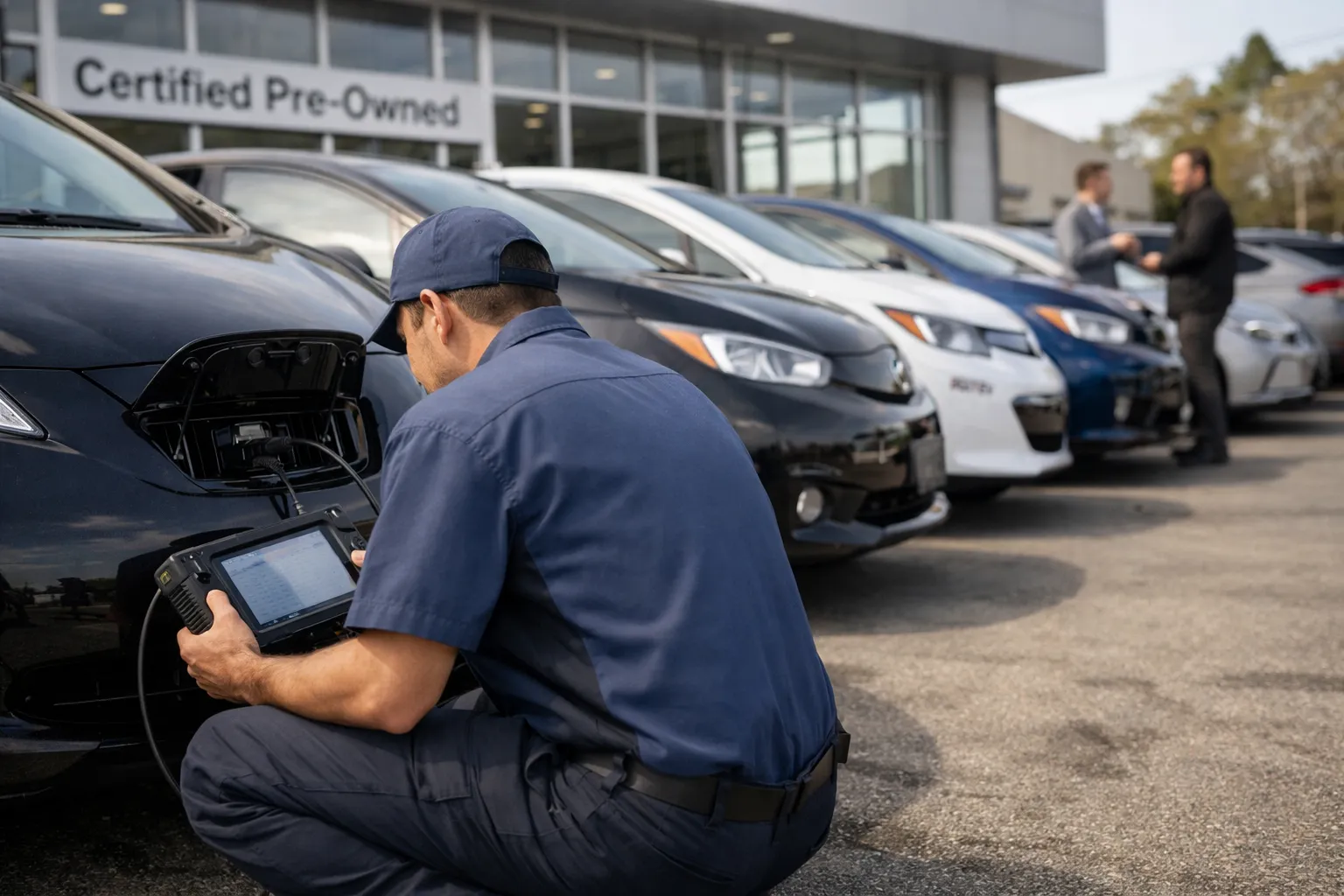
Early-adopter concerns about battery degradation remain a key buyer consideration. CPO programs historically commanded premiums by bundling extended powertrain or battery warranties and dealer inspections. As more independent testing tools and third-party battery diagnostics have become common, buyers can assess state-of-health themselves—or choose third-party warranties—reducing the unique perceived value of manufacturer CPO badges.
3. Policy and incentives shifting demand
Federal and state incentives for new EVs (including tax credits under federal programs) remain a crucial demand driver for new-vehicle sales. When new EV incentives or attractive lease programs are available, some buyers favor new vehicles over used ones, altering the competitive dynamics between new, CPO and private-market used EVs. At the same time, some states and utilities have launched targeted used-EV rebates or incentives; those local programs create mixed regional effects on CPO pricing.
4. Financing and residual value realities
Higher interest-rate environments make monthly-payment comparisons more salient. Dealers have used CPO financing offers aggressively to move certified units, narrowing effective payment-based premiums. Separately, manufacturers and captive lenders adjusting residual estimates on newer EVs has changed the calculus for trade-in and wholesale pricing.
5. Manufacturer and dealer strategies
Many OEMs expanded CPO programs to include more models during the EV ramp-up; that increased certified supply. Dealers—facing lot turnover targets and floorplan costs—discounted CPO pricing or bundled incentives to accelerate sales, reducing visible premiums.
Regional and model-level nuance
Not all CPO EVs are affected equally. Differences to watch:
- Top-selling mainstream models (compact crossovers and sedans) show the largest compression because those segments had the biggest lease pools and highest subsequent supply.
- Luxury and low-volume performance EVs still carry stronger CPO scarcity premiums in many markets, but even those are softer than two years ago.
- Regions with robust incentives for used EVs (state rebate pilots, municipal programs, utility credits) can support higher prices for certified units; conversely, markets with heavy supply and weaker incentives show the most compression.
What this means for buyers: strategic options
For interested buyers, the changing premium landscape creates opportunity—but only if you act with data and a plan. Here are concrete tactics.
1. Compare total cost, not sticker premium
Calculate total cost of ownership (TCO) over your expected ownership window. Factor in: purchase price, interest rate or lease terms, expected depreciation, any remaining battery warranty coverage, state and utility rebates, insurance, and expected charging costs. A smaller CPO premium may be justified if the certified warranty meaningfully reduces expected repair exposure and resale uncertainty.
2. Treat CPO as a bundle—price the parts
Break down the CPO package: the inspection report, any extended battery or powertrain warranty, roadside assistance, and exchange or return policies. If you can buy a comparable third-party warranty or inspection for less, a non-CPO unit plus warranty may be a better deal.
3. Verify battery health and warranty transfer
Ask for a battery state-of-health or capacity report. Confirm whether the manufacturer’s battery warranty is transferable to a second owner and whether transfer requires dealer paperwork or fees. If transfer is restricted or expensive, the CPO warranty’s value increases.
4. Negotiate on effective terms
Negotiate beyond price: ask for lower financing rates, waived dealer fees, extended maintenance packages, or a better buyback/return window. Dealers often prefer bundling concessions over cutting sticker price, and these concessions can improve your TCO.
5. Time your purchase for local cycles
Inventory and pricing move with new-model introductions, end-of-quarter dealer incentives, and regional auction cycles. If listings show aging CPO inventory or multiple similar certified units, wait and negotiate—or expand your search radius.
Case study: hypothetical comparison
Consider two 2022 compact EVs with similar mileage: a dealer CPO asking $25,000 and a private-sale non‑CPO asking $22,000. If CPO includes a two-year battery warranty and the buyer would otherwise purchase a third-party battery warranty for $1,500, the effective premium is $500—far smaller than the sticker gap. Conversely, if the buyer can source an equivalent warranty for $800, or the private seller provides recent battery diagnostics, the CPO advantage disappears.
The point: quantify warranty cost, expected repair risk and financing offers rather than treating CPO vs non‑CPO as binary.
Checklist for buying a CPO EV in 2026
- Obtain and review the official CPO inspection report; request a copy in writing.
- Get a battery state-of-health (SoH) measurement and confirm battery-warranty transfer rules and any associated fees.
- Compare CPO price to similar non-CPO listings within a reasonable radius; factor in incentives and estimated TCO.
- Negotiate financing, dealer fees and additional coverage—focus on effective monthly payments.
- Consider a third-party pre-purchase inspection that includes battery diagnostics if the CPO report is limited in scope.
Bottom line
CPO EVs in 2026 remain a compelling option for buyers who value a manufacturer-backed warranty and a dealer-verified inspection. But the once-consistent premium that CPO programs commanded has narrowed in many cases because of rising late-model supply, better independent diagnostics, shifting incentives and dealer inventory management. Savvy buyers will treat CPO as one tool among several—price it, quantify its benefits, and compare it to well-documented non‑CPO alternatives before deciding.
For car-buying enthusiasts, the takeaway is straightforward: more choice means more leverage. Equip yourself with battery data, TCO math and local market intelligence, and you can use the softened CPO premium to secure a better overall deal on a used EV.