Overview — What we’re reviewing
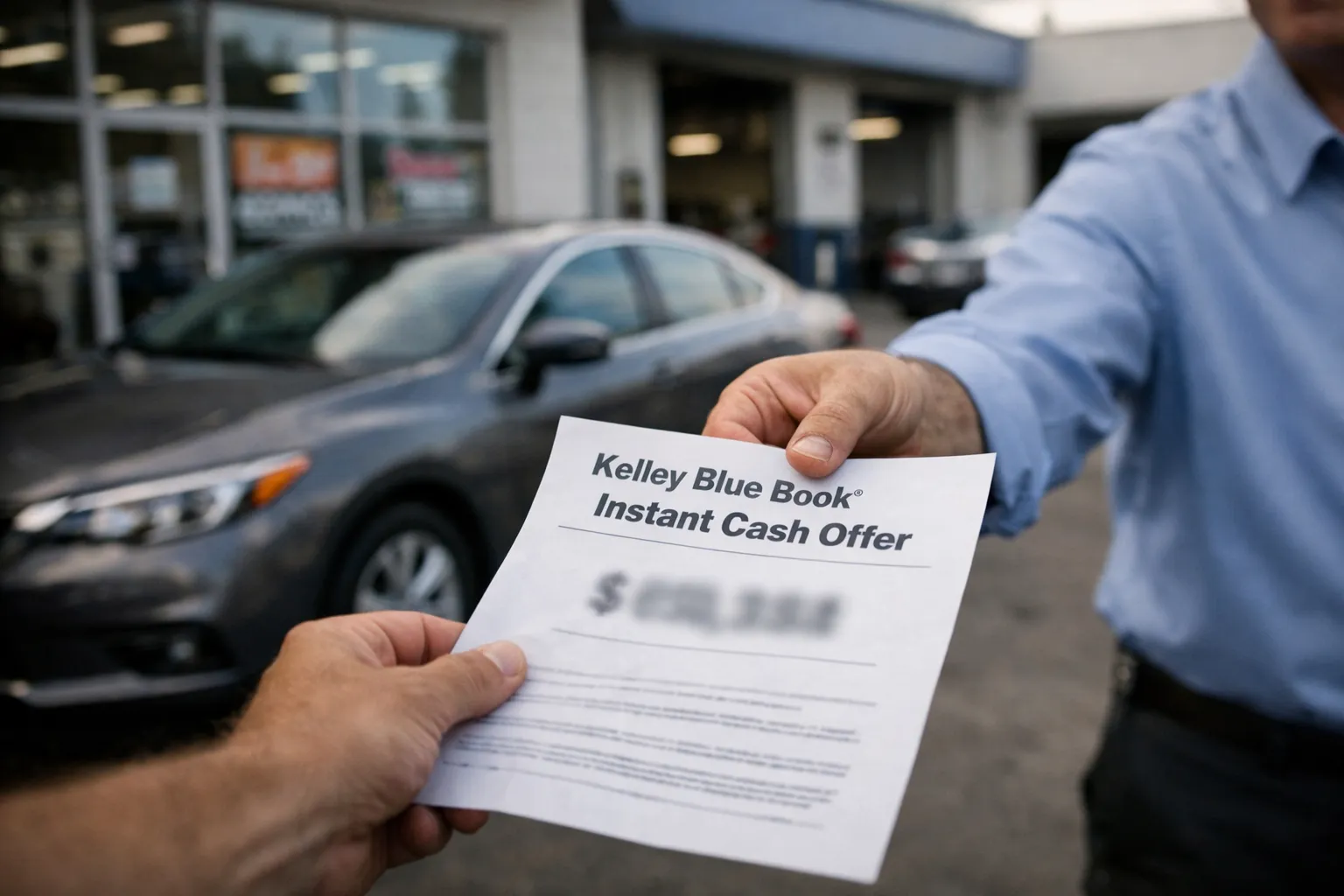
This update evaluates Kelley Blue Book’s Instant Cash Offer (ICO) as of June 2026: the VIN-driven online appraisal that issues a dealer-backed offer for trade‑ins or quick sales. Key specs at a glance:
- Provider: Kelley Blue Book (a Cox Automotive brand)
- Input: VIN or year/make/model + mileage + condition questions
- Output: Printable/digital offer, typically time-limited (commonly 7–10 days)
- Redemption: Participating dealer inspects and finalizes; offer is conditional on inspection
- Cost to seller: Free to generate
Background — Who makes ICO and why it matters
Kelley Blue Book, part of Cox Automotive, has run the Instant Cash Offer program for several years as a bridge between online valuations and dealer transactions. ICO is aimed at sellers who want a documented, dealer-capable offer they can present at a dealership — a middle ground between private-party listings and full “we buy cars” services. In the past two years the used-car market has softened from pandemic highs; in response dealers and platforms have tightened inspection thresholds and expanded digital appraisal tools. ICO remains a widely used, free entry point to dealer trade-in negotiations.
Features analysis — What’s changed in 2026
- More rigorous inspections: Dealers now often use standardized inspection apps during ICO redemptions. Expect more detailed condition flags and photo documentation than in earlier years.
- EV and hybrid adjustments: ICO’s condition form and dealer inspections increasingly account for EV battery state-of-health, range loss and charging equipment. Sellers of electrified vehicles will commonly be asked for recent battery diagnostics or DC fast-charge history.
- Software and access checks: Modern vehicles include software locks and subscription services (navigation, driver assist). If features are disabled or not transferrable, dealers may reduce the offer.
- Wider dealer tool integration: KBB has deepened integrations with dealer DMS (dealer management systems) and appraisal apps, which speeds validation in many metro markets and shortens hold times to same‑day in some cases.
- Time limits and adjustments: Offers still expire and are conditional. Typical windows you’ll see now are 7–10 days; expect tighter windows when wholesale markets are volatile.
Pros — Where ICO still shines
- Fast, documented baseline: ICO gives a printed/digital promise you can use at the counter, which simplifies trade-ins and shortens negotiation time.
- Dealer workflow fit: Because the offer is designed for dealer redemption, title, pay-off handling and trade-in credit are generally straightforward.
- Good for buyers trading at a dealer: If you’re buying another vehicle from the same dealer, ICO can be the most convenient path to apply equity toward the purchase.
- Improved EV handling: Recent updates make ICO more transparent about how battery condition and warranty status affect value—useful for EV sellers who previously saw unexpected reductions.
Cons — Limitations and notable pitfalls
- Inspection-driven drops: Offers remain conditional. Dealers commonly reduce the headline ICO when inspection reveals undisclosed damage, mechanical issues, or degraded EV battery capacity.
- Not top dollar: ICO prioritizes liquidity and dealer resale margin; private-party sales usually net more, especially for popular models and low-mileage vehicles.
- Participation varies: Coverage is strong in most metros but can be thin in rural areas or small markets; some dealers accept ICO only as trade-in credit toward a purchase, not as a straight buy.
- Market sensitivity: When wholesale prices swing, ICO windows can shorten and dealers may add larger inspection buffers.
Pricing and value — What using ICO costs you
Generating an ICO is free. The practical cost is opportunity cost: the difference between the ICO and the highest net price you could get via private sale or competitive bidding. For many common cars, that gap is often a few hundred to a few thousand dollars depending on condition, local demand and whether you’re trading into a purchase that reduces sales tax liability. ICO’s value proposition is speed and certainty, not absolute maximum proceeds.
Who it’s for — Use cases that make sense in 2026
- Deal shoppers trading in: If you plan to buy at a dealership and want a fast, documented trade-in credit, ICO remains one of the simplest options.
- Sellers prioritizing speed and convenience: Those who want minimal hassle, immediate paperwork and a quick close should consider ICO.
- First-time sellers or complex paperwork: ICO reduces negotiation stress and helps walk you through title payoff and tax treatment at the point of sale.
Who should avoid ICO
- Owners of highly desirable models (low-mileage luxury cars, collectible trims) — private-party or consignment often pays more.
- Sellers of rare or modified vehicles — standardized valuation models struggle to capture niche premiums.
- Those in remote markets with little dealer participation — ICO’s leverage weakens without dealer competition.
Alternatives — Compare ICO to specific competitors
- Private sale: Best for top dollar but requires time, listings, showings and safety precautions.
- Direct buyers (CarMax, Carvana, Vroom): These firms offer quick online estimates and in-person or curbside appraisals; CarMax is notable for a firm in-person offer typically valid for 7 days.
- Marketplace instant offers (CarGurus, Cars.com): Aggregators and classified sites now offer instant offers that feed dealer bidding — good to compare alongside ICO.
Practical tips — How to get the best result with ICO in June 2026
- Be conservative and fully accurate on condition answers to avoid post-inspection reductions.
- For EVs, obtain a recent battery state-of-health report (from dealer/service center or OBD tool) and bring charging receipts if available.
- Document maintenance, recent repairs and ownership history; provide proof of open recalls being resolved.
- Request the dealer’s inspection notes in writing and ask for line-item explanations of any reductions.
- Always compare the ICO to at least one direct-buyer (CarMax/Carvana/Vroom) and a private-party price before accepting.
- If trading toward another vehicle, calculate post-tax benefit: many states let you apply trade-in credit against the purchase price for sales-tax savings.
Verdict
As of June 2026, Kelley Blue Book’s Instant Cash Offer remains a practical, low-friction tool for sellers who value speed, documentation and dealer-ready offers. It has evolved to handle EV-specific concerns and tighter dealer inspection workflows, but the core trade-off is unchanged: convenience and certainty for potentially less than private-party proceeds. Use ICO as part of a quick comparison toolkit — ideal when you’re trading at a dealer or need fast closure. If maximizing net proceeds is your primary objective, plan for a private sale or solicit multiple competitive offers first.
Frequently asked questions
Is the ICO offer guaranteed?
No. ICOs are conditional and subject to dealer inspection. Dealers commonly adjust the offer for undisclosed damage, title issues, mechanical problems or diminished EV battery capacity.
How long is an ICO valid?
Most ICOs include a time limit—commonly 7–10 days—but windows can vary by market and may be shortened during volatile wholesale periods. Check the offer terms when you generate it.
Will an ICO get me more than a private sale?
Usually not. Private-party sales frequently yield higher net proceeds for desirable vehicles. ICO’s advantage is speed and reduced hassle; use it when convenience or a dealer trade-in matters more than the absolute top dollar.
What special steps should EV sellers take?
Bring battery diagnostics or a recent state-of-health report, charging history and any remaining warranty paperwork. Disclose range loss and charging issues upfront—surprises on inspection are the most common reason for reductions on EVs.