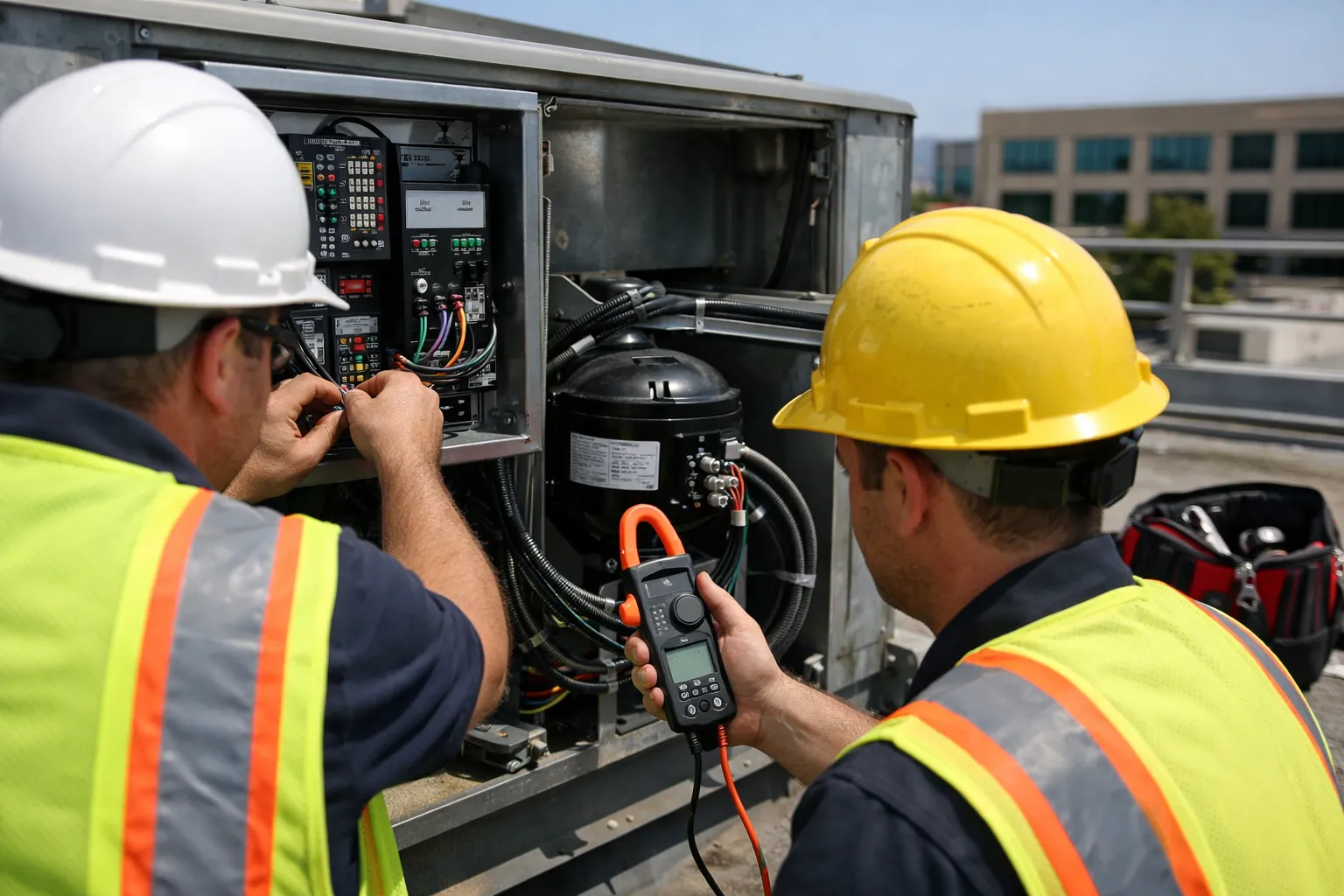
Retrofitting existing rooftop packaged units (RTUs) with electronically commutated motor (ECM) fans, variable‑speed drives (VFDs) for fan systems, and modern controls is one of the highest-value energy upgrades available for commercial HVAC. Done correctly, it reduces fan and part‑load compressor energy, improves comfort control, and positions buildings to comply with the 2021/2024 IECC and recent ASHRAE 90.1 requirements that many jurisdictions began adopting in 2024–26.
Who this guide is for and what it covers
This guide is written for HVAC enthusiasts, technicians, engineers and small contractors who want a practical, step‑by‑step approach to planning, selecting components, installing, and commissioning RTU retrofits focused on:
- Replacing or upgrading supply/exhaust fans with ECM motors.
- Adding VFDs and static‑pressure control for efficient fan operation.
- Integrating smart controls (DDC/BACnet/Modbus) and sensor strategy.
- Estimating energy savings, payback, and navigating common rebates and code checks in 2026.
Why retrofit RTUs now?
Two drivers make RTU retrofits compelling in 2026:
- Energy regulations and utility programs: Many jurisdictions require higher envelope and HVAC efficiency; utilities continue to fund RTU upgrades (rebates for ECM motors, VFDs, and advanced rooftop units).
- High part‑load operation: Commercial RTUs rarely operate at full load. Variable‑speed fans and controls lower energy at typical operating points and reduce cycling losses in compressors.
Step-by-step RTU retrofit workflow
1. Baseline assessment — don’t guess the starting point
Measure and document the RTU’s current performance before any work:
- Inventory: make/model, nominal capacity (tons), supply/exhaust fan HP, motor nameplate, belt/pulley arrangements, existing controls and communication protocols (t-stat, DDC, BACnet).
- Operating profiles: typical weekly run hours, economy cycles, occupied/unoccupied setbacks.
- Field measurements: baseline supply fan kW (true RMS clamp), static pressure in duct or plenum, supply airflow (traverse or pitot), and sensible cooling kW at the unit.
- Refrigerant type and charge, compressor type (scroll, reciprocating, screw), and oil type — important if planning compressor/inverter changes.
2. Establish retrofit objectives and constraints
Decide priorities: maximum energy savings, lowest first‑cost, or meeting a rebate/energy code. Note constraints:
- Physical: curb and cabinet space, motor mount types (sheave vs direct drive), shaft and frame dimensions.
- Electrical: service capacity, available breaker spaces, transformer sizing for controls.
- Controls: need for BACnet/Modbus integration or an independent RTU controller.
3. Select the right components
Key selection criteria and practical tips:
- ECM fans: choose OEM retrofit kits or plug‑in ECM motors that match the existing fan wheel and shaft. Look for PM/ECM motors with integrated drive electronics and external speed control input (0–10 V or PWM).
- VFDs for fans: if the fan will remain an induction motor, select a VFD sized to motor HP with built‑in HVAC features (PID loops, auto‑tuning, safe torque off). For ECM fans, a VFD is not required — use the ECM speed interface instead.
- Variable-capacity compressors: if replacing compressors, prefer factory-designed inverter/inverter-scroll packaged RTU compressors rather than field VFD retrofits to scroll compressors (retrofit VFDs for scrolls are uncommon and can risk warranty).
- Controls: pick an RTU controller that supports BACnet/IP or Modbus TCP for building integration, supports static pressure reset, supply-air reset, and supports demand-based ventilation sequences.
- Sensors: high-quality duct static pressure sensor, supply-air temperature, return-air temperature, CO2 (for demand‑control ventilation if required), and kW transducer for performance validation.
4. Verify mechanical compatibility and prepare for install
Before ordering parts:
- Verify fan wheel clearance, shaft diameter, keyway type and rotation direction.
- Confirm motor mounting (C‑flange, foot, or direct) and ensure mechanical adapters are available.
- Plan wiring routes for VFDs and controls; verify conduit paths and space for VFD panels (heat dissipation is a consideration).
5. Installation best practices
Field practices that prevent delays and callbacks:
- Lockout/tagout and verify power down. Arc‑flash assessment for any service >120 V.
- Replace belts, sheaves, and bearings as needed when converting to ECM or VFD control to avoid early failures.
- Mount VFDs in ventilated, dust‑protected enclosures with line reactors or DC filters if required by the motor supplier.
- Use screened, shielded cabling for analog speed signals; follow vendor grounding recommendations to reduce EMI that can disrupt controls.
6. Controls configuration & sequences
Configure the following minimum sequences:
- Static pressure reset: set a static target that drops with reduced flow and implement a proportional band to avoid hunting.
- Occupancy schedules and setback: integrate with building schedule or provide local override with minimum ventilation enforced.
- Supply‑air temperature and economizer interactions: ensure fan speed control does not conflict with economizer damper logic.
- Soft start/soft stop and minimum speed limits to prevent motor overheating and preserve ventilation.
7. Commissioning and validation
Commissioning is essential. At minimum:
- Verify wiring and mechanical alignments.
- Record supply fan kW at multiple setpoints and compare against baseline.
- Measure airflow at minimum, 50% and 100% commanded speed using traverse or calibrated airflow hood.
- Verify static pressure sensor bias (zero/offset) and tune control gains.
- Run a 48–72 hour performance log capturing fan kW, run hours, temperature and static pressure for rebate paperwork.
Example savings and simple ROI (illustrative)
Example: 10‑ton RTU serving an office with a 5 HP supply fan that runs 3,000 hours/yr. Baseline fan power ~4.0 kW (motor + drive losses). Estimated continuous annual fan energy = 4.0 kW × 3,000 h = 12,000 kWh.
ECM upgrade with static pressure reset reduces energy by roughly 30–45% depending on duty cycle. If savings = 40%:
- Annual savings ≈ 4,800 kWh. At $0.12/kWh, annual cost savings ≈ $576.
- If combined with VFD-driven whole‑system optimization and part‑load compressor improvements, total HVAC energy savings might reach 15–25% (fan + refrigeration interactions).
Typical installed cost for an ECM retrofit kit + controls and commissioning can range $3,000–$8,000 per RTU depending on complexity. After incentives (many utilities rebate $500–$2,000 for ECM/VFD retrofits) and energy savings, simple payback often falls in the 3–7 year range for commercial RTUs. Always run a project-specific financial model.
Rebates, permits and compliance (2026 considerations)
Rebate programs continue to vary by utility; check local program portals (Mass Save, NYSERDA, California IOUs, local municipal programs). Incentives often require pre‑approval, baseline measurements, and post‑installation verification reports — plan for these deliverables in your scope.
Permit requirements: mechanical or electrical permits are commonly required for major RTU alterations. Refrigerant work requires EPA 608 certification for technicians. For projects claiming code compliance (IECC/ASHRAE 90.1), document test data and equipment performance curves.
Common pitfalls and how to avoid them
- Poor integration: installing VFDs/ECMs without updating control logic can cause conflicts with economizers and compressors — resolve sequences up front.
- Overspecced VFDs and lack of harmonic mitigation: select appropriate drive sizing and filters when feeding sensitive building power systems.
- Neglecting commissioning: without verification the expected savings rarely materialize.
- Warranty and refrigerant mismatch: replacing compressors or changing refrigerant types without OEM approval can void warranties and create reliability issues.
Tools, templates and checklist
Useful items to include in every retrofit project file:
- Baseline measurement worksheet (nameplate, kW, airflow, static pressure).
- Site photos of motor/fan, nameplate, control panels and wiring diagrams.
- Pre‑approval and rebate checklist.
- Commissioning test sheet: airflow by setpoint, kW by setpoint, sensor offsets, control setpoints.
Final recommendations
RTU retrofits combining ECM fans, VFD‑based fan control, and modern RTU controllers yield significant, verifiable energy and comfort benefits and help buildings meet tightening code and utility program rules in 2026. Success depends on careful baseline measurement, mechanical compatibility checks, proper controls sequencing, and rigorous commissioning. When in doubt, pilot one RTU and validate savings and operational impacts before scaling up across a portfolio.
For hands‑on projects: prioritize a thorough baseline, engage the controls vendor early, budget for commissioning, and confirm rebate pre‑approval. That sequence minimizes surprises and maximizes realized savings.